
So, what exactly is mixed media art?
At its most basic level, mixed media is an approach to art-making that involves combining two or more different artistic materials in a single piece. It’s a creative philosophy that throws the rulebook out the window, giving artists the freedom to mix anything and everything—from paint and paper to fabric and found objects.
What Does Mixed Media Art Actually Mean?
Imagine an artist as a chef. A traditional painter might stick to a classic recipe, using only oil paints on canvas. A mixed media artist, on the other hand, sees the entire pantry as their playground. They don't just stick to one food group.
Instead, they might combine:
- Acrylic paints layered over bits of collaged newspaper.
- Watercolor washes blended with sharp ink drawings and soft pastel highlights.
- Sculptural elements, like pieces of wood or metal, physically attached to a painted surface.
- Textiles, threads, and even old fabric scraps woven directly into the composition.
The real "meaning" of mixed media isn't just about the list of materials. It’s about the magic that happens when those materials come together. The way they interact builds incredible layers of texture, depth, and story that a single medium just can't achieve on its own.
To make it even clearer, let's break down the core ideas behind mixed media.
Mixed Media Art Core Concepts at a Glance
This table simplifies the key principles that define this wonderfully flexible art form.
| Concept | What It Really Means |
|---|---|
| Material Fusion | It's all about combining different art supplies that normally wouldn't "go" together. |
| Layering | Building up surfaces with multiple materials to create physical depth and texture. |
| Rule-Breaking | There are no hard-and-fast rules. If it works for the piece, it's fair game. |
| Experimentation | The process is a journey of discovery—asking "what if?" and seeing what happens. |
These concepts aren't just academic terms; they are the very soul of the mixed media process, encouraging a playful and intuitive approach to creating.
The Spirit of Experimentation
At its heart, mixed media is all about experimentation. It completely rejects the old, rigid lines drawn between "painting," "sculpture," and "drawing."
This art form encourages an almost child-like curiosity, where an artist is constantly asking, "What happens if I add this?"
That spirit of inquiry is what drives the work forward. An artist might mix sand into wet paint to get a gritty, earthy texture. They might stitch delicate threads across a canvas to symbolize invisible connections. This turns the act of creating into a real journey of discovery, where the final destination is unknown. To really appreciate this process, it helps to understand the journey behind any original art piece, no matter the medium.
The function of art is to renew our perception. What we are familiar with we cease to see. The writer shakes up the familiar scene, and, as if by magic, we see a new meaning in it. – Anais Nin
This quote from Anais Nin gets to the core of it. By combining unexpected materials, mixed media artists shake us out of our visual comfort zones. They force us to lean in, look closer, and see the world in a new light. This is actually quite similar to how we can learn to appreciate non-representational art; if you're curious, you can explore our guide on how to understand abstract art.
Ultimately, mixed media is a deeply personal and expressive language, offering infinite ways for an artist to tell their unique story.
Where Mixed Media Art History Begins
To really get a feel for what mixed media art is all about, you have to go back to its rebellious beginnings. The story kicks off in the early 20th century with a few pioneering artists who decided that art could be made from more than just paint on a canvas. This wasn't a slow, gentle evolution; it was a full-blown break from centuries of artistic tradition.
Think about it: before this, the art world had strict, unspoken rules. Painters painted. Sculptors sculpted. The materials were distinct and the lines were clear. But then, a few artists started asking a radical question: "What if we could use anything?" That one simple question would completely change the course of modern art.
The First Bold Experiments
The first real shockwaves of this new way of thinking came from the Cubist movement. Around 1912, artists like Pablo Picasso and Georges Braque did something that was, at the time, completely unheard of. They started gluing everyday stuff—newspaper clippings, bits of wallpaper, even pieces of a chair's caning—right onto their canvases.
This wasn't just for a cool texture. It was a statement. They were challenging the very idea of what a painting even was.
By bringing real-world objects into their work, they blurred the line between art and life, forcing people to see both in a totally new light. This act of gluing materials onto a surface, which we now call collage (from the French word coller, meaning "to glue"), became the cornerstone of mixed media art.
This rebellious spirit was infectious. It quickly spread to other avant-garde movements that were just as eager to tear up the rulebook and find new ways to express themselves.
From Cubism to Dada and Surrealism
Right after the Cubists, the Dadaists grabbed this spirit of experimentation and ran with it. Dadaism was born from the chaos and disillusionment of World War I, so the artists involved were all about rejecting logic and embracing absurdity. They created assemblages—three-dimensional pieces made from "found objects" or what most people would just call junk—to protest the stuffy conventions of a society they felt had failed them.
In a similar vein, Surrealist artists like Max Ernst and Joan Miró used collage and assemblage to explore the weird and wonderful world of the subconscious. They mashed together bizarre, unrelated images to create scenes straight out of a dream, showing that mixed media could be a powerful way to dig into psychology.
Historically, mixed media art truly found its footing during these modern art movements. Pioneers like Picasso and Braque used collage to bring non-art materials into their paintings, forever expanding what we consider visual art. You can find more great insights on how the art market has evolved on Black Art Magazine.
This timeline really shows how the practice went from a radical act to a widely accepted artistic approach.
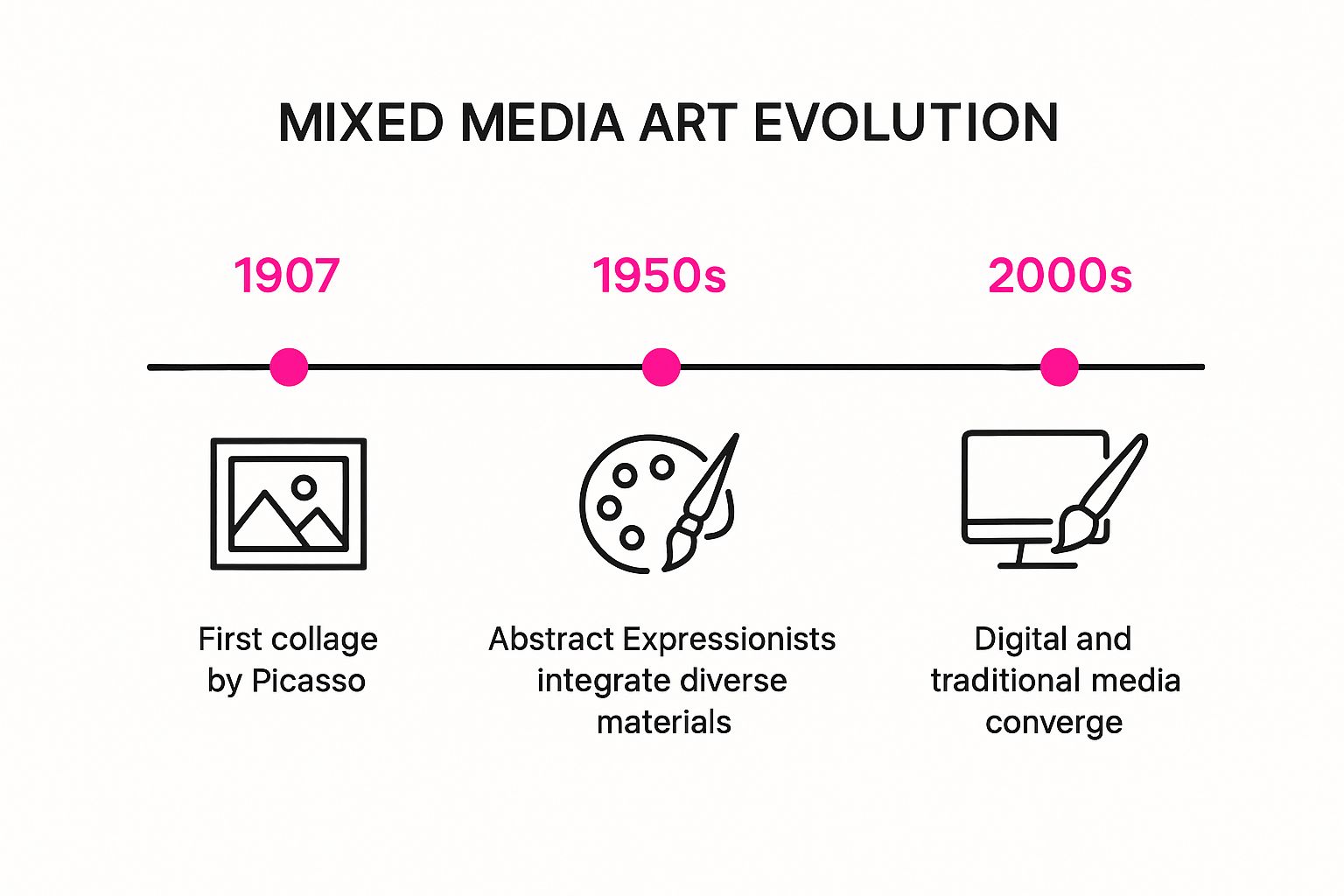
As you can see, what started with simple collages in the early 1900s went on to influence major art movements and, eventually, even blended with the digital tools we use today.
4 Popular Mixed Media Techniques to Try
Once you grasp what mixed media is all about, the real fun begins.## 4 Popular Mixed Media Techniques to Try
Once you grasp what mixed media is all about, the real fun begins. Diving into the techniques is like opening a creative toy box—each one offers a different way to build texture, layer meaning, and bring your ideas to life.
Think of it this way: if a single medium is like one instrument, mixed media is the full orchestra. You get to be the conductor, deciding which sounds and textures to combine. Let's look at a few of the most common and powerful techniques you'll encounter.
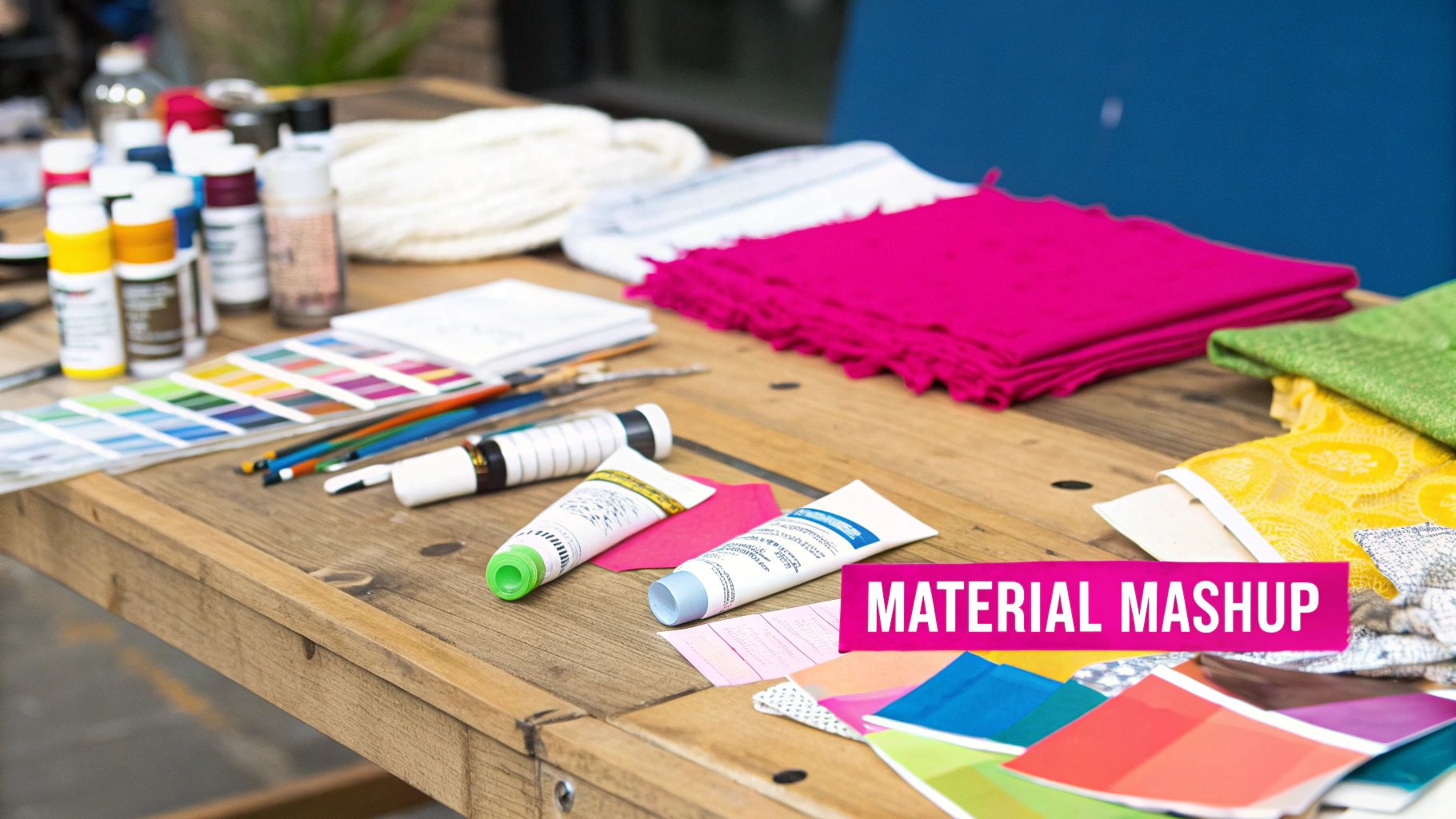
1. Collage: More Than Just Cut and Paste
At its core, collage is the art of gathering and adhering different flat elements—like paper, old photographs, fabric, and newspaper clippings—onto a single surface. It’s one of the most accessible entry points into mixed media because you can start with materials you already have around the house.
But a great collage is so much more than just gluing things down. It's a storytelling medium. When you place a vintage postcard next to a modern, graphic pattern, you're creating a conversation between the past and the present. Each piece you add contributes to a larger narrative, building a visual story layer by layer.
This idea of fusion is central to what mixed media is all about. A collage isn’t just a random collection of items; it’s a carefully composed piece where every element works together to create something new and cohesive.
2. Assemblage: Building Art in 3D
While collage typically lives on a flat surface, assemblage takes those same principles and bursts into the third dimension. This technique is all about creating sculptures from “found objects”—things that weren't originally intended to be art materials. We’re talking about anything from rusty machine parts and driftwood to old toys and broken china.
Assemblage challenges you to see the artistic potential in everyday junk. The process is a form of construction, where the artist physically builds a sculpture piece by piece. The final work often carries the history and energy of its components, giving it a depth that brand-new materials can’t replicate.
"Threads in art… are the threads of our connection to one another, to all life on the planet – past, present, and future… They are our heart connections and the very threads that pull at our heart strings." – Wendy Meg Siegel
This quote beautifully captures the spirit of assemblage. By bringing unrelated objects together into a single, unified form, artists often explore themes of connection, memory, and transformation.
3. Altered Books: Giving Old Stories New Life
An altered book is exactly what it sounds like: an existing book that has been transformed into a unique work of art. Instead of just reading the words, the artist treats the entire book as a canvas.
The pages might be cut, folded, painted over, or used as a base to attach other objects and create intricate dioramas. It’s a powerful way to deconstruct a familiar object and build an entirely new narrative from its bones, turning a mass-produced item into a deeply personal sculpture.
4. Encaustic Painting: Working with Wax and Heat
This is a technique with deep roots, dating all the way back to ancient Greece. Encaustic painting involves using heated beeswax that has been mixed with colored pigments. The artist applies the molten, pigmented wax to a surface (usually a rigid one, like a wood panel).
What makes encaustic so compelling for mixed media is its incredible capacity for layering. The warm wax can be scraped back to reveal colors underneath, and you can embed other materials like paper, photographs, or fabric directly into its layers. The translucent quality of the wax creates a dreamy, luminous effect that’s truly unique.
From cutting up books to painting with hot wax, these techniques show just how endlessly inventive mixed media can be. Each one pushes the boundaries of what art can be made from, proving that creativity truly has no limits.
Why Mixed Media Art Matters Today
In a world buzzing with social media feeds, constant information, and a blend of cultures, mixed media art feels more relevant than ever. It's not just about mixing paint with paper; it’s a powerful reflection of our everyday lives. Just think about your own day—it’s a mashup of digital pings, physical conversations, old memories, and new ideas all happening at once.
Mixed media art captures this beautifully chaotic reality. Artists use this approach to tackle big, modern topics like personal identity, consumerism, and environmental issues. By literally weaving different materials together, they make a statement you can almost touch. Imagine an artist incorporating shredded plastic into a painting to talk about waste, or stitching old family photos onto fabric to explore heritage. It makes the idea tangible.
A Mirror to Our Modern World
One of the most exciting things about mixed media is how it tears down old walls. It completely blurs the line between what was once considered "fine art" and what was dismissed as "craft." This has made the art world a more welcoming and interesting place. Suddenly, materials like textiles, found objects from the street, or even digital prints are given the same respect as oil paint.
This open-minded spirit is why mixed media is now a huge part of art education. Today, learning how to combine different materials and explore concepts is considered essential for any artist's growth. In fact, over 60% of fine arts programs around the globe now include mixed media in their core curriculum, teaching young artists to experiment without fear. If you're interested in art market trends, MyArtBroker.com offers some great predictions. This focus in education ensures the next generation of creators will keep pushing boundaries.
The Emotional Connection in Materiality
Beyond the big ideas, mixed media art offers an experience that is deeply tactile and emotional. Every material has its own story, its own texture, its own energy. The artist's choice of materials becomes just as important as their choice of colors. To see how a contemporary artist thinks about this, you can read about how Wiktoria Florek uses color in her art.
The magic of mixed media art is that it’s not just about making pretty pictures; it’s about finding a way to express yourself and maybe even work through some of life’s ups and downs.
This is why mixed media connects so strongly with people. The layers in the work pull you in, asking you to get closer and piece together the story from a scrap of fabric, a bold brushstroke, and a line of text. It's a visual language that’s perfectly built to tell the complex, fragmented, and beautiful stories of our time.
Inspiring Artists Who Mastered Mixed Media
Talking about the mixed media art meaning in theory is one thing, but seeing it in practice is where the concept really clicks. The true power of this approach comes alive when you look at the artists who have pushed its boundaries. From the trailblazers of the 20th century to the visionaries of today, these creators show us just how expressive and diverse this art form can be.
By exploring their work, we can get past simple definitions and see how combining different materials creates compelling, layered stories. These artists aren't just mixing paint and paper; they're weaving together ideas, histories, and raw emotion.
The Pioneers Who Changed the Game
If you trace the modern history of mixed media, you’ll inevitably land on Robert Rauschenberg. Back in the mid-20th century, he started creating his famous "Combines"—pieces that were neither painting nor sculpture, but a fascinating hybrid of both. He would attach everyday objects like tires, stuffed goats, and quilts right onto his canvases, completely demolishing the wall between art and life.
Rauschenberg's work was a game-changer. He showed the world that any object could be art if the artist's intent was strong enough. He forced everyone to rethink what a painting could be, opening the door for generations of artists to experiment without limits.
Another giant in the field is Louise Nevelson, known for her incredible, single-color wooden sculptures. She would wander the streets of New York City, gathering discarded wood scraps—bits of old furniture, broken architectural details, and other debris. She then assembled these found objects into massive, intricate walls and painted them a uniform color, usually black, white, or gold. In her hands, chaotic junk was transformed into elegant, unified compositions.
Contemporary Visionaries in Mixed Media
Today’s artists are carrying that torch forward, using mixed media to tackle complex modern issues like identity, globalization, and environmental decay.
- Wangechi Mutu: This Kenyan-American artist creates stunningly intricate collages. She masterfully blends magazine cutouts with painted imagery and found objects to build surreal, powerful figures that challenge our ideas about gender, race, and identity.
- El Anatsui: A Ghanaian artist, El Anatsui makes breathtaking, tapestry-like sculptures from thousands of flattened aluminum bottle caps stitched together with copper wire. His work is a powerful commentary on consumerism, waste, and global trade, turning literal garbage into something beautiful and monumental.
These artists get to the very heart of the mixed media art meaning. Their choice of materials is completely tied to the stories they want to tell, proving that sometimes, the medium really is the message.
“The act of painting is a spiritual covenant between the maker and the higher powers. The intent of the artist flows through the work of art, no matter what the technique or style.” – Audrey Flack
This idea of intention is everything. For artists like Wiktoria Florek, the creative process is an emotional and deeply personal conversation. To see how she channels her own life into her art, take a look at her MyMotherhood abstract collection, which uses a blend of materials to tell intimate stories. Each of these artists, in their own unique way, uses the language of mixed media to make their vision a reality.
How to Get Started with Mixed Media
Feeling that creative spark? The best part about mixed media is that you don't need a fancy studio or a huge budget to jump in. At its heart, this art form is all about resourcefulness and seeing the potential in everyday things. Getting started is really just about looking at the world around you with a fresh perspective.
Your first step is to start gathering. Think of yourself as a creative treasure hunter, collecting little bits and pieces that catch your eye.
- Paper Scraps: Old ticket stubs, interesting junk mail, the insides of security envelopes, or pages from a vintage book all work beautifully.
- Fabric and Fibers: Snippets from old clothes, bits of ribbon, colorful thread, or pieces of yarn add wonderful texture.
- Found Objects: Think small! Buttons, pressed leaves, flattened bottle caps, or any non-bulky trinkets from your junk drawer are perfect.
This collection becomes your personal library of textures and stories. If you're looking to explore a bit more intentionally, checking out different creative craft gifts and material kits can be a fantastic way to discover what you enjoy working with.
Your First Project: An Art Journal Page
An art journal is the perfect, no-pressure playground for your first experiment. Grab an old notebook, or even just a solid piece of cardboard. The goal isn't to create a masterpiece on your first try; it’s simply about the fun of playing with your materials.
- Create a Background: Slap on some simple craft paint. Don’t have paint? No problem. Use a glue stick to cover the page with some of that interesting paper you collected.
- Add Collage Elements: Once your background is dry, start layering your treasures. Glue down a cool image from a magazine, a scrap of fabric, or that old movie ticket. See what feels right.
- Introduce Texture and Marks: Now, make your mark. Doodle with a pen, write a few words over your collage, or add a bit of 3D texture by gluing down a piece of thread or a button.
The magic of mixed media art isn’t just about making pretty pictures; it’s about finding a way to express yourself. The real joy is in the process of creative unfolding, not the final result.
Embrace the mess and the process. The easiest way to get over that "fear of the blank page" is to just make a mark—any mark at all. From there, you just keep adding the next layer. This playful approach is the fastest way to find your own unique artistic voice.
A Few Lingering Questions About Mixed Media
Still have a few questions about what mixed media art is all about? You're not alone. Let's clear up some of the most common points of confusion so you can feel confident exploring this wonderfully flexible art form.
Collage vs. Mixed Media: What’s the Real Difference?
It’s easy to get these two mixed up, but the relationship is pretty simple. Think of mixed media as the big, overarching category, and collage as one specific technique that falls under its umbrella.
Every collage is a piece of mixed media art because, by definition, it combines different materials like paper, photographs, and glue. But not all mixed media is a collage. The term is much broader and can include everything from 3D assemblages and altered books to pieces that incorporate wax, wood, or even metal.
Are There Any Rules About What Materials I Can Use?
Absolutely not, and that’s the whole point! The spirit of mixed media is all about breaking the rules and celebrating creative freedom.
You can pull from anywhere. Use traditional art supplies like paints and inks right alongside found objects, textiles, sand, old keys, or digital prints. The only "rule," if you can even call it that, is a practical one: make sure your materials will actually stick together and stand the test of time.
What's the Easiest Way to Get Started with Mixed Media?
The best advice is to start small and keep it simple. Don't overthink it.
Grab a sturdy piece of paper or an old journal you don't mind experimenting in.
- First, create a background. Splash on some craft paint or glue down some interesting patterned paper.
- Next, start layering. Add some magazine cutouts, old ticket stubs, or fabric scraps.
- Finally, add the details. Use a simple pen or marker to draw on top of your layers.
The key is to experiment without any pressure. The real joy is in the process of seeing what happens, not in creating a perfect masterpiece. Just have fun combining different textures and images to discover what you enjoy.
At Wiktoria Florek, we see art as an energetic portal that invites deep, inner transformation. Discover emotionally charged, large-scale mixed media works that blur the lines of painting and speak directly to the soul. Explore the full collection of Wiktoria Florek's art.