
What Makes Intuitive Abstract Expressionism So Powerful
Imagine a work of art that connects directly with your emotions, bypassing your analytical mind entirely. This is the heart of intuitive abstract expressionism. Where traditional art might prompt the question, "What do you see?" this style instead asks, "What do you feel?" It is a raw, unfiltered form of visual communication that grows from instinct, movement, and subconscious thought rather than careful planning. Its power isn't found in a perfect image but in the tangible energy left on the canvas—the trace of a decision made in an instant.
Think of it like the difference between following a precise recipe and cooking by intuition. A planned painting follows steps to reach a set goal. An intuitive abstract piece, however, is a voyage of discovery. The artist doesn't start with a final picture in mind but with a feeling, a color, or a sudden impulse. Each brushstroke is a direct response to the previous one, building a spontaneous visual conversation. This focus on the process itself makes the final work an authentic record of a creative moment, filled with genuine human emotion.
A Dialogue Between Artist and Canvas
This creative approach is all about letting go. Artists must learn to silence their inner critic and follow the non-verbal prompts of their subconscious. It’s a vulnerable method that demands a great deal of trust in one's own instincts. The objective is not to dominate the materials but to collaborate with them, welcoming "controlled accidents" and unexpected outcomes. This partnership between the artist and their medium is what gives the artwork its undeniable life. When you look at a piece of intuitive abstract expressionism, you are not just seeing a finished picture; you are witnessing the evidence of a profound personal journey.
Art as a Reflection of Inner Worlds
The deep emotional connection of this movement is closely linked to its historical and psychological roots. It emerged after World War II, a time when many were searching for meaning in a world shaken by chaos. Drawing from philosophies that valued individual experience, artists turned their focus inward. The canvas became a map of their subconscious feelings and raw internal states. You can learn more about the emotional foundations of this style from Composition Gallery.
This history helps explain why the art feels so personal and urgent—it was born from a deep need to express what words could not. This approach is still just as compelling today, offering a powerful alternative to our highly curated and filtered world by celebrating authentic, spontaneous expression.
How New York Became The Birthplace Of Artistic Revolution
To get to the heart of intuitive abstract expressionism, we need to step back in time to New York City in the 1940s. The city was more than just a major urban center; it became a safe harbor. As war tore through Europe, many of its most innovative artists and intellectuals fled, finding a new home in Manhattan. This wave of migration turned the city into a melting pot of fresh ideas, where European artistic concepts met a distinctly American sense of rebellion and freedom. For years, Paris had been the center of the art world, but this transfer of talent and creativity prepared the ground for a new artistic capital to emerge.
This new environment created a strong sense of community and sparked intense creative conversations. Artists like Jackson Pollock, Willem de Kooning, and Mark Rothko would meet in downtown studios and smoky bars to discuss the purpose of art in a world recovering from war. They all felt that traditional, realistic art was no longer enough to convey the deep anxieties and big questions of their time. They wanted something more direct and honest—an art that came from within. This shared desire for a new visual language set the stage for a movement that would change modern art forever.
The Rise of a New American Art
The outcome was Abstract Expressionism, a movement that was raw, emotional, and unapologetically bold. It wasn't a single style but rather a common mindset. It celebrated the creative process itself, turning the physical act of painting into a form of personal statement. Picture Jackson Pollock vigorously dripping and pouring paint onto a canvas spread on the floor—his movements were as much a part of the artwork as the final piece. The goal wasn't to paint the world as it looked, but to capture the inner feeling of being alive in it.
This new art form was a truly American creation, characterized by its large scale, confidence, and rugged individualism. The movement made its public debut between 1943 and the mid-1950s, a time of great artistic exploration. A key event occurred in 1950 when a group of 18 artists, who became known as 'The Irascibles,' boycotted a major exhibition at the Metropolitan Museum of Art to protest its traditionalist jury. This bold stand drew significant media coverage and established Abstract Expressionism as a serious and challenging force in the art world. You can explore the movement’s key moments by learning more on The Art Story.
A Lasting Legacy
The New York School, as these artists were called, did more than just create a new style; they shifted the entire focus of the art world from Paris to New York. Their success showed that important art could be deeply personal, spontaneous, and not based on recognizable objects. This core idea of intuitive abstract expressionism—putting inner feeling and instinct at the center of creativity—was a major break from centuries of artistic tradition. It created a powerful legacy that continues to inspire artists today to trust their instincts and create their own rules, free from the pressure of convention.
Essential Techniques That Define Intuitive Expression
To really get what intuitive abstract expressionism is all about, we need to look at how artists physically turn raw feelings into art. These methods aren't about following strict rules. Instead, they’re about creating a visual language through spontaneous action, color, and texture. While they might look random, these techniques are skilled practices that let artists channel their instincts into powerful visual forms. The focus shifts from perfect representation to emotional impact, making the act of creation just as important as the final piece.
This approach is like a dynamic conversation between the artist and their materials. Intuition leads every decision, from the first mark on the canvas to the final layer. The artist doesn't try to completely control the paint but works with it, letting drips, splatters, and unexpected textures become part of the story.
Action Painting and Gestural Abstraction
One of the most recognizable techniques is action painting, where the artist's physical movement is a core part of the artwork. Don't just think of it as painting—think of it as a performance. The canvas becomes an arena where the artist's energy is captured in bold, sweeping gestural marks. This isn't about carefully drawing an image; it's about using the entire body to apply paint, creating a piece that feels alive with motion.
To do this, artists often use unconventional tools, moving beyond standard brushes. You might see them use:
- Sticks, trowels, or even their hands to apply paint directly.
- Dripping, pouring, and splattering to build up energetic layers.
- Large, sweeping arm movements that create lines conveying speed and force.
The aim is to capture a genuine, unfiltered impulse. The finished painting becomes a direct record of the artist's physical and emotional state during its creation.
The Power of Color Fields and Layering
On the other end of the spectrum from the high-energy motion of action painting is color field painting. This technique offers a more reflective but equally intense experience. Here, artists use huge, solid areas of a single color or a few related shades to completely surround the viewer. The goal isn't to show energetic gestures but to create an immersive emotional atmosphere. Imagine a massive canvas of deep blue—it might stir feelings of calm or sadness, letting your mind drift within the color itself.
Layering is another key technique in intuitive abstract expressionism. Artists build surfaces with many coats of paint, sometimes scraping or sanding away parts to show the colors hiding underneath. This method gives the work a sense of history and depth, almost like looking at a geological map of emotions. Each layer adds complexity, contributing to the artwork's overall emotional weight and visual richness.
To better understand how these techniques come together, let's explore some of the most common methods in the table below. It breaks down the what, why, and who of intuitive abstract expressionism's core practices.
Key Techniques in Intuitive Abstract Expressionism
Comparison of major techniques used by abstract expressionist artists, their characteristics, and notable practitioners
| Technique | Description | Key Characteristics | Notable Artists |
|---|---|---|---|
| Action Painting | The physical act of painting is central. Paint is energetically applied to the canvas through dripping, pouring, and gestural movements. | Dynamic, spontaneous, emphasizes the artist's physical process, captures motion and energy. | Jackson Pollock, Willem de Kooning |
| Color Field Painting | Focuses on large, flat areas of solid color to create an immersive and contemplative experience for the viewer. | Meditative, monumental scale, non-gestural, emphasizes the emotional power of color. | Mark Rothko, Barnett Newman |
| Gestural Abstraction | A broader category that includes action painting, where the brushwork is loose, expressive, and reflects the artist's inner state. | Energetic brushstrokes, textured surfaces, prioritizes emotional expression over form. | Franz Kline, Lee Krasner |
| Layering (Sgraffito) | Building up multiple layers of paint and then scratching or scraping away the top layers to reveal the colors and textures underneath. | Creates depth and history, reveals hidden elements, adds complex visual texture. | Clyfford Still, Joan Mitchell |
As the table shows, while some artists like Pollock focused on pure action, others like Rothko explored emotion through immense fields of color. Many, however, combined these approaches, using both gestural marks and thoughtful layering to create their unique emotional language.
This infographic shows the relationship between color, emotion, and the final composition.
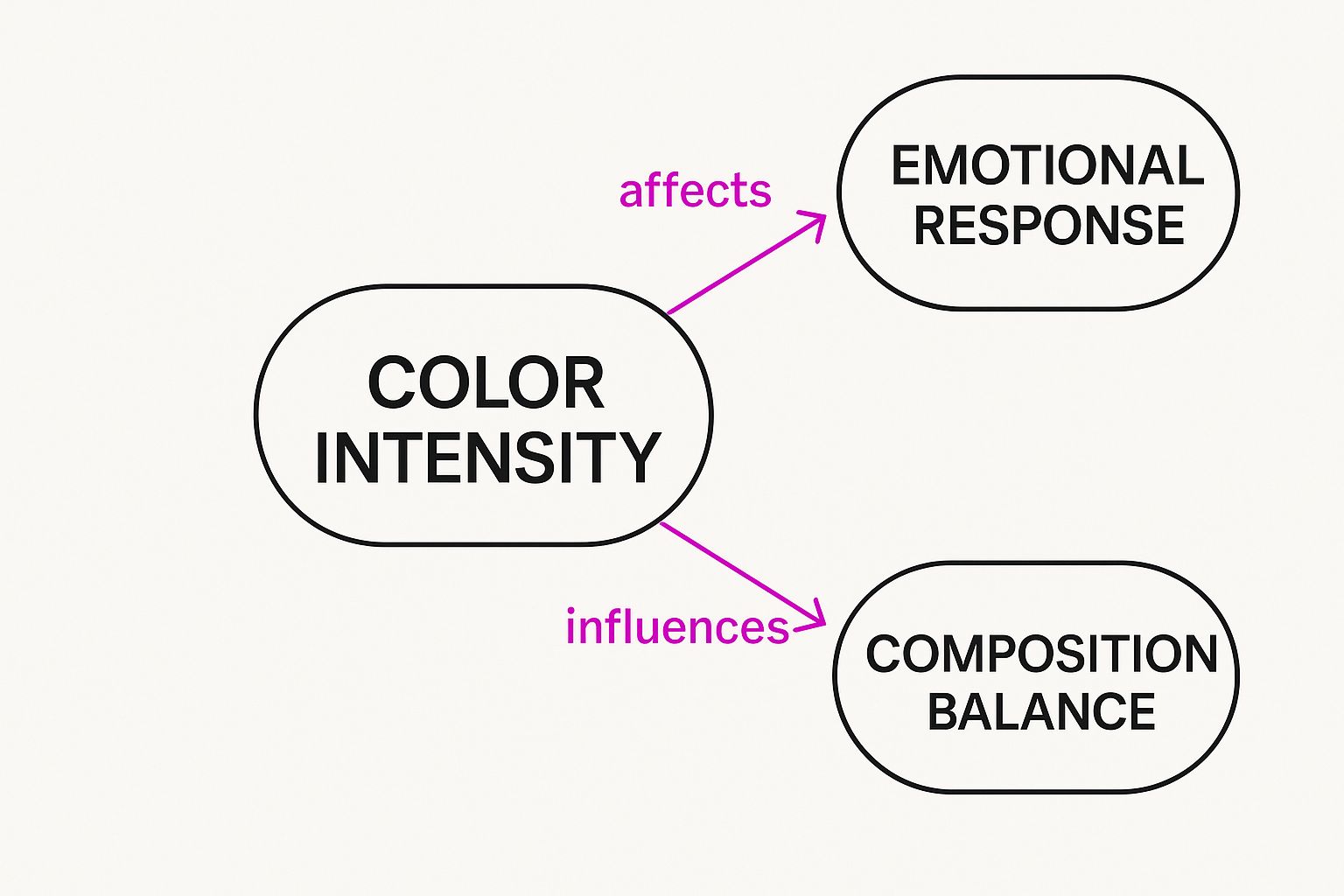
The image illustrates how a shift in color intensity directly affects the viewer's emotional response. This, in turn, requires the artist to adjust the composition's balance to maintain a sense of harmony. This give-and-take is central to how these artists build meaning without using literal images.
The Philosophy Behind Trusting Your Creative Instincts
What happens when an artist sets aside formal rules and decides to trust their gut? This question is at the heart of intuitive abstract expressionism. It's more than just a style; it's a belief that the most genuine art springs from the subconscious, not from a detailed blueprint. This approach challenges the long-held academic view that prized technical mastery and careful planning above all else.
This way of thinking has deep roots in existentialist philosophy, which champions the idea of creating one's own meaning in life. For these artists, a blank canvas wasn't for painting a pretty picture but for embarking on an inner journey. They let go of conscious control, allowing their raw emotions and impulses to guide their hands in a process that is both vulnerable and liberating.
The Subconscious as a Creative Partner
A central idea in this philosophy is automatic drawing or painting. Picture an artist entering a focused, almost meditative state, letting their hand glide across the canvas without a specific plan. The lines, forms, and colors that emerge are not directed by rational thought but come straight from the subconscious. This technique is like a visual form of free association, creating an artwork that acts as a raw artifact of the artist’s inner world.
To reach this state of creative flow, many artists use practices like mindfulness and meditation. These disciplines help to silence the "inner critic"—the nagging voice of doubt that can shut down creativity. By quieting the mind, the artist becomes more open to the intuitive whispers that lead to unexpected and powerful artistic choices. The objective is to stop thinking about what to paint and simply be in the act of creation. You can find more inspiration on this in "Follow Your Dream," an episode from artist Wiktoria Florek.
Redefining Artistic Skill
This philosophy fundamentally reconsiders what it means to be a "skilled" artist. Is skill found in the ability to render a perfect portrait, or is it in the courage to honestly express one's inner state? For those who practice intuitive abstract expressionism, the latter holds far more weight. They see the most meaningful art as a collaboration between the artist’s intent and the unpredictable behavior of their materials.
This results in a dynamic dance between conscious decisions and spontaneous impulses. An initial mark might be entirely unplanned, but the artist then responds to it, adding layers and making adjustments in a continuous conversation with the work. This approach shows that creativity isn’t always about maintaining tight control; sometimes, the best work happens when we trust the process and learn to let go.
Contemporary Masters Like Wiktoria Florek Leading The Way
The rebellious energy of the mid-20th century New York School never disappeared; it just transformed. Today, a new wave of artists is carrying the torch of intuitive abstract expressionism, honoring its core ideas of spontaneous, emotional creation while adding modern materials and fresh points of view. Among these artists is mixed-media painter Wiktoria Florek, whose work shows just how powerful this art form remains.
Contemporary artists aren't just repeating what's been done. They are actively pushing the limits of what abstract painting can be. By mixing classic gestural painting with new materials, they create art that speaks to the complex feelings of modern life. This blend of old and new keeps the movement alive and relevant, showing that the core idea—trusting your creative gut—is truly timeless.
Expanding the Expressive Toolkit with Mixed Media
One of the most important shifts in modern intuitive abstract expressionism is the widespread use of mixed media. This technique involves using different materials together on one canvas, such as acrylics, inks, gold leaf, and textural pastes. For an intuitive artist, this is like learning a new language to express emotion. Each material has its own unique texture, look, and meaning, allowing for richer and more detailed expression.
Using mixed media fits perfectly with the spontaneous heart of the movement. An artist might feel an impulse not just to add a splash of color but also to press a piece of cloth into the wet paint or scratch lines into the surface. This approach creates physical layers that reflect emotional depth. For example, the rough feel of a textural paste might represent a struggle, while the bright shimmer of gold leaf could symbolize a moment of hope or insight.
This piece shows how different materials can work together on one surface. The result is a visual conversation between textures and shapes that paint alone could not create.
Wiktoria Florek: Intuition and Material Alchemy
Artist Wiktoria Florek’s art is a brilliant example of this evolution. Her large canvases are dynamic spaces where materials and emotions crash and blend. She skillfully combines traditional acrylic paints with less common elements, producing works that feel both chaotic and balanced. In her creative flow, choosing a material is as intuitive as making a brushstroke. This method helps her build surfaces that feel both ancient and contemporary, inviting people to have a deep, sensory experience.
Florek’s approach shows how today’s artists stay true to the principles of intuitive abstract expressionism while using a distinctly 21st-century voice. Her art is proof that true expression isn't limited to a single medium. By exploring how different materials interact, artists like Florek can communicate a wider range of feelings, from deep vulnerability to powerful resilience. You can see this clearly in her Motherhood series, where she explores profound personal change through her unique style. To learn more about her methods, you can explore the WFA abstract collection details. Her work proves that the journey of intuitive art is always moving forward, finding new ways to map the human soul.
How to Experience Abstract Art Like a True Insider
Standing before a massive, swirling canvas of intuitive abstract expressionism can feel like trying to read a language you’ve never seen. The secret is to stop trying to “read” it and start learning to “feel” it. The experience is less about finding a specific meaning and more about opening yourself up to a direct emotional and sensory connection.
The first step is simple: allow yourself to react without judgment. Your gut feeling—whether it’s joy, confusion, peace, or unease—is your starting point. This initial response is the most authentic way to begin a dialogue with the work. Unlike a portrait or landscape that gives you a clear subject, abstract art invites you to bring your own experiences to the canvas. Trusting this first impression is essential; it’s the purest form of communication between you and the artist's creation.
A Practical Guide to Viewing
Approaching these works involves more than just a quick glance. It’s a full-body experience that changes dramatically based on your physical distance from the piece. Think of it like exploring a new landscape. Here’s a step-by-step approach to deepen your engagement:
-
The Distant View: Start by standing far back. From this vantage point, you can take in the entire composition. Notice the overall rhythm, the balance of shapes, and how major colors interact. Does the piece feel chaotic or calm? Does it pull your eye to one spot or let it wander freely? This is your "bird's-eye view."
-
The Mid-Range View: Now, move closer—about five to ten feet away. The grand composition starts to break down into smaller, more interesting relationships. You’ll begin to see the energy in the brushwork and notice how different areas of color connect or clash. This is where you can see how the artist built the piece.
-
The Up-Close View: Finally, get as close as the gallery allows. This is where the magic of texture and layering is revealed. You can see the thickness of the paint, the scrape marks from a palette knife, or the subtle shimmer of a mixed-media element like gold leaf. These details are the artist’s fingerprints—physical evidence of their creative process. Notice how the light catches these different surfaces.
To help structure your viewing process, this table offers a guide to focus your attention and prompt deeper reflection at each stage.
Guide to Experiencing Abstract Expressionist Works
A step-by-step approach to viewing and appreciating intuitive abstract expressionist paintings.
| Viewing Stage | What to Focus On | Questions to Ask | Common Experiences |
|---|---|---|---|
| Distant View | Overall composition, color balance, and general mood. | Does the painting feel heavy or light? Balanced or chaotic? | A sense of the work's overall energy and emotional tone. |
| Mid-Range View | Brushstrokes, color transitions, and relationships between shapes. | How do the colors interact? Are the lines fast or slow, sharp or soft? | Discovering smaller compositions and appreciating the artist’s technique. |
| Up-Close View | Texture, material layers, and fine details. | Can I see different materials? How thick is the paint? | A feeling of intimacy and connection to the artist's physical process. |
This structured approach helps you move beyond a simple first impression and into a richer dialogue with the artwork, appreciating both its emotional impact and technical skill.
From Looking to Seeing
As you move through these viewing stages, begin asking different kinds of questions. Instead of "What is this supposed to be?" try asking:
- What is the mood of this color palette?
- What kind of energy do these lines and shapes have? Are they aggressive, gentle, fast, or slow?
- If this painting were a piece of music, what would it sound like?
This mental shift helps you focus on the artwork’s formal qualities—color, line, texture, and composition. Recognizing these elements is fundamental to understanding the piece on its own terms. For more guidance on this topic, you can read our complete guide on how to understand abstract art.
Ultimately, appreciating intuitive abstract expressionism is a personal journey. The large scale of many pieces is intentional, designed to envelop you and create an immersive environment. While a high-quality reproduction can show you the image, it can never capture the physical presence and textural depth of seeing the work in person. Each viewing is a unique encounter, and your personal reaction is not only valid but the most important part of the experience.
Why This Movement Still Matters for Modern Creativity
Decades after its explosive arrival, the core ideas of intuitive abstract expressionism continue to flow through our creative world. Its influence reaches far beyond the gallery wall, showing a remarkable power to adapt and find new relevance. The movement's central message—that true expression springs from an inner impulse rather than a detailed plan—is more than an artistic principle; it's a potent approach to creativity itself.
This philosophy has found a home in disciplines that shape our daily lives. In graphic design, expressive textures and spontaneous marks add a human quality to digital branding. Interior designers often use large, gestural artworks to set the emotional temperature of a space, making it feel dynamic and alive. Even digital artists, who work with pixels instead of paint, use algorithms and randomizers to create "controlled accidents," mirroring the physical spontaneity of the original action painters.
The New Frontiers of Intuitive Expression
The importance of intuitive abstract expressionism is also being constantly refreshed by global events and cultural changes. In a world filled with digital noise and curated perfection, there's a growing desire for authenticity. This movement offers a direct response by celebrating raw, unfiltered emotion. As a result, new artists are using its principles to tackle distinctly modern challenges.
These emerging creators are finding inventive ways to push the art form forward:
- Technological Integration: Artists now blend traditional painting with digital tools, producing hybrid works that examine the relationship between the physical and the virtual.
- Cross-Cultural Dialogues: By mixing intuitive methods with cultural symbols and non-Western artistic traditions, creators are expanding the abstract vocabulary and telling new, global stories.
- Social and Environmental Commentary: Many use the chaotic, emotional language of abstraction to react to current issues like climate change or social unrest, producing art that feels urgent and deeply personal.
A Tool for Personal Discovery and Healing
Perhaps one of the most powerful modern uses of this philosophy is in art education and therapy. The non-judgmental, process-first nature of intuitive creation offers a safe environment for personal exploration. In these settings, the aim isn't to create a masterpiece but to connect with one's inner world. In fact, research indicates that up to 70% of art therapists use abstract or non-representational methods in their practice.
This therapeutic application highlights the movement's lasting power. It gives people from all walks of life a way to communicate feelings that words can't capture, which can lead to greater self-awareness and emotional release. By encouraging individuals to trust their gut and accept imperfection, it helps them find their own creative voices. From professional studios to community workshops, the legacy of intuitive abstract expressionism is not a dusty piece of history; it is a living, breathing practice that continues to empower and inspire. It teaches us that sometimes, the most meaningful act of creation is simply to let go.
Discover how this powerful philosophy is brought to life through visionary works. Explore the emotionally charged, mixed-media art of Wiktoria Florek and find a piece that speaks directly to your soul.