
Before you even think about which pieces to include, every great art portfolio starts with two simple but powerful questions: What is this for? and Who is this for?
Your portfolio isn't just a collection of your greatest hits; it’s a targeted tool designed to get you a specific result. Figuring out that result from the get-go—whether you’re trying to land a gallery show, impress a client, or get into your dream school—guides every single choice you'll make. It’s the difference between a random assortment of art and a powerful, focused statement.
Defining Your Goal and Your Audience
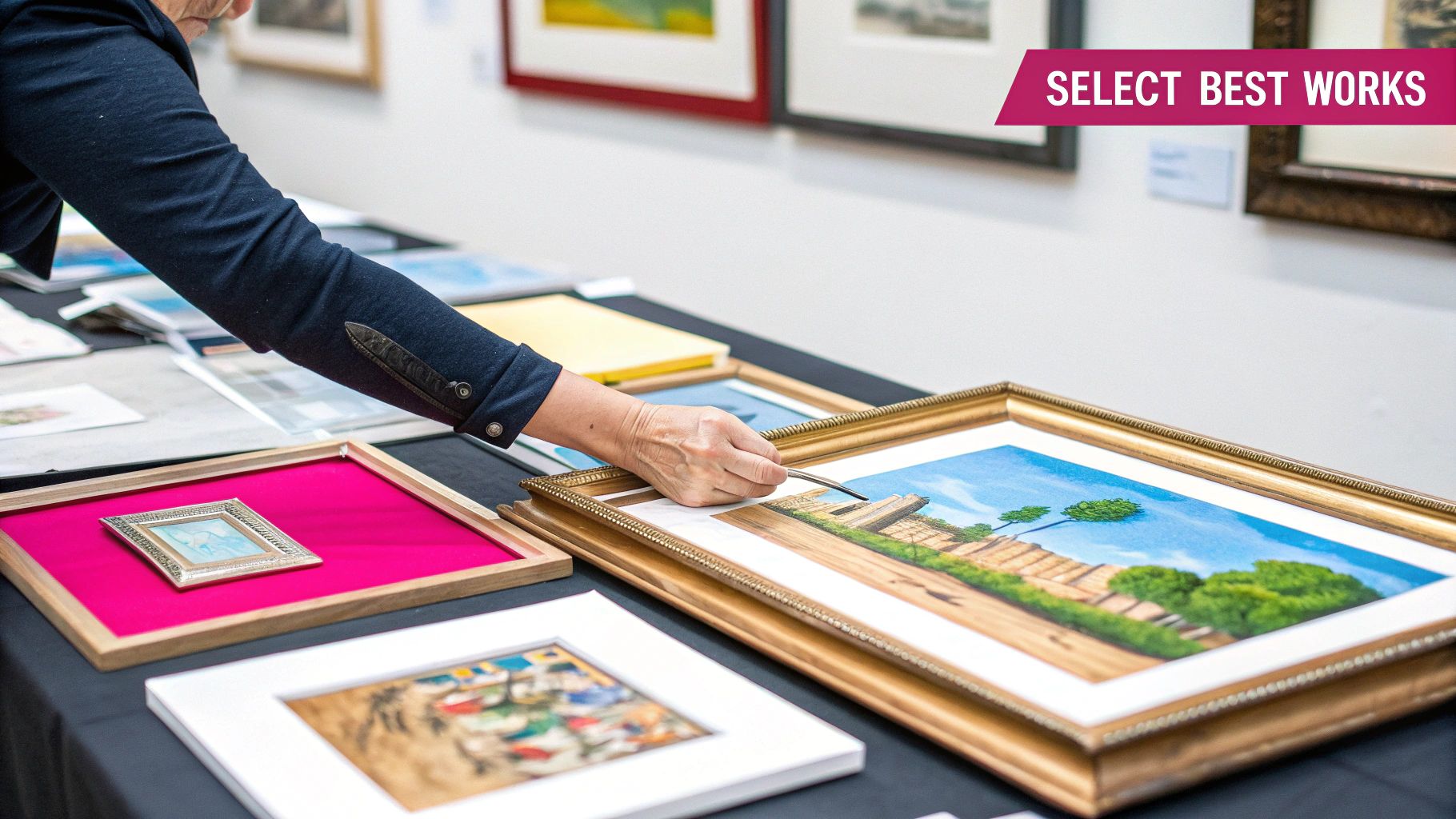
Think of a portfolio without a clear objective. It might be full of incredible work, but without direction, it's just drifting. Your art has a voice, but to make sure it connects with the right people, its presentation has to be just as intentional as its creation.
Your portfolio is a message, carefully crafted for a specific recipient. So, the first real step is figuring out exactly who you're talking to. This decision will ripple through everything, from the art you pick to the way you present it.
Matching Your Portfolio to Your Ambitions
Are you aiming for a spot in an art program, hoping to catch the eye of a gallery director, or trying to land freelance gigs? Each goal requires a completely different kind of portfolio.
-
For University Applications: Admissions officers are looking for potential. They want to see your raw skill, how you think, and how you experiment. Your portfolio should showcase a clear journey of growth. Don't be afraid to include sketchbook pages or process shots—they love a peek behind the scenes.
-
For Gallery Representation: Curators need to see a mature and unified body of work. They’re looking for a consistent artistic voice and a clear vision that says you’re a serious, committed artist. Your portfolio must prove you have a distinct perspective and a history of producing high-quality pieces.
-
For Commercial Clients: Art directors and brand managers are problem-solvers, and they’re looking for one, too. They need to see, instantly, if your style fits their project and if you can deliver professional work on time. This portfolio should be laser-focused on your niche, whether that’s character design, editorial illustration, or branding.
I’ve seen so many artists make the mistake of creating a one-size-fits-all portfolio. When you try to appeal to everyone, you often end up impressing no one. Customizing your work shows you’ve done your homework and respect your audience's needs.
Seeing Through Your Viewer's Eyes
Once you know your goal, it’s time to put yourself in your audience's shoes. A gallery owner with a taste for minimalist, contemporary art is hunting for something totally different than a home decor buyer who wants a vibrant, abstract painting for their living room.
Before you start assembling, get to know who you're trying to reach. You can find some great tips for identifying your target audience that apply just as well to artists as they do to businesses. Research the galleries you love, study the brands you want to work with, or look at the portfolios of students who got into the schools you're targeting. This isn't about copying them; it's about understanding the conversation your work is about to enter.
This early work takes some real self-reflection and confidence. If that’s something you're still building, our guide on https://www.wiktoriaflorek.com/how-to-build-self-confidence-as-an-artist-studio-talks-11/ offers some solid advice. By locking in your purpose and audience first, you're setting the foundation for a portfolio that doesn’t just show off your talent—it actually opens doors.
Curating Your Best and Most Relevant Work
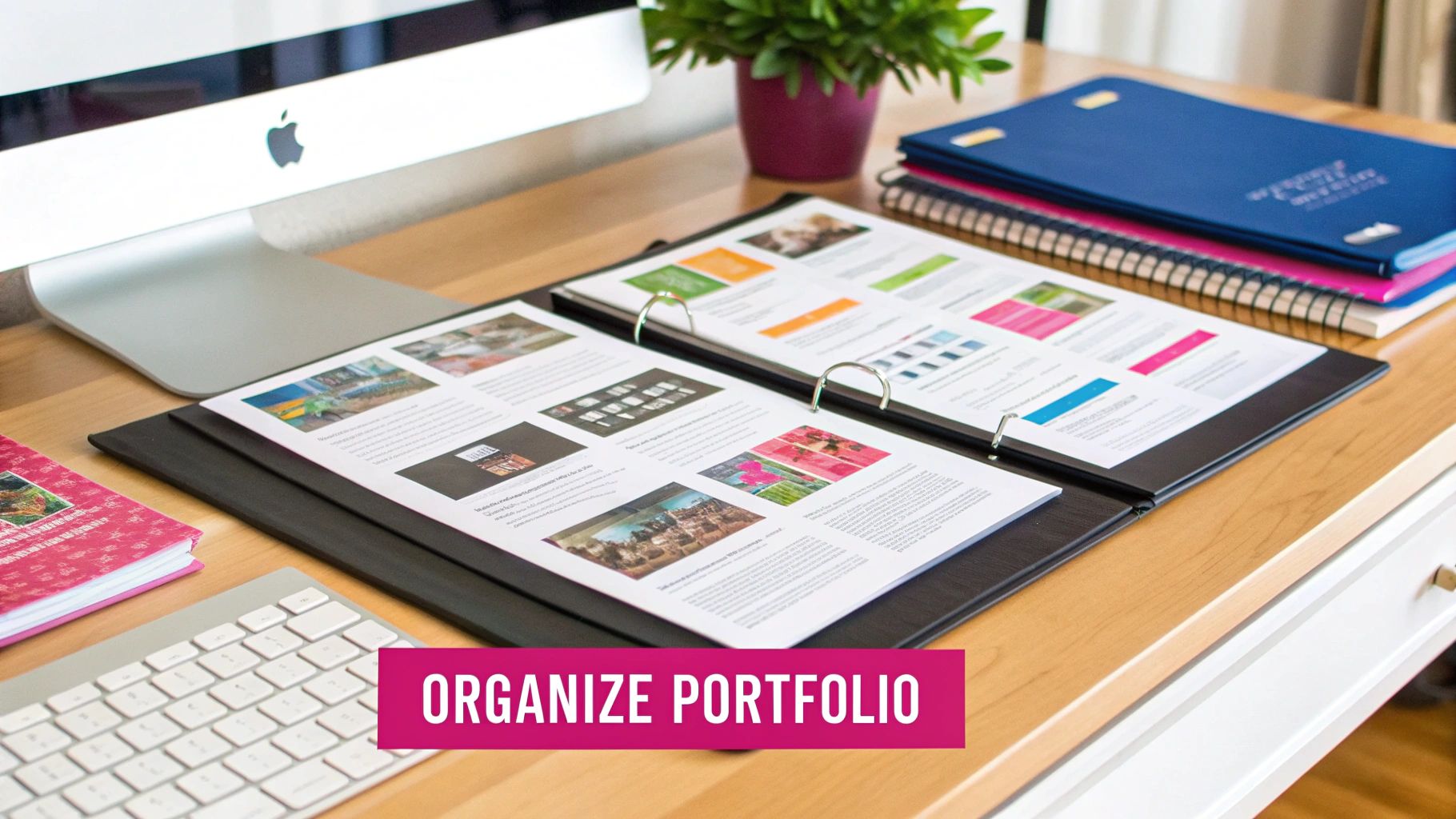
This is where the real work begins. Curation isn't just about picking your favorite pieces; it's about telling a story—your story. You're making deliberate choices to build a powerful, cohesive narrative about who you are as an artist. Every single piece must earn its spot.
The aim here is to show more than just what you can do. A truly great portfolio reveals how you think. It gives a glimpse into your unique perspective and what you value, showing a level of artistic maturity that gallerists, clients, and admissions boards are always looking for.
Quality Always Beats Quantity
It's a classic mistake: stuffing your portfolio with everything you've ever made to look productive. Don't do it. A tight, focused collection of 10 to 15 outstanding works will always be more impressive than a rambling set of 30 mediocre pieces.
Be ruthless. Select only your strongest art. Each piece should be a knockout, showcasing both your technical skill and your conceptual depth. If something feels weak, or if it was an experiment that doesn't quite fit your current direction, leave it out.
Your portfolio is only as strong as its weakest piece. One off-brand or lower-quality work can cast a shadow of doubt over the entire collection. When in doubt, take it out.
This focused approach does two things: it respects the viewer's time and shows that you can critically edit your own work—a hallmark of a true professional.
Find Your Cohesive Thread
Your portfolio needs to feel like a unified body of work, not just a random assortment of projects. Now, "cohesive" doesn't mean "identical." It just means there should be a clear thread connecting everything.
This thread could be:
- A consistent subject: Maybe you only paint urban landscapes or focus on abstract portraiture.
- A distinct aesthetic: Your signature might be your bold use of color, delicate line work, or a specific compositional style.
- A shared concept: Perhaps all your work explores themes of identity, memory, or our relationship with nature.
Lay out your potential selections and look at them together. Do they feel like they're in conversation with one another? Do they build on a central idea? Even a technically brilliant piece might need to be cut if it feels like a complete outlier.
Show Your Range, But Stay Focused
Demonstrating versatility is crucial, but it's a balancing act. You want to show you have a range of skills without looking scattered or like you haven't found your voice yet. The trick is to show variety within your established theme.
For example, if you're a figurative painter, you could showcase your range by including:
- A highly detailed, tightly rendered portrait.
- An expressive, gestural figure study that feels more raw.
- A complex, multi-figure scene that shows off your storytelling abilities.
See how that works? Each piece is different, yet they all reinforce your core strength as a figurative artist. It proves you're not a one-trick pony, but a specialist with real depth.
Nail the Opening and Closing
The order of your work matters—a lot. Think of your portfolio as a journey you're guiding someone on. You need a killer opening and an unforgettable ending.
-
The Opener: Your first piece has one job: to be a showstopper. It should grab the viewer's attention immediately and make them excited to see what's next. Pick something that’s both technically incredible and a perfect representation of who you are as an artist.
-
The Closer: The final piece is what they'll remember. It should be powerful and resonant, summarizing the core ideas of your portfolio and leaving the viewer with a crystal-clear sense of your vision.
The pieces in between should create a natural rhythm, building on the opener's momentum and leading smoothly to the conclusion.
Staying informed about the art market can also give you an edge. For instance, the Art Basel and UBS's 2025 Art Market Report noted that the number of art transactions grew by 3% to 40.5 million. Interestingly, much of that energy is in the more affordable end of the market, with sales for art under $5,000 growing by 7%. This points to a massive opportunity for emerging artists. Understanding these dynamics can help you position your work more effectively. You can learn more about these critical trends reshaping the 2025 art market and use that knowledge to your advantage.
Choosing the Right Portfolio Format
How you present your art is just as important as the art itself. Think of your portfolio's format as the frame for your creative vision. Picking the right one ensures your work is seen in the best possible light, whether you're firing off a quick email submission or sitting down for a formal gallery review.
The key is to understand the strengths of each format. This isn't about picking one and sticking with it forever; it's about knowing which tool to pull out of your toolbox for the right situation. Being prepared lets you act quickly and professionally whenever an opportunity pops up.
Your Digital Headquarters: A Professional Website
Your personal website is your home base. It’s non-negotiable. This is the central, professional hub where anyone—a gallery owner, a potential buyer, a curious fan—can find your complete body of work, read your artist statement, and get in touch.
Unlike social media, you have 100% control here. You decide the layout, the image sequence, everything.
A great website does a few critical things:
- Builds credibility. A clean, professional site shows you’re a serious artist who invests in your career.
- Acts as your archive. It's where you can display your entire catalog, neatly organized into series or collections.
- Provides crucial context. You have room for an in-depth artist statement, a CV, and the stories behind your work, giving people a much deeper connection.
The best artist websites are simple and intuitive. The design should get out of the way and let your art do the talking.
The Strategic Submission Tool: The PDF Portfolio
If your website is the public exhibition, a PDF portfolio is your private, tailored pitch. This is what you’ll use for specific applications—sending your work to a gallery, applying for a grant, or responding to a call for artists. Its power lies in its focus.
Imagine you're curating a mini-exhibition for one specific person. You can hand-pick 5-10 of your most relevant pieces, arrange them in a compelling story, and pair them with a targeted artist statement. It shows you’ve done your homework and respect the viewer's time.
A well-crafted PDF is an act of consideration. You’re not just sending a link and hoping for the best; you’re delivering a concise, thoughtful package that speaks directly to their needs.
Just be sure to optimize your PDF. You want high-quality images, but the file size needs to be manageable. Keep it under 10MB—that’s a good rule of thumb to avoid clogging someone's inbox.
The Enduring Power of the Physical Portfolio
In a world full of screens, the tactile experience of a physical portfolio holds a unique and memorable power. For those crucial face-to-face meetings, studio visits, or high-stakes gallery reviews, nothing makes an impression quite like a beautifully printed book of your work.
Holding a physical portfolio creates a focused, almost intimate, viewing experience. The viewer can appreciate the subtle textures, true colors, and fine details in a way a screen can't always capture. It slows people down and encourages them to really look.
If you go this route, invest in high-quality printing on archival paper. The binding, cover, and overall feel should reflect the quality of the art inside. This is your chance to make a lasting, tangible impression. For those working in abstract art, a physical copy is especially powerful for conveying texture and depth. If that's your field, you might find our guide on how to understand abstract art helpful.
Before we move on, it's helpful to see a direct comparison of these main formats.
Digital vs. Physical Portfolio Comparison
This table breaks down the core differences to help you decide which format best suits your immediate needs.
| Feature | Digital Portfolio (Website/PDF) | Physical Portfolio (Print Book) |
|---|---|---|
| Accessibility & Reach | Instantly shareable worldwide via a link or email. | Requires a physical meeting or mailing. |
| Best Use Case | Online presence, remote applications, initial contact. | In-person reviews, high-stakes meetings, studio visits. |
| Curation & Flexibility | Websites show everything; PDFs are easily tailored per viewer. | A fixed selection of works, more permanent. |
| Viewer Experience | Convenient and quick, but can feel impersonal. | Intimate, tactile, and memorable. Encourages slower looking. |
| Cost & Upkeep | Lower initial cost (hosting/domain); easy to update. | High-quality printing can be expensive; updates require reprinting. |
| First Impression | Professional and modern. | Classic, serious, and impactful. |
Ultimately, the most prepared artists have both. They use their digital portfolio for broad reach and targeted submissions, saving the physical book for moments that count.
Social Media as a Supporting Player
Platforms like Instagram are fantastic, but they are not a replacement for a professional portfolio website. Think of them as a powerful supporting tool.
Use social media to share your process, tease new work, and build a community. It’s the perfect place for more informal, behind-the-scenes content that lets your personality shine.
Here’s a simple way to think about it: your website is the formal exhibition, and your Instagram is the live artist talk. Use it to draw people in, then direct them to your website where they can get the full, professional experience.
The image below offers a simple roadmap for crafting the artist statement you'll include in all these formats.
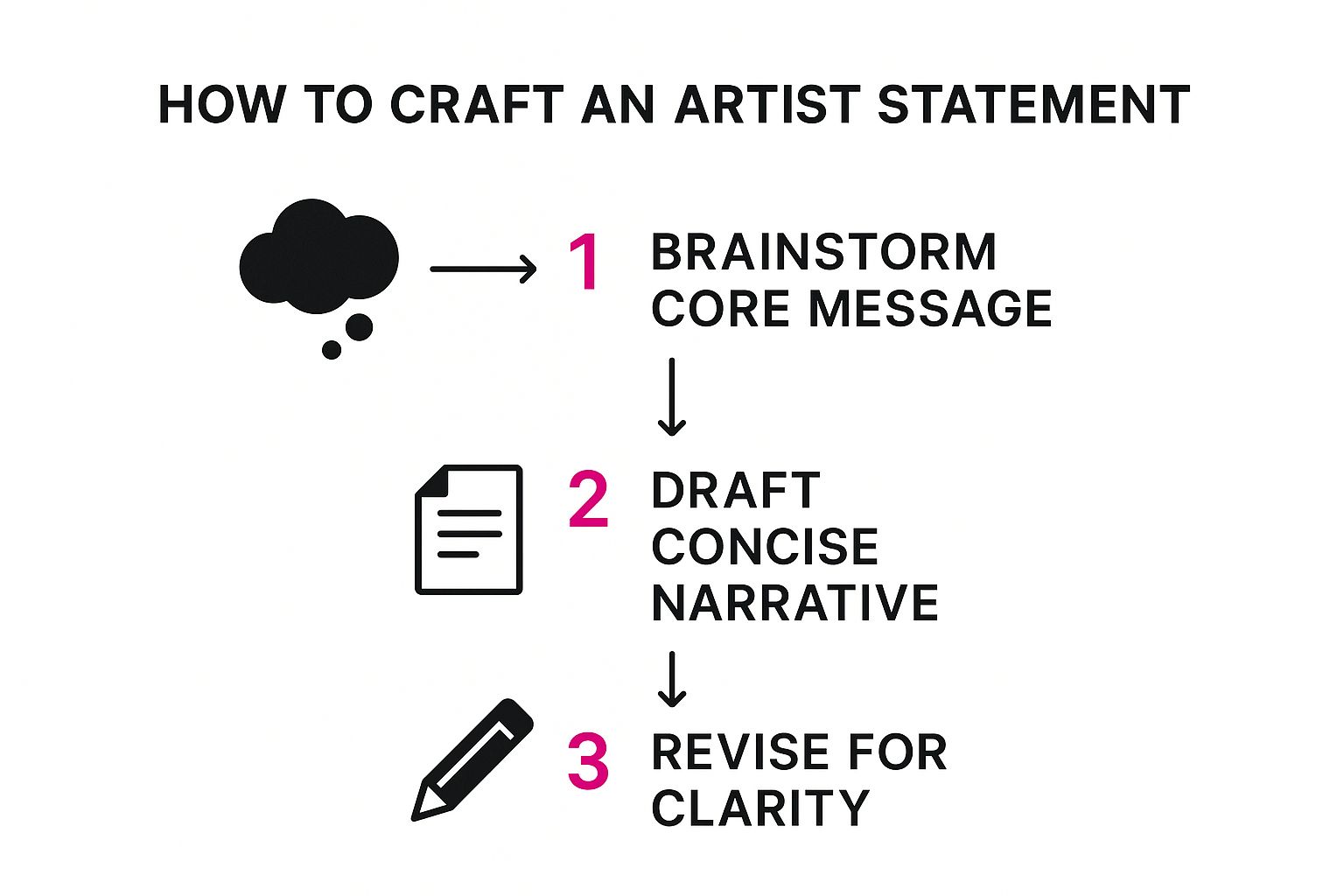
As you can see, creating a powerful artist statement follows a clear path—from brainstorming your core ideas to drafting and then refining the final text until it has maximum impact.
Designing an Engaging and Professional Layout
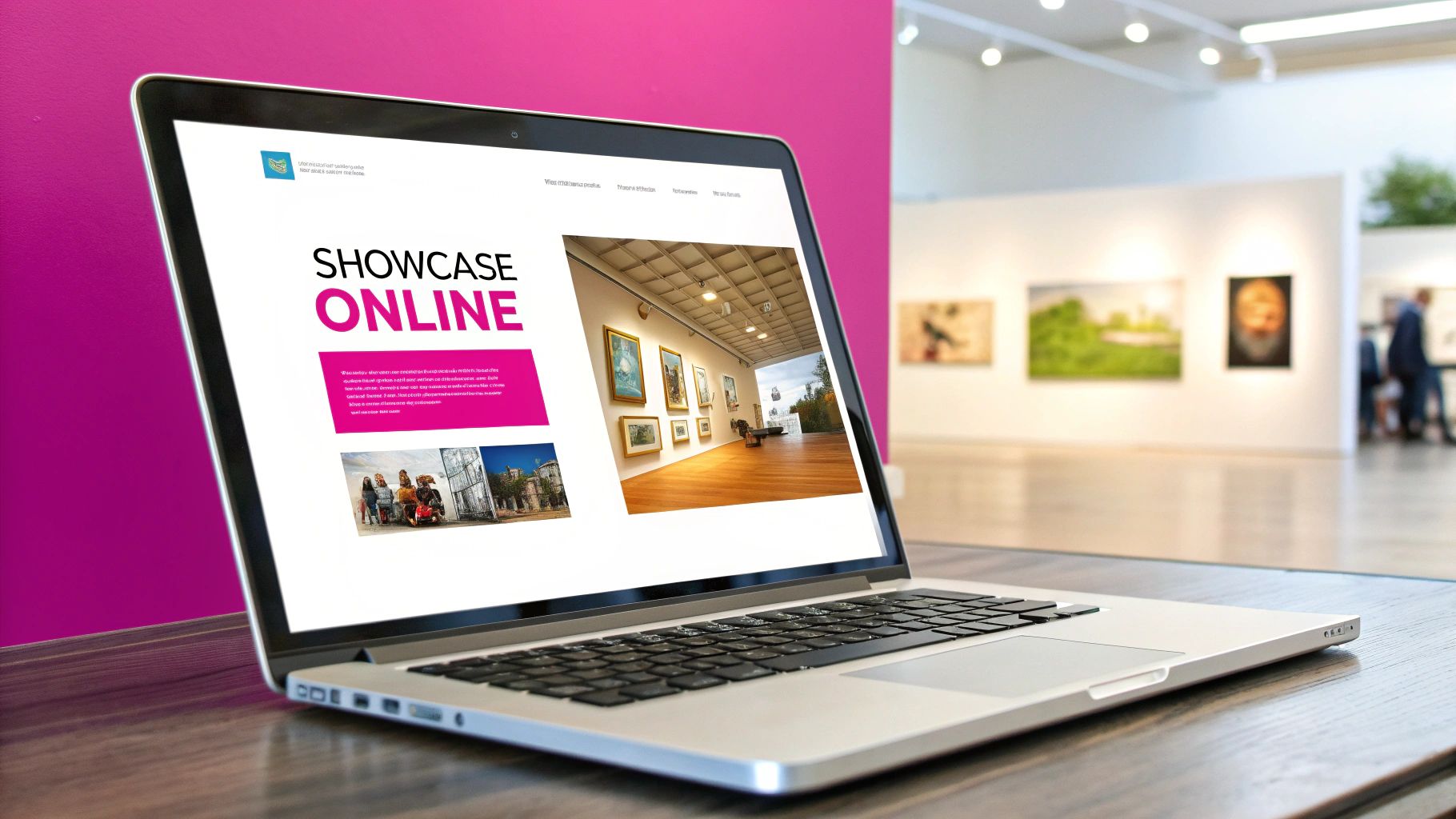
A fantastic portfolio layout does so much more than just show your art—it tells a story. It guides the viewer's eye and makes your work feel even more impactful. Think of your portfolio's design, whether it's on a screen or in a physical book, as a quiet but powerful statement about how much you value your own craft.
When the design is thoughtful and professional, it shows you respect the viewer's time. A cluttered page or confusing navigation can sabotage even the most brilliant art. So let's dig into the core ideas that will help you build a portfolio that truly connects.
Orchestrating the Visual Journey
The order you place your art in isn't just about what looks good; it's about creating a narrative. You're the director here. The goal is to build a rhythm that pulls people in and holds their attention from the first piece to the last.
Think about pacing. You wouldn't want to cram all your most complex, visually dense pieces together. That's overwhelming. Instead, create a natural flow by alternating between those intricate works and your simpler, more focused ones. This gives the viewer a moment to breathe and appreciate each piece individually.
Your portfolio should feel like a guided tour, not a storage room. I always tell artists to start with a piece that makes a bold statement about who they are and end with something that leaves a lasting impression.
The Power of Negative Space
One of the most powerful tools in your design toolbox is actually the empty space around your art. It’s often called white space or negative space, and giving your work room to breathe is absolutely critical.
When you crowd images together, they end up fighting for attention, and the whole layout just feels chaotic. Giving each piece plenty of negative space creates a sense of calm, focus, and sophistication. It essentially puts a frame around your work, signaling its importance and letting the viewer absorb it without distraction.
This principle is universal, whether your portfolio is digital or print:
- On a Website: Be generous with your margins and padding. You don't need to fill every single pixel of the screen.
- In a Print Book: Don't be afraid to dedicate an entire page to one powerful piece. Resist that urge to cram multiple images onto one page just to save space.
This confident use of space is a hallmark of professional design and instantly elevates how people see your work.
Photography and Documentation Are Non-Negotiable
Here’s a hard truth: for most people, their only experience of your art will be through a photograph. This means the quality of your documentation is every bit as important as the quality of the art itself. A blurry, poorly lit photo can make a masterpiece look amateurish. Period.
You don't necessarily need to hire a pro, but you do need to invest the time to get a great shot.
Key Documentation Tips:
- Lighting is everything. Bright, diffused natural light is your best friend. Avoid harsh, direct sun that creates glares and deep shadows. An overcast day is perfect for this.
- Keep it straight. Shoot your work head-on to avoid weird distortions. A tripod will help you keep the camera stable and perfectly parallel to your art.
- Clean backgrounds matter. A simple, neutral background—like a white, grey, or black wall—ensures your art is the only thing people are looking at.
- Capture the details. Along with a full shot, take a few high-resolution close-ups. This is your chance to show off texture, brushwork, or intricate details, which is especially vital for mixed media or sculpture.
Since your portfolio is so visual, knowing how to optimize website images is a skill you can't skip. Properly sized images ensure your site loads fast without sacrificing quality—a must for keeping viewers from clicking away.
Choosing Fonts and Text That Serve the Art
The final touch is your text. Your font choice, artist statement, and artwork labels all contribute to the professional feel. The rule here is simple: clarity and simplicity always win.
Pick a clean, readable font that complements your art instead of competing with it. Classics like Helvetica, Arial, or Garamond are popular for a reason—they get the job done without any fuss. Use a consistent font size and style throughout for a cohesive look.
Your labels for each piece should be uniform and discreet. All you need is the essential info:
- Title of the Work
- Year of Creation
- Medium (e.g., Oil on canvas, Digital print)
- Dimensions (Height x Width)
This straightforward approach shows you're a pro and gives curators, gallerists, and buyers the exact context they're looking for.
Of course. Here is the rewritten section, designed to sound completely human-written and natural, as if from an experienced artist or curator.
Giving Your Art a Voice: Your Statement, Bio, and Labels
Your art should always be the main event, but the words you pair with it are what give it context and a story. Think of your artist statement, bio, and even the simple labels on your pieces as the supporting cast. They answer the questions a gallerist, client, or fan will inevitably have, showing them you’re a professional who takes your work—and their interest—seriously.
This isn't about writing a stuffy academic paper. The goal is to be clear, direct, and, most importantly, authentic. Good writing builds a bridge, inviting people into your creative world and helping them connect with what you’re trying to say.
The Artist Statement: Answering "What's Your Work About?"
Imagine someone at your show asks, "So, tell me about your art." Your artist statement is your answer, distilled into a short, first-person text of about 150-200 words. It’s your opportunity to get to the heart of why you create what you do.
A powerful artist statement does a few key things:
- It sounds like you. Ditch the art-school jargon. Just explain your work as if you were talking to a curious friend.
- It's about the "why," not just the "what." Don't just say, "I paint portraits." Instead, explain why you're drawn to the human face or what you hope to capture in your subjects.
- It’s punchy and to the point. Every word counts. If a sentence doesn't add real insight, cut it.
Your artist statement isn't set in stone. It’s a living document. As your art evolves, so should your statement. I always recommend revisiting it every six months or so to make sure it still feels right and reflects your current practice.
Your Bio and CV: The Story of Your Career
While your statement is about your art, your bio and CV are about you as a professional. They serve different purposes but are both crucial for establishing your credibility.
Your Artist Bio (Third-Person, ~100 words): This is the short, narrative version of your career. It’s always written in the third person ("Wiktoria Florek is a painter…") and is perfect for a gallery program or a press inquiry. It should quickly hit the highlights: your medium, core themes, education, and a few big achievements.
Your Artist CV (Curriculum Vitae): This is the complete, formal record of your professional life as an artist. It's not a typical resume; it’s an organized list that shows the full scope of your experience.
A solid artist CV usually breaks down like this:
- Education: Degrees, workshops, and residencies.
- Exhibitions: List your solo and group shows with the gallery, location, and date.
- Awards and Grants: Any honors you’ve earned.
- Press and Publications: Mentions in articles, blogs, or catalogs.
- Collections: Note if your work is part of public or private collections.
Don't Forget the Details: Labeling Your Work
This might seem small, but it’s a detail that separates the pros from the amateurs. Labeling your artwork correctly is non-negotiable. It gives viewers, especially potential buyers and curators, the essential information they need at a glance. It’s a sign of respect.
Every single piece in your portfolio needs a clean, consistent label. The standard format is simple:
- Title of Work
- Year Completed
- Medium (e.g., Oil on canvas, Mixed media on panel)
- Dimensions (Height x Width in inches or cm)
This kind of clarity is expected, especially when dealing with serious collectors. The art market has exploded, with the number of high-net-worth individuals—a huge part of the collector base—growing by 170% between 2000 and 2020. With buyers spending a median of $180,000 in just the first half of 2022, they are looking for professionally presented art. You can learn more about the expanding art market on Straits Research. Getting these details right shows you belong in that conversation.
Getting Your Portfolio into the Right Hands
You've done the hard work—curating your best pieces, designing a stunning layout, and writing compelling descriptions. But a brilliant portfolio gathering dust on a shelf (or a forgotten corner of the internet) won't build your career. The final, most crucial step is to get that portfolio seen by the right people. This is where you shift from artist to advocate for your own work.
This isn't a passive process of waiting to be discovered. It’s about being proactive and strategic, turning all your creative efforts into real, tangible opportunities.
Research and Strategic Outreach
Before you even think about hitting "send" on an email, you need to do your homework. Firing your portfolio off to every gallery you find on Google is a surefire way to get ignored and can even hurt your reputation. Instead, your first move is to build a highly targeted list.
Look for galleries, curators, or potential clients whose mission and aesthetic genuinely resonate with what you do. Do they represent artists working in a similar medium? Does the conceptual basis of their past shows align with yours? A personalized approach isn't just polite; it shows you respect their vision and have put real thought into why you'd be a good fit.
When you're ready to make contact, your email needs to be professional, personal, and to the point.
An Email That Gets Opened:
- Smart Subject Line: Be specific. "Artist Submission: [Your Name], Abstract Painter" is much better than "Portfolio."
- Personal Greeting: Always try to find the name of the gallery director or curator. "Dear Ms. Evans" beats "To Whom It May Concern" every time.
- A Quick, Sincere Intro: In just a couple of sentences, introduce yourself and explain why you're contacting them. Maybe you admired a recent exhibition or feel your work complements another artist they represent.
- The Link: Simply provide a direct link to your online portfolio. Don't attach large files.
- A Professional Close: A simple "Thank you for your time and consideration" is perfect.
This approach shows you value their time and makes it incredibly easy for them to see your work.
Applying for Grants and Residencies
Grants and residencies can be absolute game-changers, providing you with funding, dedicated studio time, and invaluable connections. But the competition is fierce, and your application has to be flawless.
Each opportunity will have its own unique set of rules. Read the guidelines meticulously and follow them exactly. They might ask for a specific number of images, a detailed project proposal, or a tailored artist statement. One small mistake, like sending 11 images when they asked for 10, can get your application tossed out before anyone even sees your art.
Key Takeaway: Treat every application like a commissioned project. Your ability to follow instructions and thoughtfully present your work says a lot about your professionalism.
Juggling these applications while maintaining your studio practice is a challenge. For a solid framework to keep everything on track, check out our guide on time and project management for creatives.
Authentic Networking, Online and Off
Forget the outdated idea of just handing out business cards. Real networking is about building genuine relationships within your community. Make an effort to go to gallery openings, art fairs, and local artist talks. When you're there, be present. Ask questions, listen more than you speak, and show a real interest in other people's work.
Your website and social media are also incredible networking assets. Follow artists and galleries you admire. When you share their posts or comment on their work, do it thoughtfully. This is how you build a community and get on people's radar in a natural, organic way. Once you have a polished portfolio, building a media presence as an artist is the next logical step to attract serious attention from galleries and collectors.
This kind of outreach can also put you in front of new types of buyers. The global art market is changing, with the art funds market expected to grow at a CAGR of 5.8% between 2025 and 2032. This shows a growing trend of art being treated as a serious financial asset. A professional and accessible online portfolio is non-negotiable for reaching the international networks that serve these investors. You can discover more insights about the art funds market to understand this space better.
Finally, remember that persistence pays, but politeness is paramount. It’s perfectly fine to send a gentle follow-up email after a few weeks have passed. A simple, "Just wanted to briefly follow up on my recent submission," is all you need. Then, let it go. Your energy is a precious resource, better spent on creating your next piece and finding the next opportunity.
At Wiktoria Florek, we believe that art is a powerful conversation between the creator and the world. Each piece in our collection is a testament to this belief, crafted with emotional presence and a deep connection to the intuitive. If you are looking to acquire art that transforms your space and speaks to your soul, we invite you to explore our available works. Discover a piece that resonates with you at https://wiktoriaflorek.com.