
Authenticating a piece of art is really about verifying its entire life story. You're digging into its history—from the moment it left the artist's studio to its current owner—to confirm it's the real deal. This detective work combines deep provenance research, consultations with seasoned experts, and sometimes even scientific analysis. It's the essential first step before making any serious acquisition, protecting both your investment and the artist's legacy.
Why Art Authentication Matters Now More Than Ever
Welcome to the intricate and often high-stakes world of art collecting. Before we jump into the "how," it's crucial to grasp the "why." Art authentication is the very foundation of a trustworthy art market. It’s the meticulous process that separates a true masterpiece from a masterful fake, safeguarding your financial investment and the cultural heritage of the artist.
Think of it as the ultimate quality control. Checking an artwork's backstory isn't just about sidestepping a bad purchase. It's about building confidence, preserving value, and making sure the piece you've fallen for has the documented history to prove its worth.
The Real-World Stakes of Authentication
Don't be fooled—even the most experienced collectors can be tricked. The art world is filled with cautionary tales of forgeries that have slipped past the gatekeepers, some even hanging in prestigious museums for decades before being exposed. This is precisely why a painstaking authentication process is your only real defense against increasingly sophisticated fraud. It’s a full-blown investigation into an artwork's soul.
This process is more critical than ever in today's dynamic global art market. While total sales recently dipped to around $57.5 billion, the sheer number of transactions actually grew by 3% to 40.5 million. This signals a more active market where verification is absolutely essential for maintaining integrity.
With projections suggesting the art market could surge to $944.59 billion by 2033, knowing how to authenticate art will only become more vital.
In this expanding market, authentication acts as a crucial anchor. It ensures that as asset values grow, the confidence in those assets grows alongside them, preventing the proliferation of forgeries that could destabilize the entire ecosystem.
More Than Just a Certificate
Ultimately, authentication delivers one invaluable thing: peace of mind. It’s the difference between owning a beautiful object and owning a tangible piece of history. Every artwork tells a story, and authentication is how you confirm that story is true. This verification process involves a few key layers of investigation:
-
Provenance Research: This is about tracing the artwork’s complete chain of ownership, from the artist’s studio right up to the present day. Every owner, every exhibition, every sale matters.
-
Expert Consultation: This means bringing in the heavy hitters—scholars, conservators, or specialists who have dedicated their entire careers to a specific artist, movement, or period.
-
Connoisseurship: This is the expert's trained eye. It's an almost intuitive ability to identify the subtle, signature characteristics of an artist's hand, from their unique brushwork to their compositional tendencies. Understanding the nuances of a style, especially something like abstract art, is a refined skill. For more on this, check out our guide on how to understand abstract art.
Mastering these skills, or at least knowing who to trust with them, is what separates a casual buyer from a knowledgeable custodian of art.
Uncovering an Artwork's Past Through Provenance
When it comes to authenticating a piece of art, provenance is everything. It’s the documented history of who has owned the artwork, from the moment it left the artist's studio to the present day. This isn't just a list of names; it's the story of the art itself, and it's your most powerful tool.
Think of yourself as an art detective. Your job is to follow the clues and piece together the artwork's life story. A solid, unbroken chain of ownership gives you—and any future buyer—confidence in its authenticity. Any gaps in that story are red flags. They don't automatically mean the work is a fake, but they certainly demand a much closer look.
Gathering the Core Evidence
Your investigation begins with paperwork. You need to gather every document connected to the artwork, no matter how insignificant it might seem. These papers are the foundation of your research and will give you the first threads to pull on.
Look for these key documents right away:
- Original Bill of Sale: This is the holy grail. A receipt from the gallery or the artist themselves is the strongest proof of where the artwork began its journey.
- Gallery or Auction House Invoices: Each time the piece was sold, it should have generated an invoice. These are critical for tracking its path through the commercial art world.
- Exhibition Labels and Catalogs: Check the back of the artwork for old labels. They often list past shows. If you can find the catalog for that exhibition, you've placed your art at a specific time and place.
- Correspondence: Don't overlook old letters. A note from the artist, a dealer, or a past owner that mentions the artwork can be invaluable, adding personal context that official records miss.
While a perfect, unbroken chain of ownership is the ideal, the reality is often much messier. True provenance is built by meticulously verifying each owner and backing up every claim with multiple sources.
A Real-World Scenario Unfolding
Let's walk through a common situation. Imagine you find a beautiful mid-century abstract painting at an estate sale. The family tells you it belonged to their grandfather, who they think bought it in New York back in the 1960s, but they can't find any paperwork. This is a classic authentication puzzle.
Where do you even begin?
First, you'd carefully examine the back of the canvas. Let’s say you find a faded, torn label from the "Tibor de Nagy Gallery." That's your first big break. A quick online search tells you this was a major New York gallery, deeply involved with the Abstract Expressionists.
Now you have a lead. The next step is to track down that gallery's archives. They might be held by a museum library or a research center like the Archives of American Art. You're digging for exhibition checklists or catalogs from the 1960s. If you find your painting listed in a 1965 show catalog, you've just landed a huge piece of the puzzle.
Digging Deeper into the Timeline
With the gallery connection established, you need to trace the ownership forward from the grandfather. Did he ever loan the painting to a museum? Was he ever mentioned in a local newspaper as a collector? You’d be surprised what you can find.
Perhaps you discover the grandfather’s name in the acknowledgments of a local museum's 1972 annual report, where he’s listed as a lender to a show on local collections. This small detail adds another verified point to your timeline, bridging the gap between the 1965 gallery show and the present day.
This whole process requires a specific mindset:
- Question Everything: Family stories are a fantastic starting point, but they need to be verified with hard evidence. Don't take anything at face value.
- Follow Every Lead: That little scribble on the back or a torn label might seem like nothing, but it could be the clue that cracks the whole case open.
- Document Your Findings: Keep a meticulous record of your research. Note down every source you checked, even the dead ends. This research log becomes part of the artwork's new, more robust provenance.
By patiently piecing these fragments together—the gallery label, the exhibition catalog, the museum's lender list—you transform a painting with a hazy past into one with a documented, credible history. This is the diligent, detective-like work that defines a serious collector.
When It's Time to Call in the Pros: Expert Opinions and the Catalogue Raisonné
Let’s be honest, your own research and provenance digging can only get you so far. Sooner or later, every serious collector learns a vital lesson: knowing when to pass the baton to a professional. You aren't expected to be a historian, a forensic scientist, and a market analyst all at once. Recognizing the limits of your own knowledge isn’t a weakness; it's one of the smartest things you can do to protect your investment.
Bringing in a specialist is a strategic move. It’s how you get a level of certainty that simply can’t be achieved through desk research alone. These people have spent their entire careers training their eyes and building a depth of knowledge for this exact purpose.
Who to Call: Building Your Authentication Team
The art world has its own set of specialists, and calling the right one is crucial. Calling the wrong person is an easy way to waste both time and money. Here’s a quick rundown of who’s who.
- Appraisers: These are the people you call to determine an artwork's monetary value for insurance, estate planning, or sales. While authenticity is part of their assessment, their main job is valuation, not a deep-dive authentication.
- Conservators: Think of them as art doctors. They are experts in the physical life of an artwork—its condition, past repairs, and material stability. A good conservator can often spot tell-tale material inconsistencies that might suggest a piece isn't what it seems.
- Authenticators & Scholars: This is the supreme court of art authentication. For any given artist, there is usually a designated authority—a specific scholar, the artist's estate, or a foundation—whose judgment is considered the final word on whether a piece is genuine.
Here’s a simple look at how you should approach working with these experts.
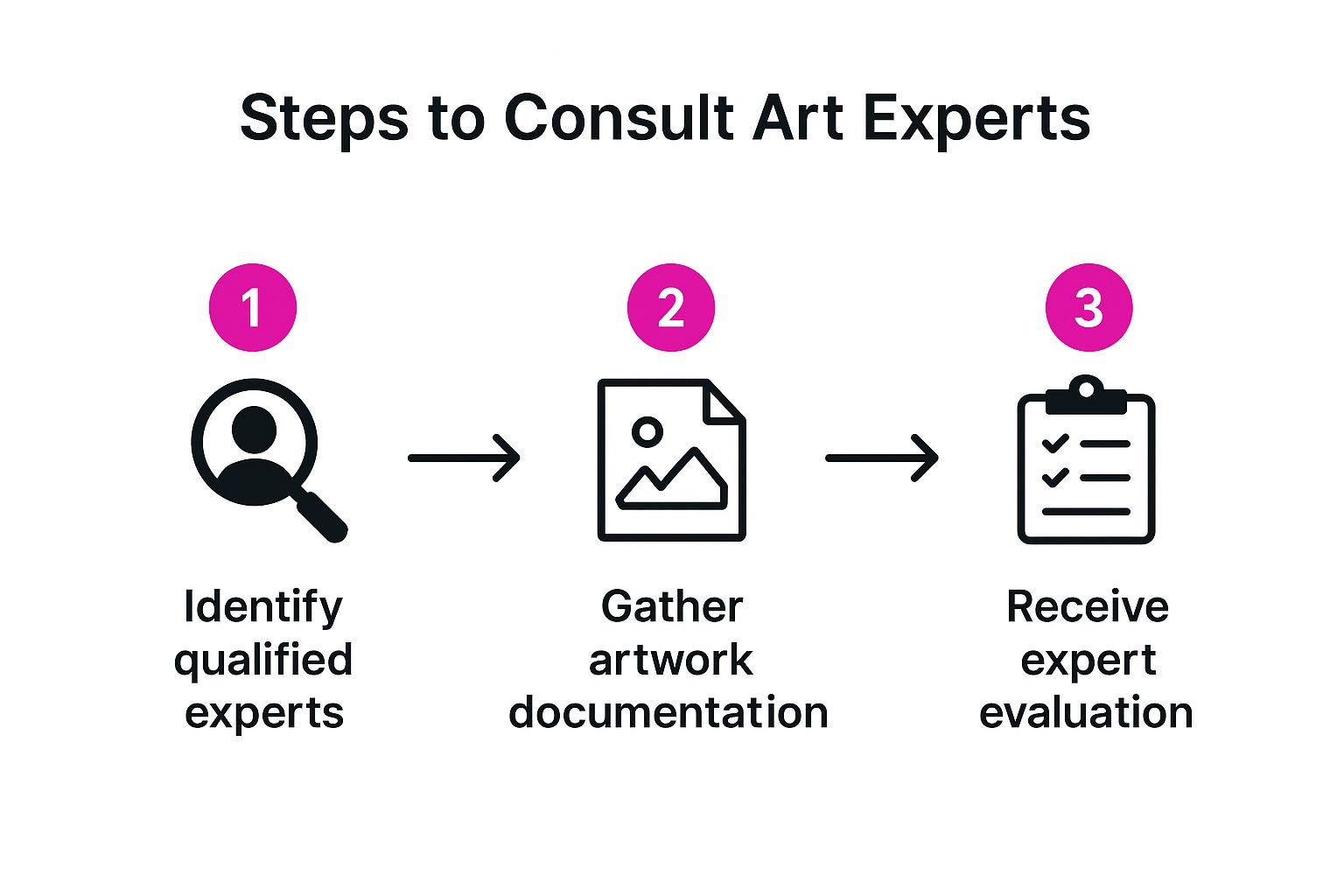
This process isn't complicated. It's about methodically moving from identifying the right person, to preparing your case, and finally, to receiving their professional judgment.
Your Secret Weapon: The Catalogue Raisonné
Before you even think about picking up the phone, your first port of call should be the catalogue raisonné. If you’re not familiar with it, this is a comprehensive, scholarly book detailing every single known work by an artist. It is the definitive reference guide.
A catalogue raisonné is far more than just a coffee table book of pretty pictures. For every single piece, it includes:
- High-quality photographs
- Essential details like title, date, medium, and dimensions
- The complete known provenance
- A history of every exhibition it has appeared in
- References to any literature where the work is mentioned
Finding your artwork in this book is a huge win. These volumes are the result of meticulous, often decades-long research and are widely considered the gold standard in the art world.
What if my piece isn't in the catalogue? Don't panic—at least, not right away. It could simply mean the book is outdated and your piece was discovered after it was published. But it absolutely means you need to dig deeper, and fast.
This is the exact moment when you need to contact the scholar who compiled the catalogue or the official authenticating body for the artist. They might already know about the piece and be planning an update. On the other hand, its absence could be a major red flag. For new collectors, understanding these critical resources is key. To learn more about starting your collection on the right foot, check out our guide on how to collect art with practical tips from studio talks.
Getting Ready for Your Expert Consultation
So, you've done your homework and identified the right expert. Now what? You need to prepare. To get the most out of their time (and your money), you need to show up organized.
Put together a complete file on the artwork. This dossier should contain every scrap of provenance you've found, high-resolution photos (front, back, and signature are a must), and a list of your specific questions. The more organized you are, the more thorough their analysis can be. A prepared collector almost always gets a more decisive and valuable opinion.
Using Scientific Analysis to Reveal Hidden Truths
Sometimes, the paper trail goes cold. Provenance has gaps, and even the most seasoned experts can disagree. When that happens, where do you turn? The answer often lies hidden in plain sight—within the very fabric of the artwork itself.
The canvas, the pigments, the layers of varnish… they all hold clues. This is where scientific analysis comes in, offering objective, concrete answers that can cut through speculation. It's less about subjective opinion and more about hard data, revealing truths that the naked eye could never see. These techniques are the art world's version of forensic science, and they've become absolutely essential for serious authentication.
Seeing Beneath the Surface
Many of the most powerful tools are non-invasive, meaning we can analyze a piece without causing a speck of damage. They give us a high-tech window into how the artwork was constructed.
Here are a couple of the most common methods I've seen deliver incredible results:
- Infrared Reflectography (IRR): This technique uses infrared light to peer through the top layers of paint, revealing the artist's initial sketches underneath. A confident, flowing underdrawing that matches the artist's known style is a huge vote of confidence. On the other hand, a hesitant, traced-looking sketch can be a major red flag for forgery.
- X-radiography (X-ray): An X-ray does for a painting what it does for a broken bone—it shows what's underneath. We can see an artist's changes, known as pentimenti, where they altered the composition by moving a hand, painting over a figure, or changing the background. Forgers almost never bother with this; they just copy the finished product.
Imagine owning a landscape by a famous artist and discovering, via X-ray, that they originally painted a self-portrait underneath. This has actually happened, providing irrefutable proof of authorship and adding a priceless story to the work.
Analyzing the Artist's Palette
Beyond the structure, we can get even more granular and analyze the chemical makeup of the materials. This is where so many forgeries get exposed. A forger might be a brilliant painter, but they often slip up on the chemistry, using materials that simply didn't exist in the artist's time.
Pigment analysis is the gold standard here. It involves taking a microscopic sample of paint—often smaller than the period at the end of this sentence—to identify the exact pigments. For example, if a painting supposedly from the 17th century contains Titanium White, which wasn't commercially available until 1921, you have definitive proof of a fake. Case closed.
The analysis can even pinpoint the origin of materials. Experts can sometimes match the unique chemical signature of lead white pigment in a painting to the specific type known to have been used in, say, Rembrandt's studio in Amsterdam. It provides a firm timeline that's incredibly difficult to cheat.
A Case Study in Scientific Discovery
If you want a perfect real-world example, look no further than the infamous forger Wolfgang Beltracchi. For years, he created stunning "lost" works by 20th-century masters like Max Ernst and Fernand Léger, fooling experts and selling his fakes for millions. His downfall wasn't a mistake in style or a hole in his fabricated provenance.
It was science.
Beltracchi was finally caught when a lab analyzed one of his paintings, supposedly created in 1914, and found traces of that pesky Titanium White. He was a genius at mimicking style and creating fake histories, but he couldn't beat basic chemistry. That one anachronistic pigment was the fatal error that brought his entire criminal enterprise crashing down.
This story is exactly why scientific analysis is a critical pillar of authentication. When you combine it with deep provenance research and expert connoisseurship, you get a powerful, multi-faceted approach. It replaces "I think" with "we know," giving you the confidence that the masterpiece on your wall is the real deal.
Authentication in the Modern Digital Art Market
The old rules of art authentication—studying brushstrokes on a canvas or tracking a sculpture's paper trail—haven't disappeared, but they now share the stage with a new digital reality. Today's art market is just as likely to be found on a blockchain as it is in a gallery, which introduces a whole new set of tools and challenges for collectors.
It might seem daunting, but the goal is exactly the same as it's always been: to be certain about who made a piece of art and that it's the one and only original. With digital art, we're just using different methods—and honestly, some of them are far more transparent than what the traditional art world is used to.
Navigating NFTs and Blockchain Verification
If you're buying digital art today, you’ll almost certainly encounter Non-Fungible Tokens (NFTs). It helps to think of an NFT not as the art itself, but as its digital birth certificate. It’s a unique, tamper-proof token that proves ownership and authenticity, and it’s permanently tied to the artwork file.
This certificate lives on a blockchain, which is basically a public, shared accounting ledger that can’t be altered. Every single time that NFT is created, sold, or resold, the transaction is recorded as a "block" of information. These blocks link together to create a permanent, unbreakable chain of history for the artwork.
This gives digital art a built-in provenance that's clear and accessible from day one.
- Immutable Record: Once a transaction is on the blockchain, it’s there for good. No one can go back and secretly change the artwork’s history.
- Transparent Ownership: Anyone can look up an NFT's history on the blockchain. You get a crystal-clear chain of ownership right back to the artist.
- Artist Verification: The artist's unique digital wallet address is baked into the NFT's creation, creating a direct, hard-to-fake link to the creator.
Blockchain is essentially a living, breathing catalogue raisonné that updates itself in real time, for the whole world to see. It offers a level of provenance transparency that the traditional art world has been chasing for centuries.
As digital art and NFTs have become more common, it's become crucial to understand what you're actually buying. Owning the token doesn't always mean you own the copyright. It's smart to familiarize yourself with the key differences between trademark and copyright so you know exactly what rights come with your purchase.
The Double-Edged Sword of Artificial Intelligence
Artificial intelligence is making its way into the art world, and it’s a classic case of a double-edged sword. AI is both a powerful tool for creating art and a sophisticated new way to forge it. For any collector, understanding both sides of this coin is no longer optional.
On one hand, AI gives us an incredible tool for verification. You can train an algorithm on thousands of an artist's works, teaching it to recognize the tiniest details—the specific way they mix colors, the weight of their lines, their compositional habits. These AI systems can then spot fakes with stunning accuracy, catching inconsistencies a human expert might miss.
But here’s the flip side: that same technology can be used to create "deepfake" art. These are new works generated by AI that perfectly mimic an artist's style, and they can be frighteningly convincing. The global AI in art market is expected to explode from roughly $3.2 billion to $40.3 billion by 2033. With an estimated 35% of fine art auctions already featuring AI-generated pieces, the line between human and machine creativity is blurring fast, forcing us to develop new standards for authentication.
Navigating a Global and Digital Marketplace
The move to digital has blown the doors off the art market, making it truly global. An artist in Warsaw can now sell a piece directly to a collector in Tokyo, no gallery needed. This is fantastic for artists and collectors alike, but it also means you have to be mindful of how things work across borders.
Legal protections for digital assets, for example, can be wildly different from one country to another. This is why having a rock-solid digital provenance is so vital. It’s a principle I apply to my own work; for example, I carefully document the story and creation of each piece in the MyMotherhoodWFA abstract collection. To confidently buy art today, you need a healthy mix of old-school diligence and new-school digital literacy.
Common Questions About Art Authentication
When you start authenticating art, theory quickly gives way to real-world questions. It's one thing to read about the process, but it's another entirely to be standing in front of a painting with a mysterious past. Let's tackle some of the most common hurdles collectors face.
Think of this as your practical field guide for those tricky "what if" moments. Whether you’ve stumbled upon a piece with no paper trail or you're wondering if that certificate is actually worth anything, these answers will help you navigate the process with a bit more confidence.
What If My Artwork Has No Provenance?
Finding a potential masterpiece with zero documented history is every collector's dream—and their biggest headache. This happens all the time with works discovered at estate sales, tucked away in an attic, or unearthed at a flea market. These are the "sleepers" the art world loves to talk about.
An empty history doesn't automatically scream "forgery." It just means your work has shifted. Instead of verifying a story, you now have to build one from the ground up, relying almost entirely on expert opinion and hard science.
Here’s where you need to focus your energy immediately:
- Find the Expert: Your first call should be to the single recognized authority on the artist in question. Their trained eye, or "connoisseurship," is your most powerful tool in this scenario.
- Bring in the Science: Techniques like pigment analysis or infrared reflectography can provide tangible data. These tests can establish a creation timeline that either confirms or flat-out denies the potential attribution.
- Scrutinize the Signature: A forensic-level comparison of the signature against known, verified examples can provide incredibly strong clues.
A piece without provenance isn't a dead end; it's a puzzle. The risk is certainly higher, but the thrill of uncovering a lost treasure is what drives the market. Your investigation effectively becomes its new provenance.
Distinguishing genuine pieces from fakes is a constant challenge. For a deeper dive into this skill, a guide on how to spot fake antiques offers some great parallel insights for art collectors.
Is a Certificate of Authenticity (COA) Enough Proof?
In a word, no. A Certificate of Authenticity is only as credible as the person or entity who signed it.
A COA from the artist’s designated estate or the scholar who wrote the definitive catalogue raisonné? That's gold. It’s considered primary evidence and carries enormous weight.
But a generic certificate from an unknown gallery or a previous owner? It's often not worth the paper it’s printed on. Forgers are notorious for creating official-looking—but completely fake—COAs to sell alongside their fake art. You have to authenticate the certificate just as you would the artwork itself.
If you can't verify the issuer, treat the COA as a minor part of the story, not the final word.
How Much Does Art Authentication Cost?
There's no simple price tag for authentication. The cost can swing wildly based on the artwork, the artist, and how deep you need to dig.
| Service Type | Typical Cost Range | What It Covers |
|---|---|---|
| Initial Expert Review | $500 – $2,500+ | A preliminary look based on high-quality photos and any documents you have. |
| Full Scholarly Research | $5,000 – $15,000+ | A deep dive into archives and historical records, ending in a formal written opinion. |
| Scientific Analysis | $1,000 – $10,000+ per test | The price for individual tests like carbon dating, X-radiography, or pigment analysis. |
For a potentially significant work, a full-scale authentication using multiple experts and a battery of scientific tests can easily climb into the tens of thousands of dollars. You always have to ask yourself: is the potential value of the artwork worth the cost of proving it?
The standards for this work are often set by the world's major art hubs. The US market, which accounts for 45% of global art sales, along with the UK (18%) and China (17%), establishes the best practices everyone else follows. This just goes to show how critical thorough verification is on a global scale. You can dig into these market dynamics in the latest Art Basel report.
At Wiktoria Florek, we believe that true art is built on a foundation of authenticity and personal connection. Each mixed-media abstract painting is a testament to this, created with a documented process and a story that begins in the studio. Explore a collection where emotional depth and artistic integrity come together.