
When we talk about art and shamanism, we're touching on one of the oldest spiritual and creative partnerships in human history. This isn't art for the sake of beauty alone. Instead, it’s a functional bridge, a living tool used to connect with the spirit world, map out visions, and heal.
The Ancient Bond Between Art and Shamanism
Let's rewind the clock. Way back, the line between artist and healer was often blurred, if it existed at all. These roles were frequently one and the same, embodied by the shaman who could journey into unseen worlds and bring back wisdom in a tangible form.
This profound connection between creating and healing isn't just a relic of the past. It's a living tradition that still informs how we think about creativity, consciousness, and what it means to be human. The art born from these practices was always functional, always purposeful. You could think of it as our very first form of spiritual technology.
A Bridge to the Spirit World
At its heart, a shaman’s job is to walk between the physical world and the spiritual realms. Art became the language for that conversation. Whether it was a painting on a cave wall, a carving on a ritual drum, or the hypnotic beat of a chant, these creative acts made the invisible visible.
- Mapping the Invisible: Shamans would return from deep trances with powerful visions. Art was the only way to record these otherworldly experiences, creating maps of the spirit world that the community could understand.
- Powering Rituals: A painted mask or a carved figure wasn't just a pretty object. It was an active participant in a ceremony, charged with the energy and intention needed to heal an individual or protect the tribe.
- Speaking with Spirits: Certain symbols and images were understood as direct lines of communication to ancestors, nature spirits, and the life force animating the world.
In many shamanic traditions, the act of creating is the act of healing. The two are inseparable. The process of making something is itself a ritual, pouring healing intention directly into the object being formed.
This isn't just theory; it's backed by a massive body of archaeological evidence. Shamanism is widely considered one of humanity’s oldest spiritual practices, with evidence pointing to traditions that go back at least 30,000 years to the Upper Paleolithic period. Cave paintings found all over the world show what experts believe are shamans mid-ritual, cementing this ancient link between art and spirit. You can explore some of these incredible ancient findings to see for yourself.
The table below breaks down the key ways art functions within a shamanic framework.
Core Functions of Shamanic Art
| Function | Description | Example |
|---|---|---|
| Healing | Art is created as a ritual tool to restore balance, remove negative energies, or invoke healing spirits for an individual or the community. | A sand painting created during a ceremony to absorb a person's illness. |
| Visionary Record | Artwork serves as a map or diary of the shaman's journeys into non-ordinary reality, preserving sacred knowledge. | Cave paintings depicting hybrid human-animal figures encountered in a trance state. |
| Spiritual Conduit | An object is imbued with power to act as a direct channel for communicating with, or containing, spiritual forces. | A carved mask worn during a ritual to embody a specific ancestral spirit. |
| Protection | Symbols and figures are used to create protective amulets or shields that ward off malevolent forces or danger. | An animal totem carved into a staff to offer strength and guidance. |
This rich legacy shows us that art has always been more than just what meets the eye. It's a fundamental human tool for making sense of the great mysteries of life and death—a powerful tradition that continues to fuel the work of contemporary artists like Wiktoria Florek.
Exploring the Shaman's Creative Spirit
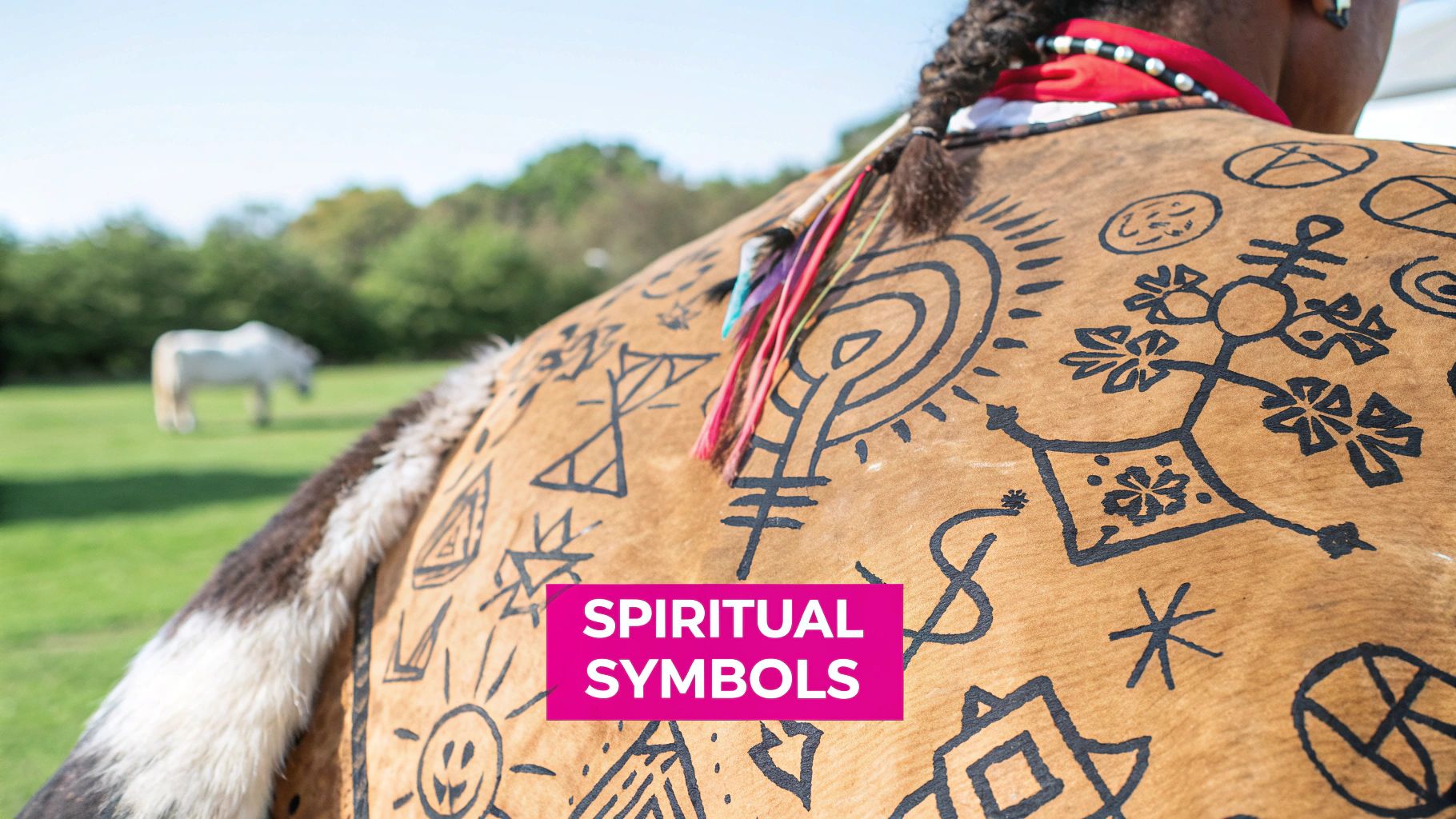
How does a healer become an artist? Or an artist, a healer? In the world of shamanism, these aren't two different jobs—they're deeply intertwined, part of the same core identity. The shaman is a creative visionary because their spiritual work absolutely requires it. Art is the very language they use to bring back wisdom from the unseen world.
Think of the shaman as a translator, standing between the physical reality we all know and a vibrant, invisible landscape of energies, spirits, and consciousness. Their main task is to journey into that other world to find solutions, restore balance, or retrieve what's been lost.
But how do you share something you found there? You can't just hand someone a vision. This is where the creative impulse comes in. The shaman has to translate the formless into form—whether it's through a song, a dance, a carving, or a painting. This act isn't just a report of the journey; it’s the final, crucial step in the healing ritual itself.
The Creative Process as a Ritual
For the shaman-artist, making art is a direct extension of their spiritual practice. The workspace becomes a sacred space, and the whole creative process is treated like a ceremony. Every single choice, from the materials they use to the marks they make, is loaded with intention and aimed at a specific healing outcome. This is a vital concept for understanding the link between art and shamanism.
It’s a different way of thinking. A modern painter might choose a color because it looks good, but a shaman-artist chooses a pigment for its energetic qualities. Red ochre isn't just used for its earthy color; it’s chosen because it represents the blood of life and our connection to the Earth. Charcoal from a lightning-struck tree might be used to channel the raw power of a storm.
This powerful intention is woven into every step:
- Sourcing Materials: Gathering pigments, wood, or fibers is often a ritual in itself, done with prayers and offerings to the spirit of the plant or place.
- Preparing the Canvas: The surface—be it animal hide, stone, or a modern canvas—is cleansed and prepared to receive sacred imagery. It’s transformed from a simple object into a portal.
- The Act of Creation: Each brushstroke, drumbeat, or carved line is a physical expression of an energetic goal, meant to have a real impact on the world.
The shaman's art is fundamentally practical. It is not made to be passively observed in a gallery but to actively do something in the world—to heal, to protect, to instruct, or to rebalance the cosmic order.
Infusing Matter with Spirit
Through this deliberate process, the finished artwork takes on a unique power. It’s no longer just an inert object but becomes a living vessel for the healing energy channeled by the shaman. When someone interacts with this art, they aren't just looking at a picture; they are engaging with the very spiritual force the shaman brought back from their journey.
For instance, a shield might be painted with the image of a protective animal spirit. This isn't merely a symbol. Through the shaman's ritualized creation, the shield is believed to hold the actual presence and power of that spirit, making it a functional tool for spiritual defense.
The connection between the creative act and the healing result is direct and inseparable.
Creation as Healing in Action
| Creative Act | Shamanic Intention | Healing Outcome |
|---|---|---|
| Painting a healing symbol | Channeling restorative energy into a visual form. | The symbol acts as a focal point for the patient's recovery, radiating balance. |
| Carving a spirit animal | Invoking the animal’s specific strengths (e.g., eagle for vision). | The owner of the carving can draw upon that spirit's power for guidance. |
| Chanting during creation | Infusing the artwork with vibrational energy and prayer. | The object becomes charged with a specific frequency that can alter its environment. |
Ultimately, the shaman's creativity flows from a profound understanding that the material and spiritual worlds are not separate. By masterfully weaving intention into physical matter, they create powerful artifacts that bridge these realms, offering tangible proof that art can, and does, heal.
How to Read the Symbols in Shamanic Art
Shamanic art isn't just a collection of pretty pictures; it’s a visual language waiting to be read. Every piece can be a map for healing, a blueprint for a spiritual journey, or a shield of protection. To really get what’s going on, you have to learn how to decode its symbols and look past the surface.
Think of it like learning a new alphabet. At first, all you see are strange, abstract shapes. But once you know what each character means, whole worlds of meaning suddenly open up. The symbols in art and shamanism work the same way—they're keys that unlock visionary states, cosmic ideas, and powerful healing energies.
The Universal Language of Symbols
While every culture has its own unique spin, certain symbols pop up in shamanic art almost everywhere. These recurring themes point to deep, fundamental human experiences and the core beliefs of the shamanic worldview. Getting to know them is the first step.
Three of the most common symbolic pillars you'll encounter are:
- Spirit Animals: These are so much more than just wildlife illustrations. Each animal embodies a specific power or "medicine" the artist is calling upon—the eagle for sharp, clear vision, the jaguar for fierce protection, or the snake for transformation and rebirth.
- Geometric Patterns: Intricate spirals, grids, dots, and lines often represent the very fabric of reality as seen in a trance. These patterns can map out energy fields, chart the soul's journey, or capture the vibrational hum of the cosmos.
- Therianthropic Figures: These are beings that are part human, part animal. They often represent the shaman’s ability to shapeshift or merge with an animal ally, borrowing its power and perspective to bring wisdom back to the community.
The symbols in shamanic art aren’t just for show. They are functional, chosen to do a specific job—whether that’s calling on a spirit, creating a protective barrier, or charting a course through the spirit world. Every single mark is loaded with purpose.
This visual breaks down how ritual, materials, and technique are all woven together to create a piece of functional, healing art.
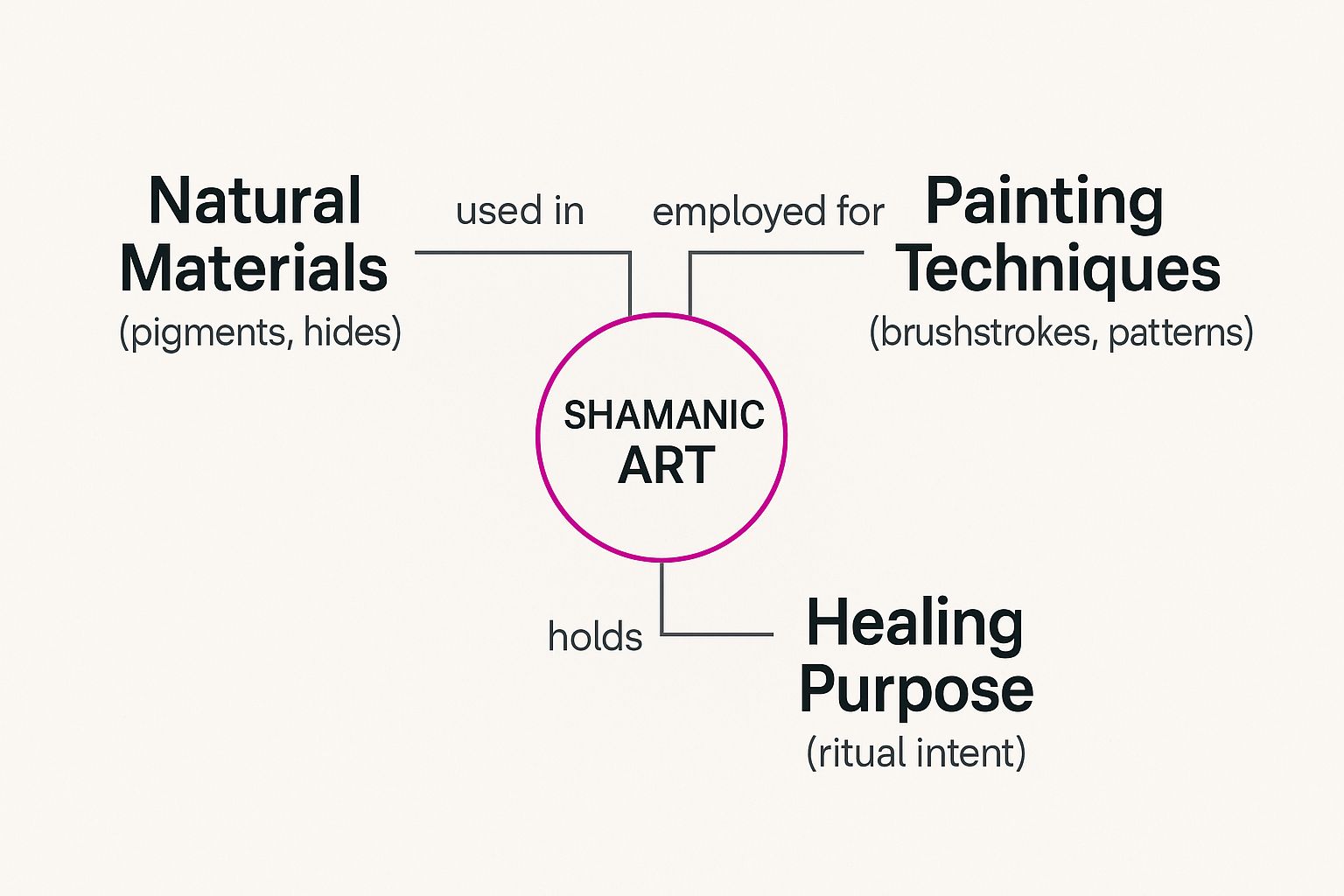
As you can see, the artwork's healing purpose is the central force, influencing everything from the choice of natural materials to the specific painting techniques used to bring it to life.
Seeing Beyond the Obvious
Looking at shamanic art requires a mental shift. Instead of asking, "What is this a picture of?" try asking, "What is this artwork doing?" Is it inviting a spirit? Creating a sacred space? Telling the story of a cosmic event?
For instance, a simple circle might not just be the sun. It could stand for unity, the cycle of life and death, or the cosmic egg from which all of creation hatched. A zigzag line could be a snake, a flash of lightning, or a map of the shaman's journey between worlds. It’s the context and the combination of symbols that build the real story.
This layering of meaning is what gives the art its potency. The symbols speak to our conscious minds, but they also resonate with a deeper, more intuitive part of ourselves. This complexity actually shares quite a bit with non-representational art. To dive deeper into that connection, check out our guide on how to understand abstract art.
Mapping Shamanic Traditions Across the Globe
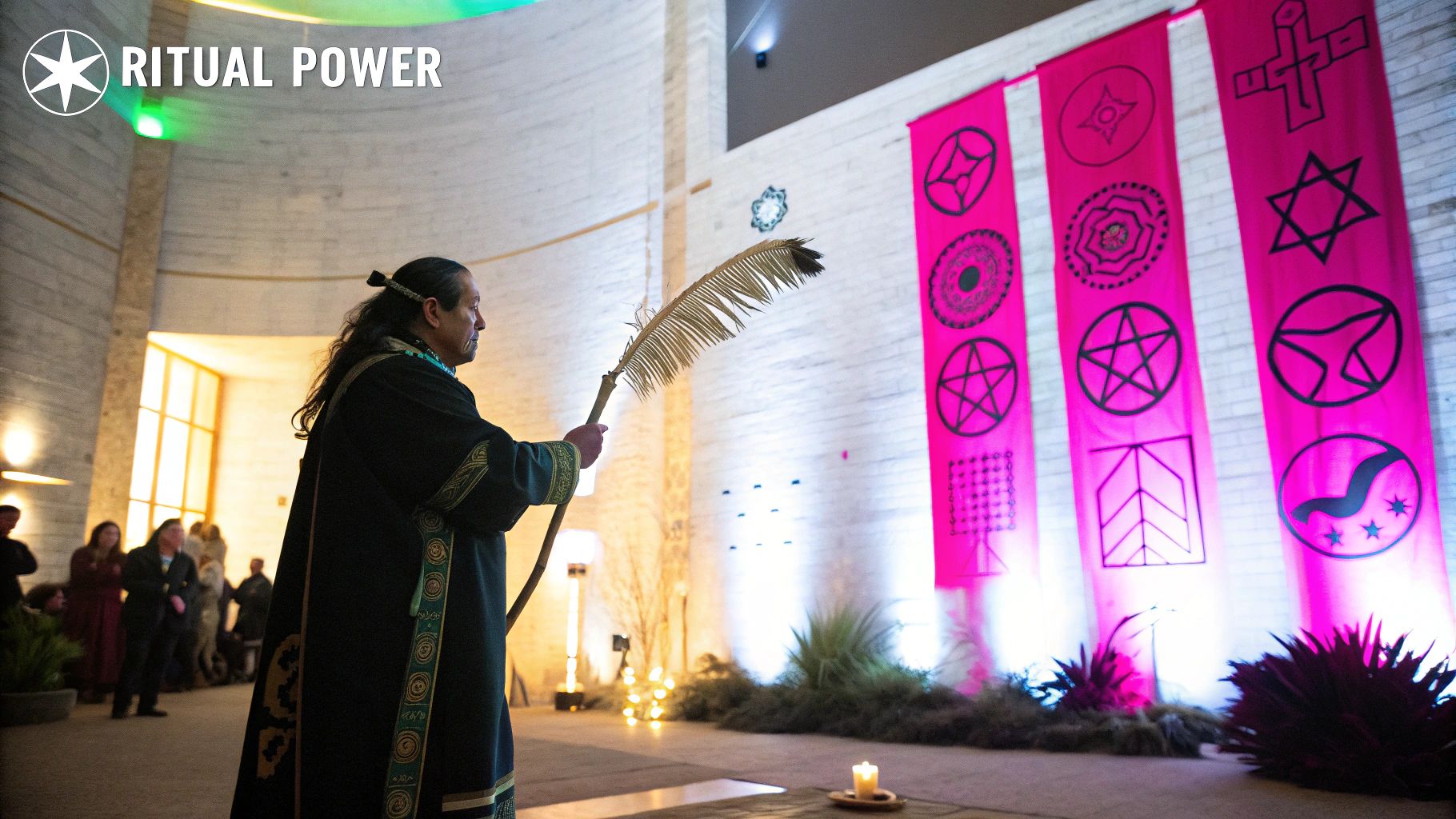
While the core idea of journeying into spirit realms for wisdom is a common thread, shamanism isn't one single religion. It’s more like a spiritual framework that has sprung up in countless indigenous cultures all over the world, from the frozen steppes of Siberia to the humid depths of the Amazon rainforest. Each tradition is a unique reflection of its own environment, its myths, and its history.
Think of it like water. Water is still water, but it takes the shape of whatever vessel holds it. The Siberian shaman’s path is carved by the vast, harsh tundra and the spirits of the reindeer they depend on. Meanwhile, an Amazonian shaman’s practice is woven into the jungle's overwhelming biodiversity and the powerful lessons taught by its sacred plants.
Their art naturally follows suit. A Siberian shaman’s drum might be painted with abstract symbols that serve as cosmic maps or guides for ancestral migrations. In stark contrast, an Amazonian shaman’s healing cloth might explode with vibrant, geometric patterns that depict visions from sacred plant journeys, teeming with spirit animals like jaguars and anacondas.
Adapting to Place and Time
Shamanic art and practices are living traditions, deeply shaped by the land and its people. This remarkable adaptability is the key to their survival and continued relevance.
-
Siberia and Northern Asia: Often considered the very birthplace of the word "shaman," these traditions place a heavy emphasis on ancestral lines and the connection between the sky and the underworld. A common motif in their art, found on drums and ritual clothing, is the "world tree" or "world pole"—a symbolic ladder connecting the different cosmic realms.
-
The Americas: Shamanic practices across the Americas, from the Inuit in the far north to the Mapuche in the south, are incredibly diverse. A great many of these traditions focus on animal spirits as powerful guides and allies. Their art ranges from the intricate, temporary sand paintings of the Navajo, created for specific healing ceremonies, to the monumental totem poles of the Pacific Northwest, which chronicle clan histories and profound spiritual encounters.
-
The Amazon Basin: Down here, shamanism is inseparable from "plant medicine." Shamans, often called curanderos or ayahuasqueros, form deep relationships with specific plants to enter visionary states for community healing. The art that emerges, like the intricate geometric patterns of the Shipibo-Conibo people, is seen as a physical manifestation of these healing energies—a song made visible.
Across all these cultures, understanding the specific rituals, like the use of sacred herbs for smudging, gives us a much deeper appreciation for the traditions themselves.
Shamanism is a living library of human spiritual experience. Each cultural expression is a unique volume, containing priceless knowledge about healing, consciousness, and humanity's relationship with the natural world. Losing even one is like losing a part of ourselves.
Facing Modern Threats
Despite their deep roots and incredible resilience, many of these traditions are now facing serious threats to their very existence. These aren't just relics of the past; they are active spiritual systems under immense pressure from the outside world.
Globally, shamanism has experienced both decline and transformation. Anthropologists have noted that the traditional roles of shamans in many communities have faded since the early 20th century, often due to external pressures like modernization, missionary work, and sweeping political changes. To get a clearer picture of this complex history, you can explore more about shamanism’s global status and the forces that have shaped its journey.
The biggest threats really boil down to two things:
-
Cultural Assimilation: For centuries, colonialism, religious persecution, and damaging government policies have actively worked to suppress indigenous beliefs. Children were often forced into schools where they were forbidden to speak their native languages or practice their spirituality, breaking the vital chain of knowledge passed from one generation to the next.
-
Environmental Destruction: Shamanism is fundamentally earth-based. When the Amazon is cleared for cattle ranches, a local shaman loses their entire pharmacy. When a river is polluted by mining, a water spirit is harmed. The destruction of sacred sites and entire ecosystems directly attacks the connection between the people and the spiritual forces they’ve communed with for millennia.
Yet, even in the face of these challenges, there is an incredible story of resilience. Many indigenous communities are fighting back, working to reclaim their heritage, revitalize their languages, and protect their ancestral lands. The enduring bond between art and shamanism is a crucial part of this fight. For many, creating art has become a powerful act of cultural preservation and spiritual resistance, a way to ensure this ancient wisdom continues to find its voice in our changing world.
Modern Artists Tapping into Shamanic Wisdom
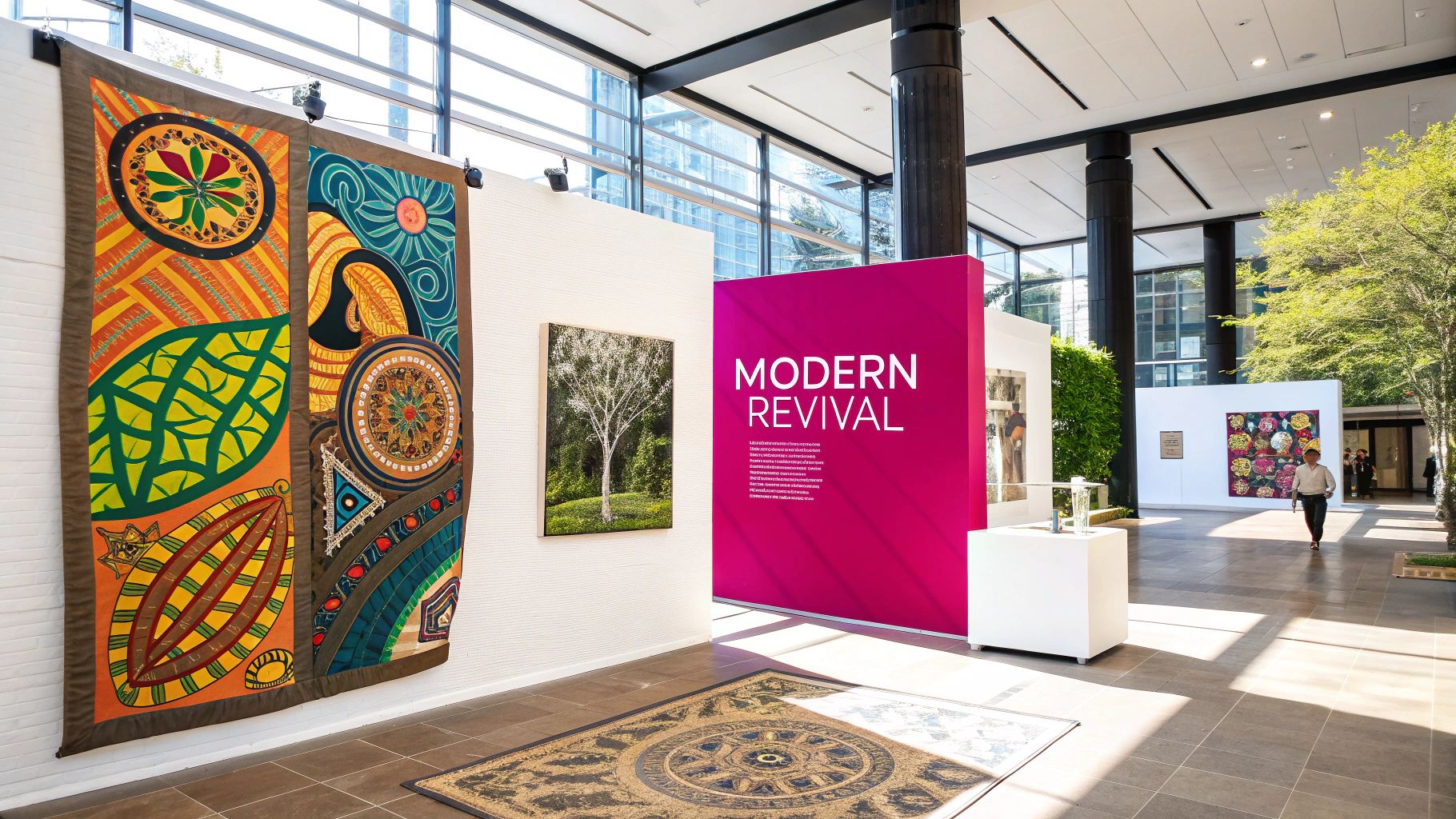
The ancient river of shamanism, with its deep currents of healing and visionary insight, didn't just dry up. It continues to flow, finding new channels in the most unexpected places—including the studios of contemporary artists. These creators feel a powerful pull toward this ancient knowledge, translating its core principles into a visual language that speaks to our modern world.
This isn't about simply copying old symbols or mimicking tribal rituals. Far from it. Instead, these artists are plugging into the very source of the shamanic path: the journey inward, a profound connection to nature, and the dance between the physical world and the spirit realm. This modern interpretation of art and shamanism is all about personal exploration, not historical documentation.
Channeling the Inner World
For many of these artists, the studio has become its own kind of sacred space. It’s a place for quiet introspection, for connecting with that deeper, subconscious part of themselves. In a way, they engage in their own rituals of creation, much like a shaman preparing for a journey. The art that emerges becomes a map of their own inner landscapes, charting emotional territories and unseen energies.
You can see this beautifully in the work of abstract mixed-media artist Wiktoria Florek. Her large-scale canvases are more than just paintings; they feel like energetic portals. She builds up layers of acrylics, inks, natural pigments, and shimmering gold leaf to create these incredibly visceral, textured surfaces that seem to pulse with life. Her process is completely intuitive, a raw translation of emotion and subconscious thought into physical form.
Florek’s art taps right into the shamanic idea that an object can hold a spirit or an energy. Her work invites you to do more than just look—it asks you to feel and connect with something deeper inside yourself. It’s like she’s bringing back a piece of wisdom from an unseen world, which is exactly what a shaman aims to do. You can see these powerful pieces for yourself by exploring her original art.
Appreciation Versus Appropriation
This rising interest naturally brings up a critical conversation: where do we draw the line between respectful appreciation and harmful cultural appropriation? It's a tricky but vital question. Genuine appreciation means honoring the deep spiritual roots of these traditions without claiming them as your own or, worse, watering them down into a fleeting aesthetic.
It’s about connecting with the universal themes of shamanism—healing, transformation, the wisdom of nature—rather than lifting sacred symbols from a culture you don't belong to.
- Honoring the Source: Appreciation starts with learning. It means understanding the history and meaning behind these practices and giving credit to the indigenous cultures that have protected them for thousands of years.
- Focusing on Universal Themes: An artist can explore concepts like visionary states or our connection to the wild without co-opting specific religious iconography they have no cultural right to use.
- Avoiding Commercialization: The real danger of appropriation is when sacred traditions get turned into a product, stripped of their spiritual weight and sold for profit.
The most authentic contemporary art inspired by shamanism doesn't imitate; it integrates. It translates the timeless principles of connection, healing, and inner vision into a personal artistic language that speaks to our modern lives.
This renewed engagement isn't a niche interest; it's gaining real traction. In the contemporary art world, shamanism is increasingly viewed as a vital framework for creativity. This trend reflects a broader cultural hunger for indigenous knowledge and different ways of seeing the world.
Ultimately, the powerful, primal link between art and shamanism is being reawakened right before our eyes. Modern artists are reminding us that the shaman’s path—the quest for vision, healing, and a deeper connection to the cosmos—isn't some dusty relic of the past. It's a living, breathing source of inspiration, offering profound wisdom for anyone willing to listen.
Common Questions About Art and Shamanism
The deeper you dive into the world of art and shamanism, the more questions seem to pop up. It’s a rich, complex field, and it’s natural to feel curious. I’ve found that a few key questions come up time and time again, so I’ve gathered them here to offer some clear, straightforward answers.
My goal is to clear up some of the confusion and build on the ideas we've already touched on. Think of this as a solid foundation for your own exploration, helping you connect the dots from the difference between shamanic and religious art to the ethics of spiritual inspiration.
What Is the Difference Between Shamanic and Religious Art?
This is a fantastic question because, at first glance, the two can look incredibly similar. The real difference lies in their purpose.
Religious art usually illustrates the established stories, figures, and beliefs of an organized faith. It’s there to reinforce a known mythology—think of paintings of saints, carvings of creation stories, or symbols representing a deity. Its role is often devotional or educational, reminding a community of its shared beliefs.
Shamanic art, on the other hand, is born from a much more personal and direct experience. It isn't about illustrating a story everyone already knows; it's about bringing back a vision from a non-ordinary state of consciousness. It's a map of an unseen world, a record of a healing journey, or a direct channel for a specific spirit.
While religious art reinforces a collective belief, shamanic art is often a primary source of new spiritual insight. It’s the raw data from a visionary experience, made tangible for the community.
Are Sacred Plants Always Part of Shamanic Practice?
The use of psychoactive plants like ayahuasca, peyote, or psilocybin mushrooms is probably one of the most famous aspects of shamanism, but it's by no means universal. Many of the world’s most powerful shamanic traditions don't use them at all.
So, how do they get there? They use other incredibly potent techniques to shift consciousness:
- Hypnotic Drumming and Chanting: The steady, driving rhythm of a drum can powerfully alter brainwave patterns, guiding the shaman into a trance state without any substances.
- Intense Dancing and Physical Exhaustion: Many traditions use ecstatic dance, sometimes for hours or even days, to push the body and mind beyond their ordinary limits.
- Fasting and Sensory Deprivation: By limiting food, water, or sensory input (like in a dark, silent cave), a practitioner can naturally open the doors to visionary states.
The choice of method is deeply tied to a tradition’s specific ecosystem and culture. Sacred plants are central to many Amazonian practices, for example, but they are far less common in the traditions of Siberia or the Arctic, where drumming and chanting have always been the primary tools.
Is It Okay for a Non-Indigenous Person to Create Shamanic-Inspired Art?
This is a crucial and sensitive topic, hitting right at the line between appreciation and appropriation. The short answer is: it all comes down to the approach.
Simply lifting sacred symbols from a specific indigenous culture without understanding, permission, or connection is widely seen as harmful appropriation. It strips those symbols of their profound spiritual context and flattens them into a decorative aesthetic.
However, a modern artist can absolutely explore the universal themes of shamanism in a respectful way. Core concepts like connecting with nature, exploring inner worlds, healing, and transformation are part of our shared human experience. Artists like Wiktoria Florek tap into this by using their creative process as a personal, intuitive journey. To get a better sense of her approach, you can find more insight by reading through her Studio Talks.
Authenticity is everything. The most respectful path for an artist is to create from their own genuine experiences, rather than borrowing the sacred visual language of a culture they don't belong to.
Is All Shamanic Art "Primitive" or "Tribal"?
Honestly, these terms are outdated and often loaded with colonial baggage. Words like "primitive" or "tribal" can suggest that this art is somehow less sophisticated than Western art, which couldn't be further from the truth.
Shamanic art systems are incredibly complex. They have their own rich visual languages, symbolic rules, and aesthetic principles that have been developed and refined over thousands of years.
What's more, the spirit of art and shamanism is thriving in contemporary art. Modern artists are using new materials and abstract styles to explore these ancient concepts, proving that this is not just a relic of the past but a living, evolving source of inspiration. The focus has simply shifted from documenting a community’s cosmology to mapping an individual’s inner, psychological landscape.
At Wiktoria Florek, this spirit of the inner journey is at the heart of every creation. Her abstract mixed-media works are more than just paintings; they are energetic portals born from an intuitive and deeply personal process. If you're looking to bring art with profound meaning and presence into your life, we invite you to explore Wiktoria's collection.