
Beyond color and form, the true emotional weight of abstract art often lies in its surface. A compelling abstract painting texture invites touch, plays with light, and tells a story that transcends the purely visual. It is the critical element that transforms a flat image into a living, breathing object that commands a room. For artists who build monumental canvases with layered, energetic surfaces, texture is a language in itself, a direct channel for raw emotion that invites viewers into a deeper conversation.
This guide moves beyond generic advice to deliver six powerful, actionable techniques for manipulating your canvas. We will explore specific methods for creating dynamic abstract painting texture, from the sculptural peaks of impasto to the scratched-in history of sgraffito. You will learn the exact steps, pro-tips, and real-world applications needed to build tactile, engaging surfaces. Each technique offers a unique way to add physical depth and narrative power to your work. Whether your goal is to create bold, physical statements or subtle, layered veils of color, mastering these textures will unlock a new and profound dimension in your abstract painting practice, turning your canvases into memorable experiences.
1. Impasto Texture
Impasto is a classic yet powerful technique where paint is applied thickly to a surface, creating a pronounced, three-dimensional effect. Unlike flat applications, the paint literally stands proud of the canvas, resulting in a surface rich with peaks, valleys, and ridges. This method gives an abstract painting texture that is not just seen but also felt, inviting light to interact with the surface in dynamic ways.
The beauty of impasto lies in its ability to record the artist's physical gestures. Every stroke of the palette knife or bristle of the brush is preserved in the dried paint, creating a tangible history of the creative process. Artists like Frank Auerbach and Willem de Kooning masterfully used this technique to convey raw emotion and energy, transforming the paint into a sculptural medium.
How to Implement Impasto
To effectively use impasto, it's crucial to select the right materials. Heavy body acrylics or oil paints are ideal as they hold their shape well. You can also mix in a gel or paste medium to increase the paint's body without altering its color, allowing you to build substantial layers.
- Start with a Solid Foundation: Work on a rigid surface like a wood panel or a well-primed, tightly stretched canvas to support the weight of the thick paint.
- Experiment with Tools: Don't limit yourself to brushes. Palette knives, trowels, and even credit cards can create unique, sharp-edged marks and smooth planes.
- Build Layers Thoughtfully: Apply paint in layers, allowing some drying time in between to prevent the colors from becoming muddy. This also helps avoid cracking as the thick paint cures.
The following infographic highlights the core principles of the impasto technique for quick reference.
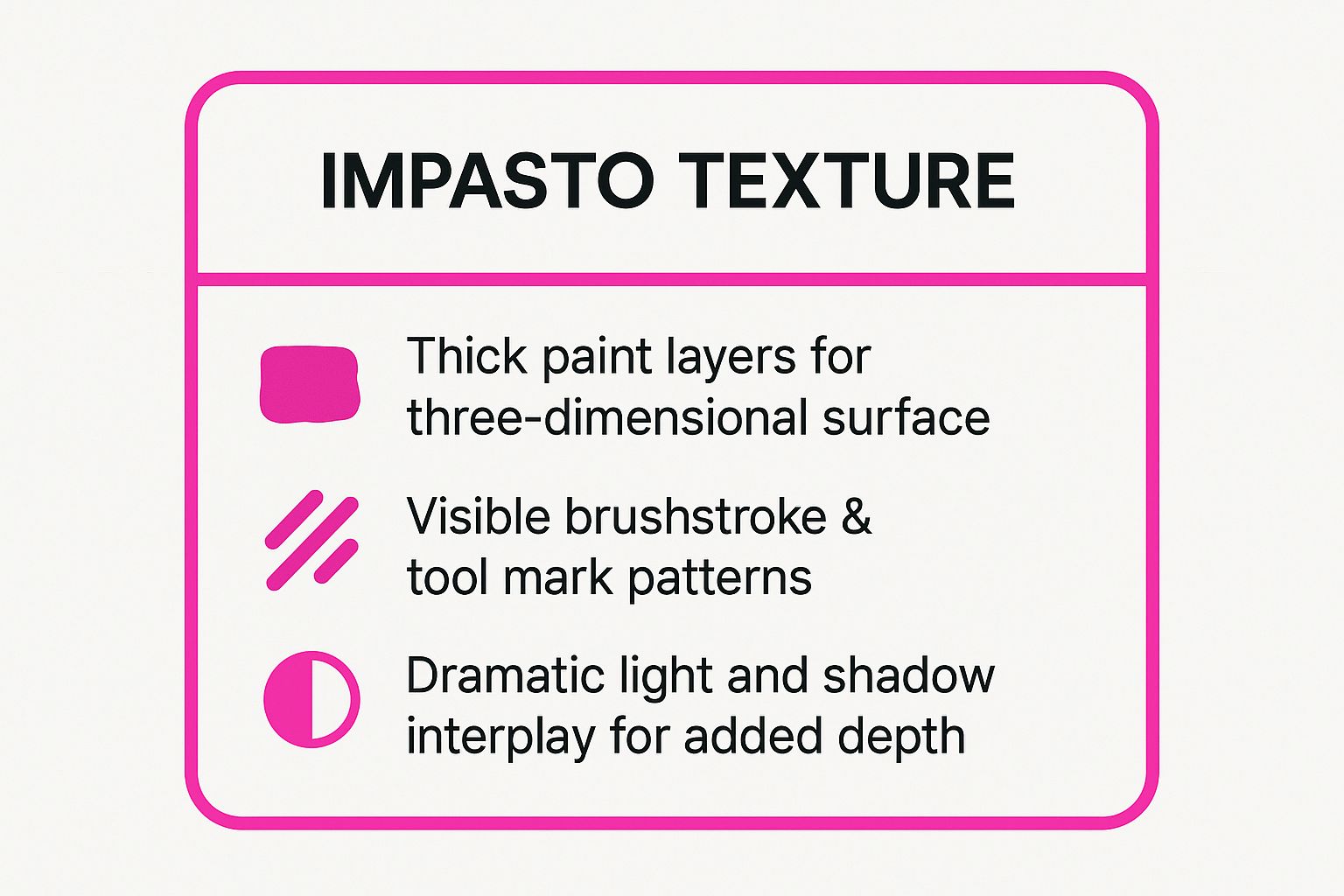
These three elements work together to transform a flat painting into a sculptural, expressive object that commands attention. Understanding how to control these aspects is key to mastering this powerful texture. This technique fundamentally changes how a viewer interacts with a piece, adding a layer of complexity that is central to appreciating non-representational art. For those looking to delve deeper into this concept, you can explore more insights on how to understand abstract art. By adding such a physical dimension, impasto creates a unique dialogue between the artwork, its environment, and the observer.
2. Sgraffito Texture
Sgraffito is a subtractive technique where an artist applies a layer of wet paint over a dry, contrasting layer and then scratches or etches into the top layer to reveal the color underneath. This process creates intricate lines, patterns, and gestural marks. The term, derived from the Italian word sgraffire ("to scratch"), results in an abstract painting texture that adds depth, history, and a delicate sense of excavation to the canvas.
The power of sgraffito lies in its directness and precision. Unlike additive techniques, it is an act of revealing what lies beneath, creating a visual dialogue between surface and depth. The resulting lines can be raw and spontaneous or controlled and deliberate, recording the artist's movements with graphic clarity. Artists like Cy Twombly used this technique to infuse his canvases with calligraphic, almost frantic energy, while Jean Dubuffet employed it to create the gritty, primal surfaces characteristic of his Art Brut works.
How to Implement Sgraffito
To successfully apply the sgraffito technique, timing and the choice of tools are paramount. The top layer of paint must be wet enough to scratch through easily but not so fluid that it flows back into the incised lines. Acrylics are well-suited for this, as their drying time can be managed with retarders.
- Plan Your Layers: Use high-contrast colors for your base and top layers to make the scratched design pop. A dark color over a light one, or vice versa, creates a dramatic visual impact.
- Select Your Tools: The tool you choose will define the character of your lines. Use palette knives or the ends of brushes for bold scrapes, while styluses, needles, or even combs can produce finer, more detailed patterns.
- Work with Confidence and Speed: Since you must work while the top layer is wet, hesitation can lead to muddy results. Practice on a test surface to get a feel for the timing and pressure required before moving to your final canvas.
The following infographic illustrates the fundamental principles of the sgraffito technique for quick reference.
These core components work in concert to create a composition defined by its excavated marks and layered history. Mastering the interplay between color, timing, and tooling is essential for unlocking the expressive potential of this technique. Sgraffito invites the viewer to look closer, to decipher the marks left behind, and to appreciate the texture that emerges from revealing hidden layers. This approach is fundamental for artists seeking to add a graphic, linear quality to their abstract works. By scratching the surface, sgraffito adds a compelling narrative of creation and discovery.
3. Dry Brush Texture
The dry brush technique is an evocative method where a brush loaded with very little paint is dragged across a surface. This creates a broken, scratchy texture that reveals the underlying colors and canvas texture, resulting in a distinctly raw and weathered effect. This approach to abstract painting texture adds a sense of history and fragility, producing irregular marks that feel both intentional and spontaneous.
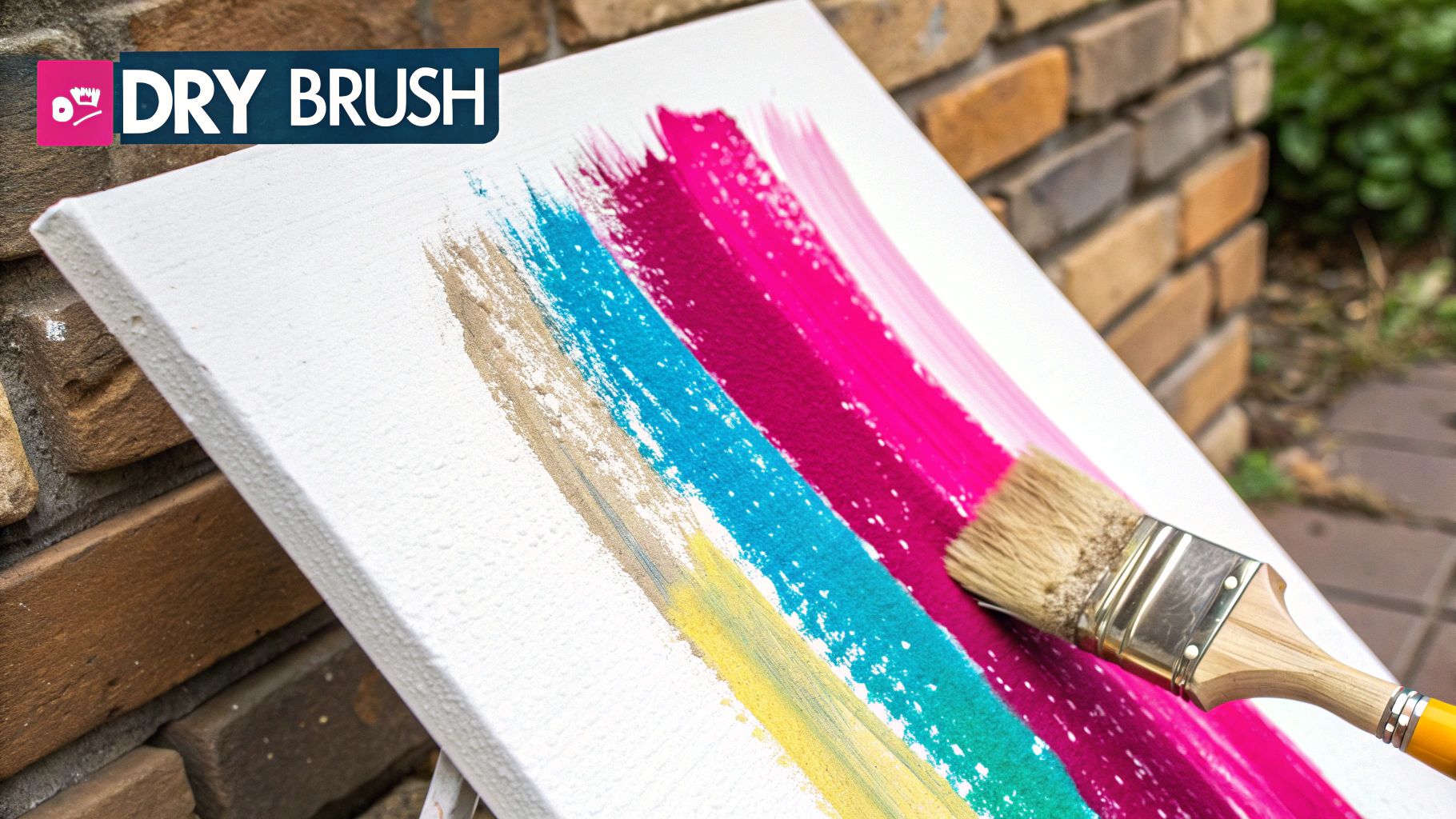
The power of the dry brush technique lies in its subtlety and control. It’s less about bold application and more about nuanced layering and texture. Artists like Andrew Wyeth used it to create incredible detail in his landscapes, while Gerhard Richter has incorporated similar scuffing and scraping effects into his monumental abstracts. The technique echoes the principles found in Chinese ink wash painting, where a semi-dry brush creates expressive, "flying white" strokes that convey movement and spirit.
How to Implement Dry Brush
To achieve an effective dry brush texture, precision and patience are key. The goal is to apply just enough paint to catch the raised tooth of the canvas or the ridges of previous paint layers, leaving the crevices untouched. This contrast is what gives the technique its signature look.
- Prepare Your Brush: Load your brush with paint, then wipe most of it off on a paper towel or palette until only a small amount remains on the bristles.
- Choose the Right Tool: Stiff-bristled brushes, like hog hair for oils or firm synthetics for acrylics, work best. They provide the resistance needed to create sharp, textural marks.
- Vary Your Pressure: Use a light touch for delicate, whisper-thin lines and more pressure for bolder, more broken-up patches. Experiment with the angle of the brush to change the effect.
- Layer Delicately: Build up the texture in multiple light layers rather than trying to achieve the effect in one go. This adds depth and prevents the application from looking heavy-handed.
This method is invaluable for adding a final layer of complexity or for creating a weathered, aged aesthetic. By allowing glimpses of the history beneath, dry brushing creates a visual dialogue between the different stages of the painting process. It transforms a simple surface into a rich tapestry of marks, whispers, and echoes, enhancing the overall abstract painting texture with a sense of refined grittiness. For those interested in seeing how texture can define an entire artistic style, exploring the works of artists who master this technique can be highly insightful. You can discover more about how such textures contribute to an artist's unique voice on platforms like Wiktoria Florek's artist portfolio.
4. Palette Knife Texture
Palette knife texture is a technique that involves applying and manipulating paint with a flexible metal blade instead of a traditional brush. This method creates a distinct surface quality characterized by sharp edges, smooth planes, and clean layers of color. The result is a bold, contemporary abstract painting texture that feels both deliberate and spontaneous, perfect for artists aiming for a clean, modern aesthetic.
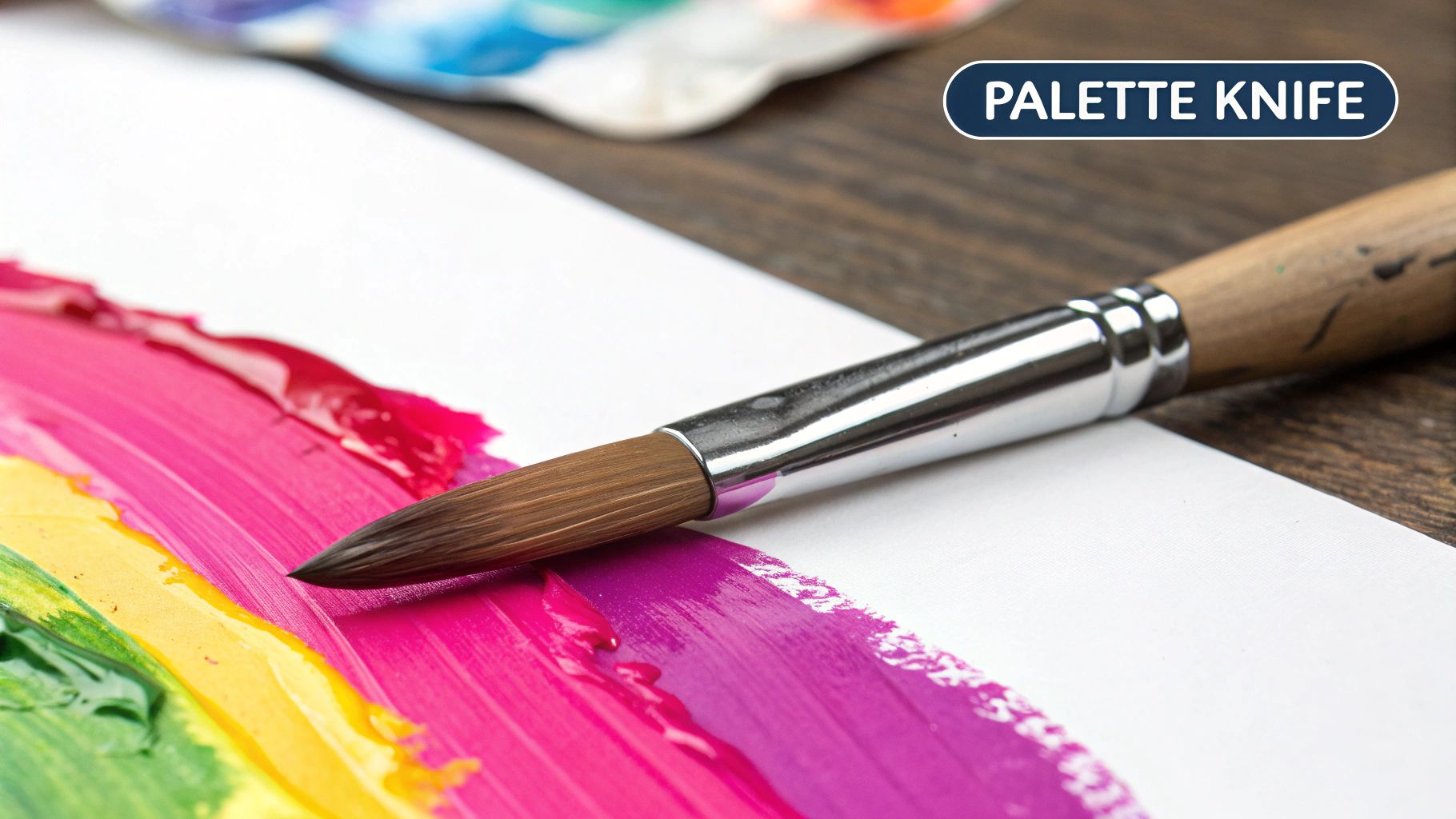
Unlike brushes, which can blend colors softly, a palette knife allows for the precise placement of opaque color blocks, creating a faceted, almost sculptural effect. It’s a technique famously explored by Gerhard Richter with his squeegee paintings, which drag large swathes of color across the canvas, and by contemporary artists like Peter Halley in his geometric abstractions. The crispness of the lines and the flatness of the applied fields of paint give these works a powerful graphic quality.
How to Implement Palette Knife Texture
To achieve a professional finish with a palette knife, control and cleanliness are key. The type of knife you choose and how you handle it will directly influence the final texture, from smooth gradients to broken, rugged surfaces.
- Select the Right Tool: Use flexible, high-quality metal palette knives. Different shapes and sizes produce different effects; long, straight-edged knives are great for broad strokes, while smaller, pointed knives offer precision.
- Maintain Color Purity: Clean the knife blade frequently between applications, especially when working with different colors. This prevents muddying and ensures each color block is vibrant and pure.
- Experiment with Pressure and Angle: Vary the pressure and angle of the knife to create a range of textures. Light pressure will skim paint across the surface, while firm pressure can carve into wet layers or create thick, flat shapes.
- Work Wet-into-Wet: For smooth blending and seamless gradients, apply colors next to each other while they are still wet and gently drag the knife across their boundary.
This technique is fundamental for artists who want to build compositions with clean, distinct color fields and sharp, architectural lines. By focusing on the direct application of pigment, the palette knife brings a unique clarity and structure to the canvas. Exploring how to use color with this directness is a key skill, and you can delve into how I use color in my art for more insights. Using a palette knife transforms painting from a process of gradual blending into one of decisive, impactful gestures.
5. Collage and Mixed Media Texture
Collage and mixed media introduce an entirely different dimension to abstract painting texture by incorporating materials beyond traditional paint. This technique involves adhering found objects, papers, fabrics, photographs, and other elements directly onto the canvas, creating a physically and conceptually layered surface. The resulting work transcends a simple painting, becoming a hybrid object that blurs the lines between two and three dimensions.
This method allows artists to build narratives and associations through the materials themselves. A piece of newspaper can ground an artwork in a specific time and place, while a fragment of fabric can evoke personal memory or tactile sensation. Pioneers like Kurt Schwitters with his "Merz" pictures and Robert Rauschenberg with his "Combines" demonstrated how assembling disparate materials could generate powerful new meanings. This approach transforms the abstract painting texture into a rich tapestry of surfaces, histories, and ideas.
How to Implement Collage and Mixed Media
Success with mixed media hinges on thoughtful integration and archival stability. The goal is to create a cohesive composition where the added elements feel intentional, not just stuck on. Using the right adhesives and protective finishes is critical to ensure the artwork lasts.
- Plan Your Composition: Before permanently attaching anything, arrange your materials on the surface. Move them around to find a balanced and dynamic composition, considering how textures, colors, and shapes interact.
- Use Archival Adhesives: Select high-quality, acid-free glues or gels designed for archival purposes, such as PVA glue or acrylic mediums. This prevents materials from yellowing or deteriorating over time and ensures a strong, lasting bond.
- Integrate Materials Seamlessly: Paint over, under, and around your collaged elements to unify them with the painted surface. This helps the added materials feel like an integral part of the artwork rather than an afterthought.
- Protect the Final Surface: Once complete, apply a UV-protective varnish or sealant over the entire piece. This not only protects the paint but also shields fragile materials like paper from light damage and environmental factors.
By weaving together different materials, you can create works with profound depth and personal resonance. This technique is especially powerful for conveying complex themes, as seen in many contemporary works. For an inspiring example of how diverse elements can communicate a unified narrative, you can explore insights from the Motherhood WFA abstract collection. The use of mixed media adds a tactile reality that invites viewers to look closer and uncover the stories embedded within the layers.
6. Glazing and Transparent Layers
Glazing involves applying thin, transparent layers of paint over previously dried layers, creating a luminous, atmospheric texture with incredible depth. Unlike opaque techniques that cover what's underneath, glazing allows light to pass through the transparent film, reflect off the lower layers, and bounce back to the viewer's eye. This process results in an abstract painting texture that is ethereal and glowing, building complex color relationships that shift with the light.
The power of glazing lies in its subtlety and its ability to create a sense of history within the painting. Each transparent layer adds to the overall visual story, contributing to a final surface that is rich and sophisticated without being physically heavy. Artists like Mark Rothko used this technique to produce his iconic, shimmering color fields that seem to float and breathe, drawing the viewer into a meditative state. Similarly, Helen Frankenthaler’s stain paintings employed a variation of this layering to achieve a watercolor-like luminosity with acrylics.
How to Implement Glazing
To successfully create depth with glazing, your choice of materials and your patience are paramount. The technique relies on the transparency of your pigments and the complete drying of each successive layer.
- Select Transparent Pigments: Use paints labeled as "transparent" or "semi-transparent." Opaque pigments will create a muddy effect. You can check the tube or manufacturer's website for this information.
- Use a Glazing Medium: Mix your paint with a glazing medium (for oil or acrylics). This thins the paint's consistency, increases its transparency and flow, and controls drying time without compromising the paint's integrity.
- Allow for Complete Drying: This is non-negotiable. Applying a new layer before the one beneath it is fully cured will lift the underpainting and ruin the effect. This is especially crucial with oil paints, which can take days to dry.
- Build Layers Gradually: Start with your lighter values and build toward darker ones. Apply the glaze with a soft brush to avoid leaving strong marks, allowing the color itself to be the focus.
This method transforms the canvas into a field of light and color, offering a deep, immersive experience. The resulting abstract painting texture is not one you can feel with your hands, but one you perceive through its deep, optical resonance. By mastering glazing, an artist can control mood and atmosphere with unparalleled nuance, making it a cornerstone technique for creating sophisticated and emotionally resonant abstract works.
Texture Techniques Comparison of 6 Abstract Painting Styles
| Texture Technique | Implementation Complexity 🔄 | Resource Requirements ⚡ | Expected Outcomes 📊 | Ideal Use Cases 💡 | Key Advantages ⭐ |
|---|---|---|---|---|---|
| Impasto Texture | High – layering and thick application with drying time risks | High – large amounts of paint needed, quality oils/acrylics | Strong 3D surface, dramatic light & shadow interplay | Expressive, textured, sculptural paintings; artists seeking depth | Dynamic depth, tactile quality, expressive gestural marks |
| Sgraffito Texture | Medium – requires precise timing scratching wet layers | Medium – basic tools (palette knives, stylus), time-sensitive | Linear, layered patterns revealing underlying colors | Abstract compositions needing linear detail and contrast | Unique linear textures, precise control of reveals |
| Dry Brush Texture | Low to Medium – brush control critical, layering encouraged | Low – minimal paint, quality stiff brushes preferred | Broken, rough, organic textures allowing underlayers to show | Weathered, atmospheric, natural surface effects | Natural textures, subtle color mixing, atmospheric effects |
| Palette Knife Texture | Medium to High – skill required for control and effects | Medium – palette knives and related tools | Smooth blends, sharp clean edges, unique textural spread | Clean, modern abstract works with sharp edges and blends | Sharp edges, quick coverage, color blending control |
| Collage & Mixed Media Texture | High – combining diverse materials requires planning | High – various materials, adhesives, possible conservation needs | Complex layered textures with physical and conceptual depth | Experimental, conceptual, layered artworks | Creative flexibility, unique textures, conceptual richness |
| Glazing & Transparent Layers | High – slow layering with drying times, pigment knowledge | Medium – transparent pigments and glazing mediums | Luminous, atmospheric depth with subtle color interplay | Sophisticated color field, atmospheric and ethereal works | Luminous depth, subtle color shifts, professional finish |
From Technique to Transformation: Weaving Your Textural Story
We've journeyed through six distinct yet interconnected worlds of abstract painting texture. From the bold, sculptural presence of impasto to the delicate, excavated lines of sgraffito, each technique offers a unique way to build a narrative on the canvas. You've seen how the raw, skipping energy of the dry brush contrasts with the decisive, sculpted planes created by a palette knife.
This exploration reveals a fundamental truth: mastering texture is not about learning isolated tricks. It is about developing an intuitive, tactile vocabulary. The true magic happens in the synthesis, where these methods begin to speak to one another. Imagine a surface where a smooth, luminous glaze partially veils a raw, gritty mixed-media element, or where sgraffito lines cut through thick palette knife marks to reveal a hidden color beneath. This is the alchemy that moves a painting from a flat object to a dynamic, multi-sensory experience.
Weaving Your Narrative with Abstract Painting Texture
The ultimate goal is to make the surface of your painting as meaningful as the concept behind it. Each textural choice contributes to the overall emotional weight and energetic frequency of the work.
- For Boldness and Presence: Use thick impasto and decisive palette knife work to create pieces that command a room and assert their physical presence.
- For Subtlety and History: Employ glazing and sgraffito to build layers of history, suggesting that something profound lies just beneath the surface.
- For Raw Energy: Leverage dry brushing and collage to introduce an element of controlled chaos, capturing a feeling of movement, spontaneity, and authenticity.
Key Takeaway: Abstract painting texture is a language. The techniques are your words, but the way you combine them creates your unique poetry. The richness of your art will come from the dialogue you create between these different surface treatments.
Your Path Forward: From Practice to Play
Your next step is to move beyond mere practice and into a state of intentional play. Don't just replicate these techniques; interrogate them. Ask yourself what happens when you combine the unexpected. What if you laid a delicate glaze over a rough, collaged surface? How would a dry-brushed layer interact with a wet, impasto field?
Start with one technique that truly resonates with your artistic voice. Master its feel, its rhythm, and its limitations. Then, purposefully introduce a second technique as a counterpoint. This deliberate combination is where you will discover your signature style. Allow the materials to guide your hand and listen to the textures as they emerge. This is how you stop simply making a painting and start creating a profound, tactile world for the viewer to explore, turning a visual work into a deeply felt experience.
To see how a master artist combines these very techniques to create powerfully emotive and investment-worthy art, explore the portfolio of Wiktoria Florek Mixed Media Abstract Painter. Her work is a testament to how sophisticated abstract painting texture can transform a canvas into an energetic portal of chaos and clarity. Discover your next acquisition or source of inspiration at her official website: Wiktoria Florek Mixed Media Abstract Painter.