
Writing a good art description is about so much more than listing facts. It's about blending the essential details—like the medium and dimensions—with a story that brings the artwork’s mood and inspiration to life. Think of it as the crucial bridge connecting your art to a potential buyer's heart and mind. The very best descriptions make someone feel something, sparking a curiosity that makes them want to own the piece.
What Makes a Great Art Description?
Before putting pen to paper (or fingers to keyboard), let's get clear on what an art description really is. In a crowded art market, it's a vital sales tool. A great description does far more than state the obvious; it turns a passive glance into an active, emotional experience.
The need for powerful descriptions has grown right alongside the global art market, which hit an estimated US$67.8 billion in sales back in 2022. With powerhouse markets like the United States (45%) and China (17%) leading the charge, your descriptions have to connect with everyone from seasoned collectors to first-time buyers. For more on how the art market is evolving, Stronddo.art offers some great insights.
A well-crafted description pulls its weight by doing three things at once:
- It informs: It gives a potential buyer all the non-negotiable details they need right up front.
- It engages: It pulls the reader in with a story, a mood, or a peek behind the curtain of your creative process.
- It persuades: It gently helps the viewer see the artwork's value and imagine it in their own space.
Think Like a Curator and a Marketer
To write a truly compelling art description, you need to wear two different hats. Your inner curator is all about context, accuracy, and artistic integrity. Your inner marketer focuses on connection, emotion, and making the sale.
The curator in you asks:
- What are the most important technical specs?
- Is there any relevant artistic or historical context?
- How can I be true to the artist's original intent?
Meanwhile, the marketer asks:
- What story will really connect with my audience?
- What feelings does this piece stir up?
- How can I make this artwork feel unique and essential?
The magic happens when you blend these two mindsets. For instance, instead of just stating "oil on canvas," you could bring it to life by describing "thick, impasto layers of oil paint, sculpted with a palette knife to create a dynamic, touchable surface." This satisfies the curator's need for accuracy while igniting the marketer's desire for sensory engagement. To really nail this, you can apply similar techniques used to humanize product descriptions, making sure your story feels genuine and personal.
To help you get the balance right, here’s a quick-reference table breaking down the must-haves versus the nice-to-haves.
Core Components of an Effective Art Description
| Element Type | What to Include | Why It's Important |
|---|---|---|
| The Essentials (Non-Negotiable) | Title, Artist Name, Medium, Dimensions, Year, Price, Availability | Builds trust and provides all the basic information a serious buyer needs to make a decision. |
| The Story (Highly Recommended) | Inspiration, concept behind the piece, what the artist was feeling or thinking. | This is where you create an emotional connection. It transforms the artwork from an object into an experience. |
| The Visuals (Optional but Powerful) | Dominant colors, textures, key subjects, the overall mood. | Helps the viewer "see" the art through your words and highlights details they might otherwise miss. |
Getting these components to work together is the goal.
A truly great art description doesn't just tell people what they are seeing; it helps them understand why they should care. It closes the gap between simply looking at art and truly experiencing it.
This approach is especially vital for abstract art. With abstract pieces, the description is a critical entry point for the viewer. It can offer clues to the emotional world or conceptual ideas that fueled the work. If you find this part tricky, our guide on how to understand abstract art offers some valuable insights on communicating its meaning.
Ultimately, your goal is to write a description that is as thoughtfully crafted as the artwork it represents.
Gathering Your Artwork's Core Details
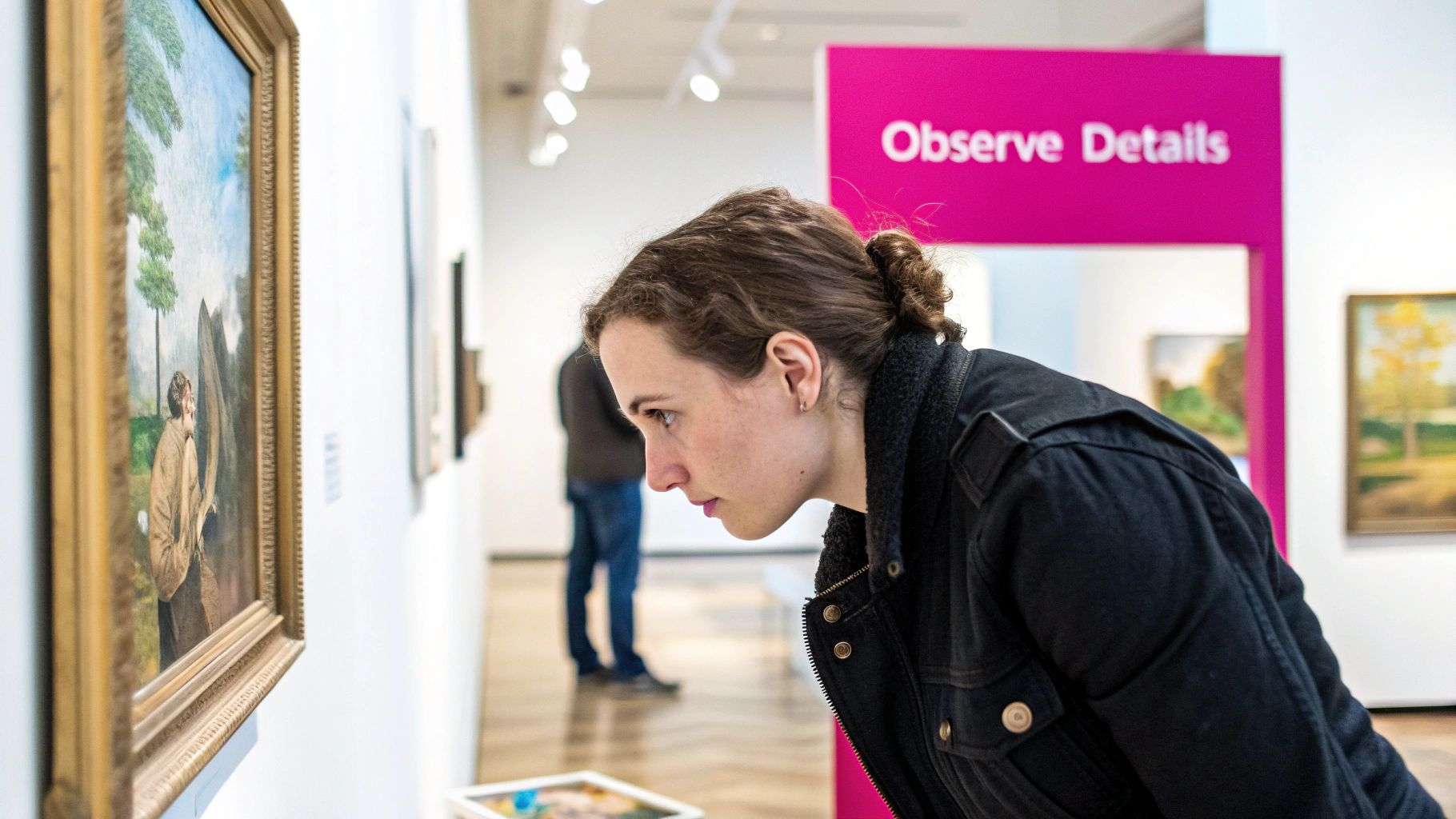
Before you write a single word of your description, you need to put on your detective hat. A truly great art description doesn't just appear out of thin air; it's built from the ground up with solid, authentic details about your work.
Think of it like gathering ingredients before you start cooking. The better your raw materials, the more impressive the final dish will be. I always recommend opening a fresh document for each artwork and just brain-dumping everything you can think of. No filter, no editing—just get it all down.
Documenting the Factual Foundation
First things first, let's get the hard facts out of the way. These are the non-negotiable details that every gallery, collector, and curious fan will want to know. Getting these right from the start is a simple way to build trust and show professionalism.
I use a quick checklist to make sure I don't miss anything:
- Official Title: What is the final, decided-upon name for the piece?
- Completion Date: The year you called it "done."
- Dimensions: Be precise. Height x Width x Depth (e.g., 48" x 36" x 1.5").
- Medium & Materials: Don't just say "mixed media." Get specific. Is it "acrylic and charcoal on raw linen" or "upcycled circuit boards and resin on a wood panel"? The details are fascinating.
- Framing & Presentation: How is it presented? Is it framed, unframed, or have you painted the edges so it's ready to hang?
This list is the skeleton of your description. It provides the essential structure that everything else will hang on.
Uncovering the "Why" Behind the Work
Okay, now for the fun part. We've covered the "what," so it's time to dig into the "why." This is where you find the soul of your artwork and the story that will make someone fall in love with it.
Grab a notebook or that document you started and be brutally honest with yourself. Don't worry about sounding poetic yet. Just answer these questions:
- What was the initial spark of inspiration? A line from a song? A weird dream? The way the light hit a dusty window?
- What puzzle were you trying to figure out with this piece? Maybe you were wrestling with a new color palette or trying to capture a feeling you couldn't put into words.
- How were you feeling when you made it? Joyful, anxious, quiet, chaotic? Your emotional state is baked into the work.
- Is there any symbolism hidden in there? Do specific colors or shapes mean something special to you?
The most engaging part of an art description often comes from the artist's personal context. People connect with stories, and the "why" behind your art is its most powerful story.
For instance, maybe a landscape painting was born from the feeling of peace you felt after a thunderstorm. Jot that down—the memory of the weird, yellow-green light, the smell of damp earth, the quiet that followed the chaos. These are the golden nuggets you’ll use to build a narrative that truly resonates. Learning how to write an art description that sells starts right here, with a deep, honest look at your own creative journey.
How to Structure Your Description So People Actually Read It
Let’s be honest. You can write the most brilliant, insightful description in the world, but if it’s a giant, intimidating block of text, no one will read it. How you arrange your words is just as important as the words themselves.
Think of your description as a guided tour. You're leading your audience from their first glance to a much deeper appreciation for your work. The best way I’ve found to do this is to borrow a simple flow from storytelling: a great opening, the main story, and a memorable ending.
This isn't a rigid formula. It's just a natural path that helps the reader connect with your art without feeling overwhelmed. It makes the experience of learning about what you’ve made feel easy and rewarding.
Start with a Strong Hook
Your first sentence or two has one job: to grab the reader and pull them in. You need to make them want to know more. This is your chance to set a mood, pose a question, or drop a single, fascinating detail that sparks their curiosity.
A great hook never states the obvious. Please, don't start with "This is an acrylic painting." Instead, lead with the feeling or the central idea behind the piece.
Here are a few ways I like to approach this:
- The Emotional Hook: Go straight for the feeling. Example: "A quiet moment of defiance in the middle of the city's chaos."
- The Question Hook: Pose the same question your artwork is wrestling with. Example: "What does it look like when a memory starts to fade?"
- The Sensory Hook: Describe a powerful visual or texture. Example: "Layers of deep indigo are shattered by a single, searing line of gold."
That first sentence is your promise to the reader that what comes next is worth their time. It’s the front door to the world you’ve built.
Build Out the Body of Your Description
Once you have their attention, the body of your description delivers the goods. This is where you’ll weave together all the interesting bits—the visual details, the story behind the piece, and the technical information you’ve gathered.
The body should feel like you’re walking someone through the artwork. Guide their eye from one point to another, pointing out what’s important. Talk about your colors, textures, and shapes, but always tie them back to the artwork’s theme or story. This is also the perfect place to mention any unique materials or techniques you used.
For instance, you could explain how you used a palette knife to build that thick, sculptural texture to get across a feeling of raw energy. Or you might share how a specific wash of ink over a textured surface creates that sense of depth and history.
The biggest mistake I see artists make is just listing facts. Don't do that. Instead, connect the 'what' (the materials, the colors) with the 'why' (the feeling, the idea). This is what turns a boring list into a real story.
Art descriptions have always been crucial for communicating an artwork's value, but what's considered valuable has changed. In 2022, nearly 90% of global art sales were concentrated in just four countries: the US, UK, China, and France. In this massive market, descriptions need to do more than talk about style; they need to provide real context. You can learn more about the trends shaping the global art market from these insights from Spear's.
End with a Lasting Impression
Your closing line should leave a mark. It's your last chance to connect with the reader and drive home the artwork's core message or feeling.
This doesn’t need to be long—in fact, a single, powerful sentence is often best. Your goal is to give the reader something to chew on long after they've looked away.
A strong ending might:
- Revisit the main theme: Circle back to your big idea, but say it in a fresh way.
- Offer a final thought: Leave the reader with a lingering question or a feeling.
- Sum up the mood: Put the emotional heart of the piece into a final, concise statement.
For example, a description that started with a hook about fading memories might end with something like, "Ultimately, the piece is a testament to what remains when all the details are gone." This ties everything together beautifully, creating a satisfying little narrative that leaves a powerful final thought.
Finding the Right Words to Tell Your Story
Once you have your structure down, it's time for the fun part: choosing the words that bring your art to life. The language you select is your paintbrush here. It can make a potential buyer feel like they're standing right in the room with your piece, sensing its texture and energy. We need to move beyond dry, academic language and start telling a sensory story.
Think of yourself as part poet, part journalist. Your job is to be both evocative and precise, painting a picture with words that doesn't just describe the art but enhances it.
This chart shows a great way to balance your description, making sure the most important part—the details—gets the most attention.
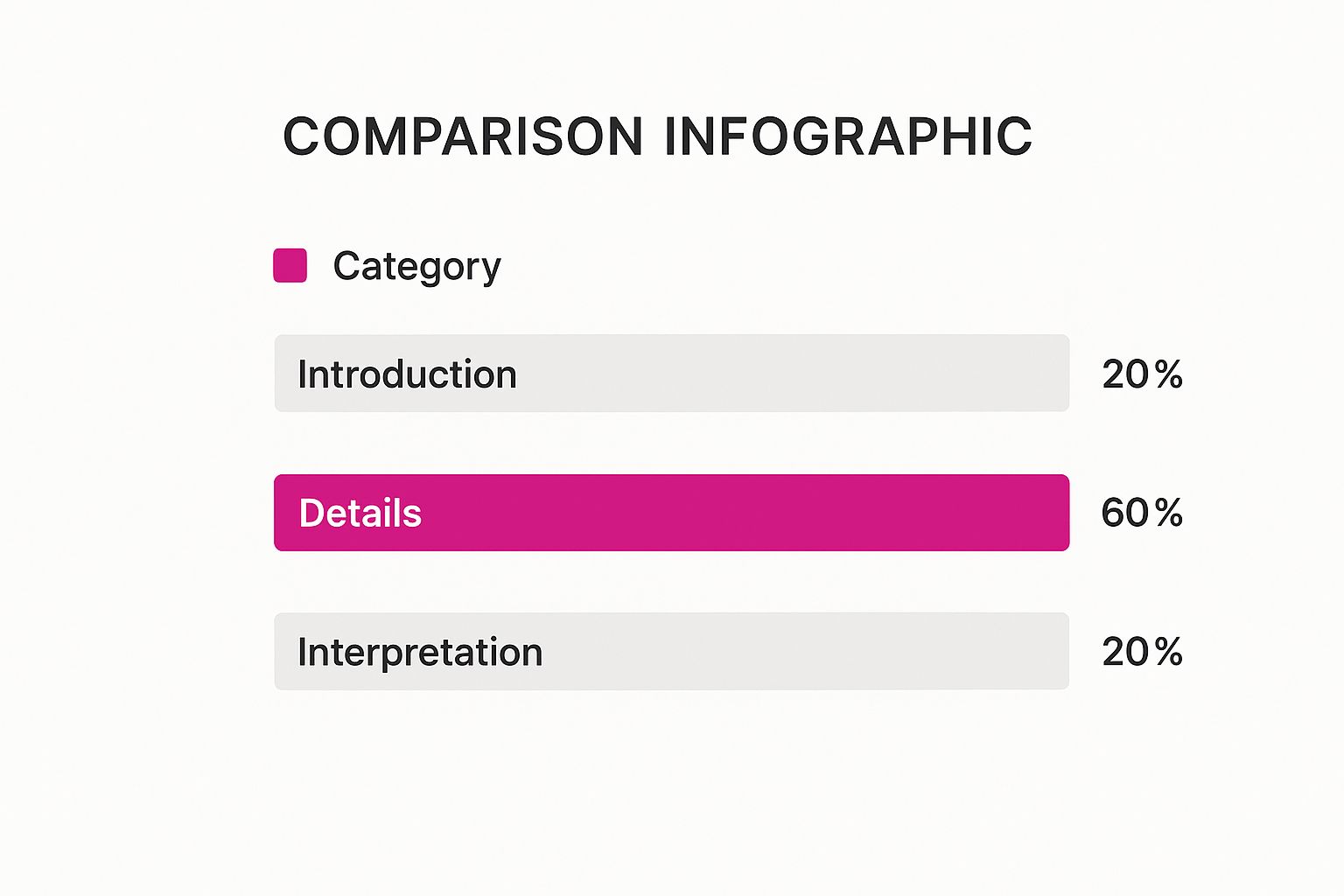
As you can see, the biggest chunk of your effort (60%) should go into those rich, descriptive details. A strong intro and a thoughtful interpretation will frame it perfectly.
Activate the Senses With Your Language
The best art descriptions don't just tell you what you're seeing; they make you feel it. They pull the reader right into the artwork by appealing to their senses, making the piece feel immediate and real.
Your best friend here is the active verb. Passive language creates distance and can feel pretty lifeless. Instead of saying, "The colors were applied," try something like, "Strokes of cobalt slash across the canvas." See the difference? The word "slash" gives you a sense of action and energy that "were applied" just can't match.
Next, get specific with your adjectives. Don't just say "blue." What kind of blue is it? A deep, contemplative indigo? A bright, cheerful turquoise? Or maybe a stormy, moody navy?
- Sight: How does light play on the surface? Is it matte, glossy, or iridescent?
- Touch: Think about texture. Is the surface smooth and velvety, or is it gritty and jagged?
- Emotion: Use words that tap into feelings. Does the piece feel chaotic, serene, defiant, or joyful?
When you layer these sensory details, you build an immersive experience that's far more powerful than a simple visual summary.
Match Your Tone to Your Audience
The words you choose also have to fit the situation. Who are you writing for? The tone you'd use for a formal gallery application is worlds apart from an Instagram caption.
- For Galleries & Curators: Keep it professional and articulate. Focus on the work's concept and technical skill. This shows you know your way around the art world but are still easy to understand.
- For Social Media: Get personal and conversational. This is your chance to share the raw emotion behind a piece or ask your followers a question to get them talking.
- For Your Online Shop: You'll want a mix of both. It needs to be professional and informative, but also persuasive enough to encourage a sale. For a little help with that, you might find some great tips by mastering persuasive writing techniques.
A Quick Tip from Experience: Your authentic voice is your greatest asset. Don't try to sound like an art history textbook if that's not who you are. People connect with real stories from real artists. Write in a way that feels true to you and your work.
Finally, try to avoid clichés and tired art-speak. Words like "ethereal," "juxtaposition," or "dynamic" have been used so much they've lost their punch. Instead of reaching for a generic term, challenge yourself to describe what you actually mean. If a piece is "dynamic," explain how it creates that feeling of movement. That kind of specificity is what will make your description memorable and effective.
Adapting Your Art Description for Any Platform
So you've poured your heart into crafting the perfect, layered art description. That's a huge step. But here’s a reality check I learned the hard way: a one-size-fits-all description simply doesn't work.
How you talk about your art on a formal gallery wall label should feel completely different from an Instagram caption or a product page on your website. Each platform has its own audience and its own unspoken rules. Ignoring this is like wearing a tuxedo to a backyard barbecue—you might look sharp, but you’ll feel out of place and, worse, you won't connect with anyone. To write descriptions that truly resonate, you have to become a bit of a chameleon.
The Gallery Wall vs. The Online Store
Let’s start with two common but very different scenarios. In a physical gallery, your description is a quiet guide. People are standing right in front of the art, experiencing it directly. The label is there to offer a bit of context or a conceptual nudge, not to be a loud salesperson. It needs to be professional and concise.
An online store, on the other hand, is a completely different beast. Your description has to do all the heavy lifting. It must stand in for the real-world experience of seeing texture, scale, and presence. This means leading with the practical stuff—dimensions, materials, framing—and then weaving in a story that makes someone feel confident buying a piece they've never seen in person.
Recent art market trends really drive this point home. After a huge spike in 2021, online-only art sales fell by 17% to $11.0 billion in 2022. While that's still a massive number, it shows people are returning to in-person viewing. This means your online descriptions have to work even harder to be clear, compelling, and bridge that digital divide.
Interestingly, the same UBS report found that galleries with higher representation of female artists saw sales growth up to 21% higher, suggesting that sharing an artist's unique story can be a powerful sales tool.
Social Media: A Storytelling Playground
Platforms like Instagram or Threads are where your personality as an artist can really shine. These spaces are all about connection and conversation, not formal analysis. While an online store description might focus on logistics, a social media post should always focus on the story.
Here are a few ways I adapt my core message for social media:
- Spark a Conversation: Instead of just stating your theme, ask a question. "What does peace look like to you?" is a great way to invite comments on a serene abstract painting.
- Share the 'Behind-the-Scenes' Mess: Did you spill coffee on a canvas and turn it into a happy accident? Share that! People crave authenticity, and it builds a real connection.
- Lean on Video: A short clip showing light glinting off the texture of your work is far more powerful than trying to describe it with words alone.
Thinking about this from a content perspective can be helpful. Reviewing strategies for crafting effective social media posts can give you fresh ideas, as many of the core principles apply to sharing your art online.
Writing tailored descriptions for each platform might feel like a lot of extra work, but it’s a vital part of your professional practice. Each channel has a different goal, whether it’s making a sale, building your reputation, or growing a community.
Key Takeaway: Think of your main art description as a block of marble. For each platform, you'll chip away different parts to reveal the unique sculpture that fits that specific context perfectly.
Adjusting your message is an essential part of your creative business plan, much like we discussed when talking about https://www.wiktoriaflorek.com/studio-talks-7-planning-for-creatives-part-2-goal-setting/. When you speak the right language in the right place, you ensure your art’s story is heard loud and clear, no matter where you share it.
To make this easier, here's a quick cheat sheet for adapting your descriptions on the fly.
Art Description Adaptation Cheat Sheet
| Platform | Recommended Length | Tone of Voice | Primary Focus |
|---|---|---|---|
| Gallery/Exhibition | 50–100 words | Formal, academic, third-person | Concept, technique, and artist's statement. |
| Website/Online Store | 150–300 words | Professional yet inviting, first or third-person | Story, emotion, and practical details (size, media, shipping). |
| Instagram/Threads | 30–150 words | Casual, personal, conversational | Behind-the-scenes stories, questions, and calls-to-action. |
| 50–100 words (in pin) | Descriptive, keyword-rich | Visuals, inspiration, and linking back to a blog or product page. |
This table is a great starting point, but always remember to check the specific norms of the community you're posting in. The more you practice, the more intuitive it will become.
See It in Action with Real Examples

Okay, we've covered the theory. But let's be honest, the real learning happens when you see these ideas in practice. So, let’s break down two descriptions for the same fictional abstract painting.
We'll call the piece "Cinder & Gold." It's a large, 60" x 48" mixed-media canvas. Imagine a heavily textured, dark gray background that’s dramatically split by a diagonal slash of gold leaf.
Our challenge? We'll write one description for a formal gallery and another, completely different one for a personal online store.
The Formal Gallery Description
When you're writing for a gallery wall, your audience is literally standing right in front of the artwork. They don't need you to describe what they can already see. Instead, your job is to offer context and insight. The tone should be professional and focused on the artwork's concept and technique.
Here’s how that might look:
Wiktoria Florek
Cinder & Gold, 2024
Mixed media with gold leaf on canvas
60 x 48 in"Cinder & Gold" explores the duality of decay and resilience. The heavily textured, ash-like surface, built from layers of acrylic and crushed pigment, serves as a foundation representing life’s inevitable entropy. A bold, diagonal rift of 24k gold leaf violently interrupts this quietude, symbolizing a moment of radical transformation or a scar that has become a source of strength. Florek’s work investigates the point at which destruction gives way to beauty, asking the viewer to find elegance in imperfection.
See how this gets straight to the point? It immediately frames the work around a core theme—duality. It uses specific, elevated language like "entropy" and "radical transformation," which speaks to a knowledgeable art audience. The entire description is written in a confident, third-person voice that puts the focus squarely on the artist's intent and the piece's conceptual weight.
The Online Marketplace Description
Selling online is a different ballgame. You're not just informing; you're trying to forge an emotional connection that bridges the digital divide. You have to be the artwork's voice and help a potential collector imagine it in their own space.
Let's take another crack at "Cinder & Gold," this time for an online shop:
Have you ever found beauty in something broken? That’s the question at the heart of "Cinder & Gold." This piece began with a feeling of quiet after a storm—a sense of what remains. I spent days building up a deep, charcoal-gray texture that feels as rough and real as weathered stone. It’s a surface that invites you to look closer and get lost in its details.
But the story isn't about darkness. It’s about the flash of hope that cuts through it. The brilliant ribbon of real gold leaf isn't just a design element; it's a symbol of resilience. It represents that flash of inspiration or strength that pulls us through difficult times. At a powerful 60×48 inches, this painting has a commanding presence that would make it the soul of any room, perfect for hanging over a sofa or in a high-ceilinged entryway.
This version feels much warmer, right? It starts with a question to pull you in and uses a first-person "I" to create a personal connection with the artist. Crucially, it also includes practical details about its size and offers placement suggestions. This helps a buyer transition from just admiring the art to actually picturing it in their home—a key step in making an online sale.
Common Art Description Questions Answered
Even with the best framework, some tricky questions always seem to pop up when it's time to actually write. Let's be honest, navigating these gray areas is part of the job. I get asked about these all the time, so let's tackle them head-on.
One of the biggest hurdles for many artists is describing abstract work. How do you describe something that isn't of something? The trick is to stop trying to explain what the art is and instead focus on what it does.
Instead of searching for recognizable shapes, talk about the energy, the feeling, the movement. You could describe the "frenetic dance of crimson lines" or the "soothing depth of layered blues." This honors the art for what it is—non-representational—while still giving your audience a way to connect with it.
Another question I hear a lot is about sharing personal stories. How much is too much? My rule of thumb is to share the inspiration, not your entire life story.
The story should illuminate the artwork, not overshadow it. If a difficult experience directly led to a painting about resilience, that connection is powerful. But if the story is unrelated, it can feel out of place and might be best left out.
Finally, what about length? There's no magic number. The "right" length completely depends on where people will be reading it.
Finding the Right Length
Think about the context. Someone standing in a gallery has a different mindset than someone scrolling on their phone.
-
Gallery Label: You've got to be brief. Think 50-100 words. The person is right there, looking at the art. Your words should be a concise, conceptual guide, not a full-blown essay.
-
Online Store: Here you have more room, so aim for 150-300 words. You need to build confidence for a potential buyer, blending that emotional connection with practical details like materials and dimensions.
-
Social Media: This is where you grab attention fast. A single, punchy sentence can work, but you can go up to around 150 words. Focus on a strong hook or a cool behind-the-scenes detail.
Ultimately, your description's length should serve its purpose. This kind of strategic thinking is a huge part of effective goal analysis and planning for creatives, making sure every word you write is doing its job.
At Wiktoria Florek, we believe that the story behind the art is what gives it a soul. Discover powerful, large-scale abstract works that transform spaces and connect with you on a deeper level. Explore the collection at https://wiktoriaflorek.com.