
Ever found yourself staring at a painting, wondering why it's worth millions while a similar-looking piece hangs in a local coffee shop for a few hundred dollars? It's a great question. The answer isn't simple, but it's a fascinating blend of the artist's reputation, the artwork's unique story, its physical condition, and its place in art history.
Why Is Some Art So Expensive?
Think of a masterpiece's value as a complex recipe. The ingredients include everything from the artist’s fame to the specific journey the canvas has taken over the years. Each element adds another layer of value, contributing to that eye-watering price tag.
It’s not just about what you see. It's about a shared belief system—a consensus among collectors, galleries, critics, and auction houses that a piece is not just decoration, but a significant cultural asset. That collective agreement is what truly separates a pretty picture from a multi-million-dollar investment.
An artwork's history, or provenance, is a huge piece of the puzzle. A painting that was once owned by a famous collector or featured in a major museum exhibition has a story and a pedigree that a new piece just can't match. This backstory doesn't just prove authenticity; it adds a layer of prestige that makes the work far more desirable.
The Core Drivers of Art Value
Of course, the artist's reputation is paramount. An artist known for breaking new ground, earning critical acclaim, and landing shows in top-tier galleries builds a powerful personal brand. Their signature essentially becomes a seal of quality and cultural relevance. This is why even a minor sketch by Picasso can command a high price—it’s valuable because it's a Picasso.
Finally, you can't ignore simple market forces. The art world, like any other market, runs on supply and demand. If an artist produced very little work or is no longer living, the scarcity of their art can send prices soaring. It's classic economics at play.
The value of art isn't just about beauty. It's a convergence of history, reputation, and market consensus. A piece becomes expensive when its story, its creator, and the demand for it all align, creating a powerful perception of rarity and cultural importance.
To understand how these factors come together, it helps to see them laid out.
Here’s a quick summary of the core elements that determine an artwork's worth, from tangible traits to the more abstract market forces.
The Core Drivers of Art Value
| Value Driver | Description | Category |
|---|---|---|
| Artist's Reputation | The artist's fame, critical acclaim, and influence on art history. | Intangible |
| Provenance | The documented history of ownership, which proves authenticity and adds prestige. | Tangible |
| Condition | The physical state of the artwork. Damage can significantly decrease value. | Tangible |
| Scarcity | How rare the piece is. Limited supply from the artist increases demand and price. | Market |
| Art Historical Significance | The artwork's role in a major art movement or its influence on other artists. | Intangible |
| Exhibition History | Inclusion in major museum shows or gallery exhibitions validates its importance. | Tangible |
| Market Demand | Current trends and the number of collectors actively seeking the artist's work. | Market |
These drivers work together, reinforcing one another to build a piece's overall value in the eyes of the art world.
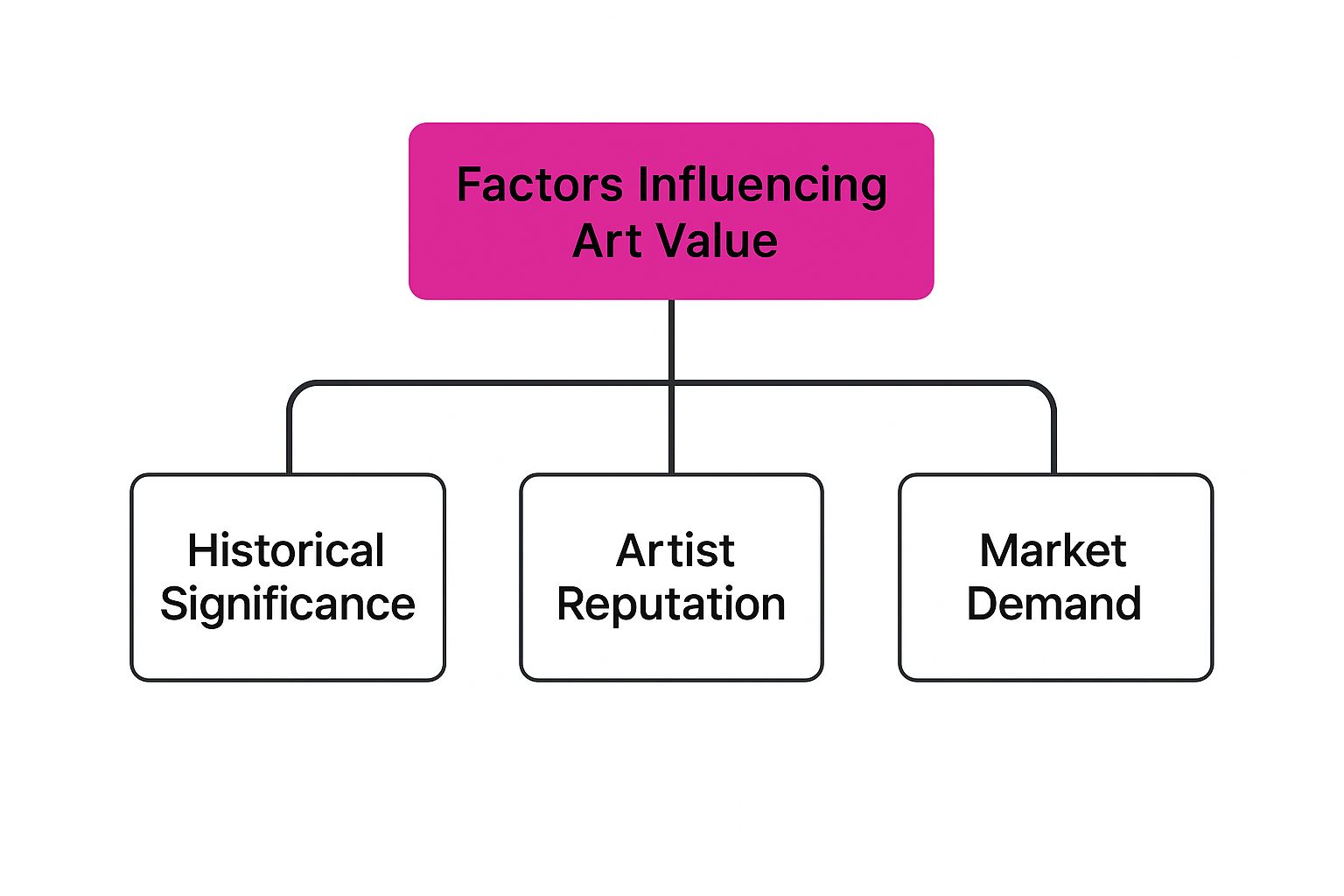
As you can see, these key pillars—historical context, the artist's brand, and market forces—are deeply connected. A weakness in one area can sometimes be balanced by incredible strength in another. However, the artworks that break records and make headlines are almost always the ones that excel across the board.
Grasping this framework is the first step toward making sense of the sometimes baffling prices you see at auction houses and galleries. It's a world where story is just as valuable as skill.
The Power of the Artist's Name

When you’re trying to understand what makes a piece of art valuable, there’s one factor that often stands above all others: the name signed in the corner. An artist's signature is so much more than just a name. It’s a brand, a seal of quality, and a story all wrapped into one.
Think of it like a luxury handbag. The materials and craftsmanship matter, of course, but it’s the famous logo that turns it into a coveted status symbol. In the art world, the artist's name works in much the same way, acting as a powerful stamp of cultural and financial significance.
This kind of reputation isn't built in a day. It all starts with technical mastery—that raw, undeniable ability to bring a vision to life. Whether it’s the hyper-realistic detail in a portrait or the confident, sweeping strokes of an abstract painter, a high level of skill is the foundation of any great artist's career. It’s the first thing collectors and experts look for.
From Skill to a Signature Style
But technical talent alone won't make an artist a household name. The real magic happens when an artist develops a unique and instantly recognizable style. Take Claude Monet, for example. His early Impressionist works, with their radical focus on capturing light and atmosphere, were unlike anything seen before. He created a visual language that was entirely his own.
Pioneering a new style or technique is what carves an artist’s place in history. It changes the conversation and inspires the artists who come after.
An artist's name becomes a powerful driver of value when it is synonymous with a specific movement, style, or idea. It transforms the artwork from a standalone object into a piece of a larger, historically important puzzle.
This is exactly why Andy Warhol’s work fetches such incredible prices. He didn’t just paint soup cans; he helped define the Pop Art movement and completely changed how we think about art, celebrity, and consumer culture. His name is now a brand that represents an entire chapter of modern history.
The Importance of a Cohesive Body of Work
An artist's value is also deeply connected to their entire body of work. A career that shows a consistent vision—one that evolves and matures over time—demonstrates serious commitment and depth. It gives critics, curators, and collectors a story to follow, allowing them to trace the artist's journey and identify their most important periods.
A strong, recognizable body of work creates a reliable market. Collectors learn what to expect from the artist, but they’re also excited to see where the work will go next. This steady output builds a solid presence and keeps demand high.
Finally, an artist's journey from a talented creator to a celebrated icon is cemented by a few key forms of external validation:
- Critical Acclaim: When respected art critics write positive reviews or academic papers about an artist, it builds immense credibility.
- Gallery Representation: Being shown by a top-tier gallery is a huge vote of confidence. It exposes the artist to the world’s most serious collectors.
- Museum Shows: A major museum exhibition is the ultimate endorsement. It places the artist's work directly into the grand narrative of art history, solidifying their legacy.
When all these pieces fall into place—skill, style, a strong body of work, and institutional support—an artist's name becomes their greatest asset. It guarantees not just a beautiful object, but a piece of an enduring story that commands both respect and high prices.
The Story Behind the Artwork
An artist's name certainly carries a lot of weight, but the individual story of a single piece of art can be just as important when it comes to its value. A painting is never just an image on a canvas. It’s a physical object that has lived a life, and that journey adds incredible layers of meaning and desirability. We call this documented history of ownership and exhibitions provenance.
Think of it like a passport for the artwork. Each stamp—a new owner, a prestigious gallery show, a feature in a museum—adds to its story and prestige. A solid provenance not only proves the piece is the real deal but also weaves a compelling narrative that elevates it far beyond being just a beautiful thing to look at.
For instance, a painting that once hung in the home of a famous historical figure or a well-known contemporary collector has a special kind of magic. That connection to a prestigious past gives it an aura of importance, making it far more desirable on the market. This paper trail is what connects the art to a much bigger story.
The Power of Provenance
A well-documented provenance is one of the most powerful tools for establishing an artwork's value. At its most basic, it assures a potential buyer that the piece is genuine and not a fake—a primary concern for any serious collector. But its influence goes much deeper.
A strong provenance answers a few critical questions that directly boost value:
- Who owned it? If a piece was part of a respected collection, like the Rockefeller family's, it inherits a layer of prestige.
- Where has it been shown? A history of exhibitions in major museums or influential galleries acts as a stamp of cultural approval.
- Is it "fresh to the market"? An artwork that has been tucked away in a private collection for 50 years can cause a frenzy when it finally reappears.
Provenance is the bedrock of an artwork's value. It provides irrefutable proof of authenticity, a traceable history of prestige, and a narrative that elevates the piece from a mere object to a historical artifact.
This chain of custody turns the artwork into a tangible piece of history. A collector isn't just buying a painting; they are buying its story and their place as the next chapter in its journey.
Capturing a Moment in Time
Beyond who has owned it, an artwork’s value can skyrocket if it perfectly captures a major cultural shift or marks a turning point in the artist's own career. Context is everything. When a piece comes to define a movement, challenge the status quo, or serve as a visual record of a major historical event, it becomes more than art—it becomes an essential document of its time.
Take Picasso’s Guernica, for example. Its astronomical value comes not just from Picasso's legendary name, but from its raw power as a monumental anti-war statement. It viscerally captures the horror of the Spanish Civil War, tying it forever to a key moment in 20th-century history.
On a more personal level, a piece might be valuable because it marks a breakthrough for the artist. It could be the first time they tried a new technique, the final piece in a lifelong series, or a work born from a profound personal experience. For example, you can learn more about the inspiration behind a collection like My Motherhood and see how an artist's personal journey directly infuses their work with unique depth and value.
This kind of context, whether historical or deeply personal, adds a richness that collectors find irresistible. It’s the story that often makes an artwork truly priceless. When you buy a piece with that kind of history, you’re not just an owner—you become a custodian of that story for the future.
Understanding Art Market Dynamics

An artist's reputation and the story behind a piece are critical, but they're only part of the puzzle. The art world is its own unique economy, driven by influential players, specific venues, and market trends that can seem mysterious from the outside. If you really want to know how prices are set, you have to pull back the curtain on these forces.
Think of the art market as having two distinct levels. The first is the primary market. This is where a brand-new artwork makes its debut, usually sold through a gallery that represents the artist. It's the launchpad for an artist's career, where their initial prices are carefully set and their reputation begins to build.
Then there's the secondary market. This is the world of resales, dominated by auction houses where artworks that have been owned before find new homes. What happens here is a huge tell; a strong performance on the secondary market signals that an artist has lasting value and true staying power.
The Role of Galleries and Dealers
On the primary market, galleries and influential dealers are the ultimate tastemakers. A top gallery is like a world-class talent scout; when they decide to represent an artist, it’s a massive vote of confidence that tells collectors, "Pay attention to this one."
But their job goes far beyond just hanging art on a wall. They are the engine behind an artist's career.
- Building an Artist's Career: They work to place an artist's pieces into the right hands—prestigious private collections and museum exhibitions.
- Validating Prices: They don't just pick a number out of thin air. They carefully manage pricing to build a stable, sustainable market and avoid the kind of boom-and-bust cycle that can torpedo a career.
- Generating Buzz: They create excitement. Through curated shows, exclusive viewings, and smart media outreach, they build the demand that makes an artist a hot commodity.
A top-tier gallery's backing provides more than just a sales channel; it offers a stamp of approval. This validation gives collectors the confidence to invest, knowing the artist has been vetted by trusted industry experts.
This system of validation is what creates a consensus around an artist's importance. Without that structured support, it's almost impossible for an artist's work to get the traction it needs to command high prices.
Auctions and Market Trends
If galleries launch careers, auction houses solidify them. When a piece performs well at a major auction house like Christie's or Sotheby's, it sends a powerful message to the entire art world. Just one record-breaking sale can ignite a firestorm of interest, boosting the value of all of that artist's other works.
Of course, the art market doesn't exist in a bubble. It often mirrors the ups and downs of the global economy. For instance, recent data shows that while the total value of the global art market dipped, that decline was almost entirely at the very top. Sales of works priced over $10 million dropped significantly, while the lower and middle segments of the market actually grew. You can read the full research on these market trends to see a detailed breakdown.
What does this tell us? While the blockbuster sales get all the headlines, the real health of the market is often found in the steady, consistent sales happening at more accessible price points. It suggests a market that is becoming more resilient and broader than just the mega-rich.
Finally, don't underestimate the power of buzz. A major museum retrospective, a glowing feature in a prominent publication, or even a wave of social media attention can cause demand to skyrocket. This can turn a respected artist into a global phenomenon almost overnight. It's this dance between galleries, auctions, economic sentiment, and cultural moments that truly shapes an artwork's journey from a studio creation to a prized asset.
How Art Is Bought and Sold Today
The way art changes hands is evolving, and these shifts have a direct say in what makes a piece valuable. While the big-name auction houses still make the headlines, a huge part of the art market now runs through quieter, more accessible channels. This is fundamentally changing how prices are set and how people build their collections.
Two powerful trends are shaping the modern art world: the surge in private sales and the undeniable influence of the digital marketplace. Together, they’re making the art scene more global, transparent, and dynamic than ever before.
The Growing Power of Private Sales
More and more, the most valuable transactions are happening behind closed doors. Private sales are deals brokered directly between a buyer and a seller, usually with a gallery or dealer playing matchmaker. They offer a level of discretion and stability that you just can't get at a public auction. When the economy feels shaky, many top collectors and sellers would rather avoid the unpredictable nature and public eye of the auction block.
This desire for privacy has made these direct deals a bedrock of the market's stability. In fact, while public auction sales can swing up and down, sales led by dealers have stayed surprisingly consistent. One recent report noted they held steady at around $36.1 billion, which tells you a lot about the preference for quiet, relationship-based transactions over the drama of an auction.
In today's art market, value isn't just hammered out in the auction spotlight. The quiet confidence of a private sale, built on trusted relationships and expert guidance, is just as powerful in cementing an artwork's worth.
For anyone serious about collecting, this trend reveals a critical truth: the best opportunities aren't always the most obvious ones. Building strong relationships with galleries and dealers is more crucial than ever. It's your ticket to seeing—and acquiring—the best works before they ever hit the public stage.
The Digital Transformation of the Art World
The other major force changing the game is the art market’s digital makeover. What was once a notoriously closed-off and exclusive world is now opening up, thanks to a whole new set of online tools.
- Online Viewing Rooms (OVRs): First introduced by major galleries, OVRs are virtual exhibitions. They let collectors from anywhere on the globe browse curated shows and buy art right from their computer or phone.
- Digital Sales Platforms: A whole ecosystem of art-focused websites and apps has sprung up, making it easier for new collectors to discover and purchase art from a massive, diverse inventory of artists.
- Social Media: You can't ignore platforms like Instagram. They’ve become incredible discovery tools, allowing artists to connect with a global audience and sell their work directly, often bypassing the traditional gallery system entirely.
This digital shift has brought in a whole new wave of buyers, especially younger collectors who are perfectly comfortable making major purchases online. It has also pulled back the curtain on a once-opaque industry, making pricing information and artist data much more accessible. If you're just dipping your toes in, you might find it helpful to check out our guide on how to start collecting art for some practical advice.
Of course, whenever art is bought and sold, logistics matter. For high-value pieces, especially antiques, thinking about their preservation and transport is part of the process. For anyone handling these kinds of assets, understanding the ins and outs of the safe transport of valuable antique furniture is essential. In the end, an artwork's value today is shaped not just by its creator or its history, but by the entire modern infrastructure that supports both private deals and digital sales.
The Human Connection to Art

After all the talk of market trends, artist reputations, and historical significance, we land on what is arguably the most powerful factor in art's value: how it makes us feel. Take away the auction houses and gallery price tags, and you're left with the core of it—art’s incredible ability to connect with us personally. This is where its true worth lies.
This is the force that pushes someone to buy a piece, often in a way that seems to defy logic. It's what I like to call an "emotional premium." A collector might pay a sum that seems wildly inflated to an outsider, but to them, it's perfectly rational. Why? Because that specific painting speaks to their own life, challenges their thinking, or brings a sense of peace they can't find anywhere else.
The most enduring value of art isn't financial—it's human. It's the silent conversation between the canvas and the viewer, a timeless exchange of ideas, emotions, and stories that transcends money and time.
This personal pull is what elevates a painting from a simple wall decoration to an essential part of someone's world. It becomes a daily touchstone for inspiration, a quiet corner for reflection, or a tangible reminder of a deeply held belief. You won't find that kind of value on any sales report.
More Than Just an Object
Art also serves as a powerful form of social and cultural capital. Owning a notable piece isn't just a sign of wealth; it's a statement about your taste, your intellect, and where you see yourself culturally. It shows an appreciation for history, for raw creativity, and for the lasting power of human expression.
For many collectors, it’s about more than just owning something beautiful. It’s a way to become part of art's ongoing story. You get to be a temporary guardian of a piece of history while supporting the artists who are shaping culture right now. Whether you're just starting out or have been collecting for years, discovering beautiful original art for your collection is really about diving into this shared human experience.
In the end, the reasons for art's value are a tangled, beautiful mix of market mechanics and pure human feeling. And while the numbers on a spreadsheet are one way to measure worth, they certainly aren't the only way. The most profound value of any artwork is its ability to speak across generations, to inspire us, and to tie us back to our common humanity. It’s that connection that makes a piece truly priceless.
Frequently Asked Questions About Art Value
The art world can feel like a maze, especially when it comes to figuring out what makes a piece valuable. Let's clear up some of the most common questions people have.
Is Art from a Living Artist Less Valuable?
Not at all. It's a common myth that an artist has to be deceased for their work to be valuable. While it's true that an artist's death creates a finite supply, which can drive up prices, plenty of living artists command jaw-dropping figures. Just look at giants like David Hockney and Jeff Koons.
For artists working today, value is built on their current influence, recent exhibitions, critical praise, and how much buzz there is around them in the primary market. Buying from a living artist is also a fantastic opportunity to get in on the ground floor before their market truly takes off.
How Much Does an Artwork's Condition Matter?
Condition is everything. Think of it like this: an artwork in pristine, untouched condition is almost always worth more than a similar piece that's been damaged or heavily restored.
Even professional restoration can affect the price, and it absolutely must be documented. Collectors want pieces that are as close to their original state as possible. They're chasing the artist's authentic vision and technique, not a repaired version of it.
An artwork’s physical integrity is directly tied to its financial and historical worth. Preserving its original state is paramount because it protects the artist's authentic hand and ensures its story remains untarnished for future generations.
Can Prints and Multiples Be Valuable?
Absolutely, but we need to be specific. We're talking about limited-edition prints that are signed and numbered by the artist. These are considered original works, not just posters. Their value hinges on a few key things:
- The Artist's Name: A print by a world-famous artist is always going to be in high demand.
- Edition Size: The smaller the edition, the rarer the print. Rarity equals value.
- Quality and Condition: The sharpness of the image, the richness of the colors, and the physical state of the paper are all critical.
On the other hand, mass-produced posters you can buy anywhere usually have little to no value on the secondary market.
Does the Size of an Artwork Affect Its Price?
Size can play a role, but it's not a simple "bigger is better" equation. For many artists, larger works do sell for more because they take more time and materials to create. That makes sense.
But this isn't a hard and fast rule. A small, historically important painting by a master could easily be worth millions more than a massive canvas by a lesser-known artist. At the end of the day, value is more closely tied to quality, period, subject matter, and provenance than to size alone. A powerful, perfectly executed small piece will always beat a large, mediocre one.
At Wiktoria Florek Mixed Media Abstract Painter, we believe that art's true value comes from the story it tells and the emotion it evokes. Discover powerful, collector-grade artworks that speak to both the intellect and the soul. Explore the collection at wiktoriaflorek.com.