
Think of art provenance research as building a biography for an artwork. It’s the meticulous process of tracing every step of a piece’s journey, from the moment it left the artist’s studio to its current location. This isn't just about dusty archives; it's a fundamental background check that secures an artwork's value, story, and very identity.
Why Provenance Research Matters Now
In the art market, a painting without a story is just a pretty object. Its history—what we call its provenance—is what breathes life into it, giving it context, authenticity, and, ultimately, value. This chain of ownership is the artwork’s resume, detailing its travels through private hands, gallery walls, and museum exhibitions.
A solid, well-documented provenance is your best defense against making a very expensive mistake.
Without it, you’re flying blind. You could be acquiring a brilliant forgery, a piece stolen from a museum, or an artwork with a deeply troubled past, like Nazi-era looted art. These aren't just hypotheticals; they are real risks that can make an artwork financially worthless or, even worse, drag you into legal battles and seizures. For any serious collector, gallery, or institution, the stakes couldn't be higher.
The Financial and Ethical Imperative
Let's be direct: a complete and verifiable history directly boosts an artwork's market value. A piece with a story that includes notable collectors or important exhibitions will always command a higher price. It’s that simple. On the flip side, gaps in the ownership history create doubt, and savvy buyers will use that uncertainty to drive the price down—or they’ll just walk away.
The real power of provenance is trust. A documented history reassures a buyer that what they are acquiring is genuine, ethically sound, and a secure asset.
This financial reality is tied directly to the ethical one. The global art market, valued at USD 552.03 billion in 2024, is in a constant fight against fakes and ownership disputes. As this Straits Research report on the art market shows, incomplete records are a huge part of the problem. That's why diligent art provenance research isn't just a good idea; it's an essential part of due diligence.
More Than Just a List of Names
Good provenance work is so much more than just compiling a list of who owned what and when. The real work is in verifying each one of those claims with hard evidence. Your goal is to construct a timeline you can defend.
So, what does that evidence look like in the real world?
- Sales receipts and official invoices from galleries or auction houses.
- Exhibition catalogues that prove the work was in a specific show at a specific time.
- Personal letters or correspondence between the artist, dealers, or collectors that mention the piece.
- Collector’s stamps or old labels found on the back of the artwork (the verso).
- Published references in art history books or, the holy grail, a catalogue raisonné.
Each document you find, each piece of evidence you uncover, adds another secure link to the chain of ownership. It solidifies the artwork’s identity and, most importantly, protects your investment.
Before diving into the "how-to," it's helpful to understand the core components you're trying to assemble. Think of your research as a puzzle where each piece provides a crucial bit of information.
Core Components of Provenance Research
| Component | What It Reveals | Why It's Critical |
|---|---|---|
| Artist's Records | The artwork's creation date and its first point of sale. | Establishes the origin point of the ownership chain. |
| Chain of Ownership | A chronological list of all known owners. | Identifies potential gaps or red flags in the history. |
| Exhibition History | Public exposure and scholarly recognition. | Adds to the artwork’s cultural significance and value. |
| Published Literature | Mentions in catalogues, reviews, or academic books. | Provides third-party validation and historical context. |
| Supporting Documents | Receipts, letters, photos, and certificates of authenticity. | Offers concrete proof to back up ownership claims. |
Ultimately, a strong provenance file tells a complete, verifiable story. It’s this narrative, supported by facts, that gives you the confidence to acquire, manage, or sell a work of art.
Following the Foundational Paper Trail
Every investigation into an artwork’s history starts with the object itself. Forget the dusty archives for a moment. The most revealing clues are often hiding in plain sight, physically attached to the artwork you’re researching. This is the foundational paper trail, and it gives you the first tangible threads of a piece's journey through time.
The first place I always look is the back of the painting, what we call the verso. It can be a goldmine. You're searching for old gallery labels, which might have crucial inventory numbers and dates. You could find collector stamps, customs stickers from when the art crossed borders, or even faint, handwritten notes dedicating the piece to a friend. Every single mark is a potential breakthrough.
Once you’ve exhausted the physical object, you can widen your search to the documents that travel with it. These are the classic building blocks of art provenance research.
Key Documents to Locate
Your main goal here is to get your hands on physical or digital copies of primary source materials. Think of them as your evidence. I always try to track down these key items:
- Original Bills of Sale: This is the ultimate proof of a transaction. It shows a clear, dated transfer from one owner to the next.
- Auction Catalogues: Even if a piece went unsold, its inclusion in an auction catalogue proves it was in a specific place at a specific time.
- Exhibition Records: A museum or gallery catalogue entry confirms the work was considered important enough to be shown publicly.
- Personal Letters: Correspondence from the artist or a dealer that mentions the artwork can be an incredible find. It connects the piece directly to the people who created or sold it.
Piecing these documents together helps you build a timeline and adds layers of confirmation to the artwork’s story. If you're new to collecting, it also helps to understand how artists document their own work. You can get a feel for this by exploring various studio talks and discussions with working artists today.
This chart breaks down the core process of provenance research, from that initial identification to the final verification.
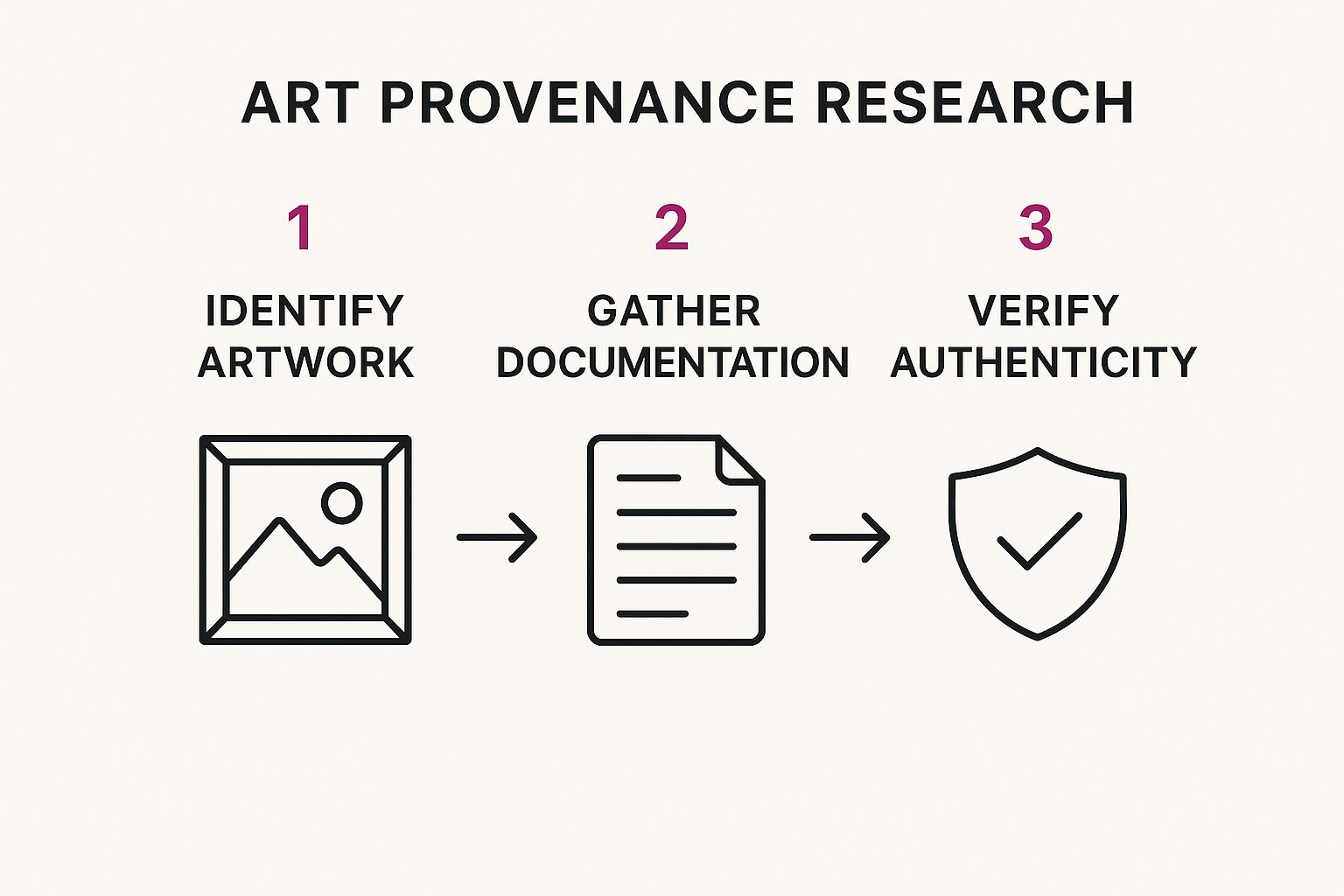
As you can see, gathering documentation is the critical step that bridges the gap between simply owning an artwork and truly understanding its authenticated history.
Interpreting the Paper Trail
Finding the documents is only half the job. You have to learn to read them with a critical eye. This is where a researcher’s experience really comes into play.
You’re looking for inconsistencies—anything that doesn't quite add up. Do the dates on a gallery label actually match the exhibition catalogue you found? Does the name on a bill of sale belong to a known collector from that era? Mismatched information is a major red flag that you’ll need to dig into.
A clean, consistent, and verifiable paper trail is the bedrock of an artwork's value and legitimacy. Discrepancies don't just raise questions—they can directly torpedo a piece's marketability and authenticity.
I treat every document like a piece of a puzzle. Your job is to figure out how they all fit together to tell a cohesive story without any gaps. The best way to do this is to organize your findings chronologically. This creates a clear timeline of ownership and immediately highlights any holes or unanswered questions you need to address next. This organized approach builds the solid, evidence-based foundation you need before you even think about moving on to digital archives or expert consultations.
Diving Into Digital Archives and Databases
When the paper trail from old receipts and exhibition catalogues goes cold, your investigation doesn't have to stop. It just moves online. The digital world is full of powerful tools for art provenance research, and they're especially crucial when you’re dealing with artworks that have complicated or difficult histories.
These databases aren't just search engines. Think of them as curated archives that can connect a single piece of art to major historical events.
This is particularly true for art with potential ties to historical conflicts. Provenance research as we know it today was forged in the aftermath of the Holocaust, driven by the need to trace vast amounts of looted art. Since 1945, a massive international effort has created specialized databases and archives to document this cultural plunder.
For instance, the UK’s National Archives collaborates with the Commission for Looted Art in Europe to maintain detailed records of art seized by Nazi Germany, which is vital work for restitution. You can see a comprehensive list of these global looted art databases to get a sense of the scale of this effort.
Starting Your Digital Search
Knowing where to look is half the battle. A scattergun approach will just leave you buried in irrelevant data. Your search needs to be targeted, focusing on databases that make sense for the artist's background, the artwork's subject, and its suspected history.
To help you get started, here are a few of the most important online resources that I turn to regularly.
Key Online Resources for Provenance Research
The sheer number of databases can be overwhelming, but a few stand out as essential starting points for almost any project, especially when investigating works with potential links to World War II.
| Database / Resource | Primary Focus | How to Use It Effectively |
|---|---|---|
| The Getty Provenance Index® | European paintings, drawings, and sculptures from the 16th to early 20th centuries. | Start here for old masters. Use its deep archive of auction catalogues and inventories to trace early ownership. |
| National Archives | Varies by country; often holds government records, including cultural property and restitution files. | Search the archives of countries relevant to the artwork's history (e.g., U.S. National Archives, UK National Archives). |
| Looted Art Databases | Art displaced or looted during WWII, particularly by the Nazi regime. | Use resources like the ERR Project or the Munich Central Collecting Point (MCCP) for any work that may have passed through Europe between 1933 and 1945. |
| Artist-Specific Foundations | The definitive source for a particular artist's work. | If one exists for your artist, check their catalogue raisonné or contact them directly. They often have the most complete records. |
These tools are powerful, but they work best when used together. Finding a piece of information in one database is just the first step; the real work is in confirming it elsewhere.
Smart Searching and Cross-Referencing
Finding a mention of your artwork is a great start, but it's not the end of the road. You have to treat every digital record with the same healthy skepticism you'd apply to a faded paper document. The real goal is to corroborate every fact with multiple, independent sources.
A single digital entry is a clue, not a conclusion. True verification comes from cross-referencing that clue across multiple, reputable databases to build a consistent and provable narrative.
Get creative with your search terms. Try the artist’s full name, just their last name, and even common misspellings. Search by the official title, but also try searching by its dimensions or a key feature in the painting. You might discover it was once known by a completely different title.
As you uncover information, document everything. I mean everything. Note the database, the record number, and take a screenshot. Did you find a sales record in the Getty Provenance Index? Great. Now, can you find a matching entry in that auction house’s own digital archive?
This layering of evidence is what turns a simple online search into rock-solid art provenance research. It’s how you bridge the gaps in an artwork's story and get closer to a complete, verified history.
How Technology Is Reshaping Provenance
While old-fashioned paper trails and dusty archives will always be the heart of provenance, a new wave of technology is completely changing how we do our research. What once sounded like science fiction, like artificial intelligence and blockchain, are now practical tools in the art world. They give us powerful new ways to verify a piece's authenticity and trace its journey.
These tools don’t replace the tried-and-true methods; they supercharge them. Think of it as adding new layers of security and analysis that were simply out of reach just a few years ago. For any serious collector or researcher, getting a handle on this tech is no longer optional.
The money flooding into this space tells the whole story. The market for art provenance systems was already valued at around $300 million in 2024. But it’s expected to explode, hitting an estimated $1.2 billion by 2032, all thanks to the rise of AI and blockchain. This isn't just a trend; it's a fundamental shift in how the industry fights fraud and verifies history.
AI as an Art Historian’s Assistant
Imagine having an assistant with a superhuman eye for the tiniest details. That's essentially what AI offers. We can train algorithms on thousands of an artist's confirmed works, teaching the AI to recognize that artist's unique "handwriting." And I'm not just talking about the signature.
- Brushstroke Analysis: AI can map the microscopic patterns of an artist's brushwork. It sees the subtle pressure, the direction, even the speed of the strokes, which are often as unique as a fingerprint.
- Material Composition: By scanning high-resolution images, an AI can help identify the exact pigments and canvas types used. It then cross-references them with the materials known to be used by the artist during a specific period of their career.
- Forgery Detection: When a potential fake comes along, the AI can instantly flag tiny inconsistencies in technique or materials that even a trained human eye might miss.
This doesn't mean an AI spits out a verdict saying, "This is a real Monet." Far from it. What it does is provide a mountain of objective data that helps a human expert make a much more informed judgment. It's a tool for gathering evidence, not a final judge.
Blockchain Creates an Unbreakable Chain
If AI helps authenticate the physical object, blockchain secures its story. Put simply, a blockchain is a shared digital record book that's almost impossible to alter. Once an artwork is registered on a blockchain, every single transaction—from the artist to the first gallery, and to every owner after that—is recorded as a permanent "block" in the chain.
Each new transaction is cryptographically locked to the one before it. This creates a transparent and tamper-proof history of ownership that anyone can see.
This technology directly attacks the age-old problems of forged documents and shady sales histories. When a piece comes with a blockchain-backed provenance, it brings a much higher level of trust because its ownership history is public and can’t be secretly changed. This is becoming especially important for new works, where artists can issue a digital certificate of authenticity right from the start. You can see how this is shaking things up by exploring more articles on contemporary art and collecting.
But let’s be clear: these technologies are not a magic bullet. A blockchain history is only as trustworthy as its first entry. If a fake piece is registered on the blockchain from the beginning, the technology will perfectly track the ownership of that fake. Technology is a powerful partner in art provenance research, but it will never replace the sharp, critical eye and deep knowledge of a human expert.
Knowing When to Call in the Experts
You’ve done your homework. You've gathered the documents, chased down the digital records, and put together a timeline. But what happens when the pieces don't fit? Maybe you’re staring at a pile of conflicting evidence, a confusing gap in the chain of ownership, or data that just doesn't add up.
This is the moment of truth. It's where even the most dedicated collector needs to recognize their limits and consider bringing in professional backup. Knowing when to stop is a crucial skill in responsible collecting. Pushing ahead with murky information isn't just risky; it can lead to a disastrous investment.
Certain red flags should immediately tell you it's time to pause and seek specialized expertise. Spotting these signs early can be the difference between acquiring a treasure and buying a problem.
Red Flags That Demand Expert Attention
If your research turns up any of the following, it’s a clear signal you’re in over your head and need a professional eye.
- Significant Gaps in Ownership: A missing decade in a painting's history is a huge concern. If that gap happens to fall during a historically fraught period, like World War II, it’s a non-negotiable reason to hire a specialist.
- Conflicting Paperwork: You've found two different auction records for the same year. Or maybe a gallery label on the back of the frame doesn't match any known exhibition. Professionals know how to untangle these kinds of knots.
- Doubts About Authenticity: The signature just looks a little off. The canvas or materials don't feel quite right for the period. These aren't things you can guess about; they are questions for forensic experts.
- Hints of Looting or Theft: Any link, no matter how faint, to a name on a looted art database or a past claim of theft requires immediate investigation by a researcher who specializes in this incredibly complex field.
When you hit these roadblocks, you're no longer doing basic art provenance research. You've entered a territory that demands very specific skills. While advice on how to collect art from an artist's perspective often highlights building a direct relationship, that's a luxury you don't have with historical works. Here, you need seasoned investigators.
Assembling Your Team of Specialists
Don't expect one person to have all the answers. Verifying a complex piece of art often requires a team effort, with each expert playing a vital role. Think of it as assembling a team of highly specialized detectives.
You are not just hiring a researcher; you are investing in certainty. An expert report can be the definitive factor that secures an artwork’s value, clears its title, and protects you from immense financial and legal risk.
Here’s a look at who you might need on your team and what they bring to the table:
- Dedicated Provenance Researchers: These are your historical sleuths. They are comfortable in dusty archives, often speak multiple languages, and know precisely how to navigate convoluted international records to fill in those critical ownership gaps.
- Forensic Art Analysts: These specialists get hands-on with the artwork itself. Using tools like infrared reflectography and pigment analysis, they can provide scientific evidence to help confirm—or deny—a work’s authenticity.
- Conservation Scientists: A conservator’s job is to assess the physical health of the artwork. Their report can uncover old restorations or repairs that aren't in the official record, offering clues about its journey and how it was handled through the years.
Make sure you vet these professionals carefully. Look for people with a proven track record, memberships in respected industry organizations, and a clear, transparent fee structure. Bringing the right experts on board is what transforms a simple collection of documents into a coherent, defensible history for your artwork.
Getting to Grips with Art Provenance: Your Questions Answered
Even with a solid plan, stepping into the world of art provenance research can feel a bit daunting. You're bound to run into questions about how much it will all cost, how long it will take, and what to do when the information you find isn't perfect.
Let's walk through some of the most common hurdles you'll face. Thinking about these issues upfront will give you a much more realistic view of the journey ahead, especially when you're dealing with a complicated history or venturing into newer realms like digital art.
How Much Does Professional Provenance Research Cost?
There’s no simple answer here—the cost of professional research is all over the map. The final bill really depends on how deep the rabbit hole goes.
For a relatively straightforward piece with just a couple of recent, well-documented owners, you might be looking at a few weeks of work and a cost of a few thousand dollars. But things can get complicated fast. If you're dealing with an artwork that has significant gaps in its history, is suspected of being looted, or has a shaky artist attribution, you’re looking at a serious investigation. These deep dives can easily take months, sometimes even years, and the costs can climb into the tens of thousands.
The price is a direct reflection of the work involved. It accounts for everything from international travel to dig through archives, fees for scientific testing, or bringing in legal experts who specialize in cultural property law.
Before you hire anyone, always insist on a detailed proposal. It should spell out exactly what they plan to do, give you a realistic timeline, and provide a clear breakdown of all potential costs. Don't commit to anything until you have that in hand.
Is a Gap in Provenance a Deal Breaker?
Not necessarily, but it’s definitely a moment to hit the brakes and look closer. A gap in an artwork's ownership history is a major red flag, and you need to understand it before moving forward.
Context is everything. A recent, undocumented sale between two known collectors is one thing. But a missing history that falls between 1933 and 1945 in Europe? That’s an entirely different level of concern, raising immediate questions about Nazi-era looting. A short, understandable gap might be acceptable if the rest of the provenance is airtight and thoroughly documented.
However, a long, unexplained gap is a huge risk. It throws the door wide open to the possibility of forgery, theft, or some other dark part of its past. This kind of uncertainty doesn't just create a legal or ethical problem; it will almost certainly crater the work's market value and make it incredibly difficult to sell later. If you find yourself in this situation, moving forward without expert advice is a serious gamble.
How Does Provenance Work for Digital Art and NFTs?
Provenance for digital art is a whole new ballgame. On the surface, the blockchain technology behind Non-Fungible Tokens (NFTs) seems like the perfect solution—a completely transparent and permanent record of ownership from the moment of creation.
Every time an NFT is transferred, the blockchain records it, creating what looks like an unbreakable chain of custody. The problem is, the real work of art provenance research has now shifted. It's less about the on-chain data and more about verifying what's happening in the real, off-chain world.
The essential questions you need to ask are:
- Artist Verification: Can you confirm that the digital wallet that "minted" the NFT actually belongs to the artist?
- File Authenticity: Did the artist genuinely create the digital file—the image, video, or sound—that the token points to?
- Platform Integrity: Is the marketplace where the NFT was first sold reputable, secure, and trustworthy?
Researching digital art is now a hybrid job. It combines old-school detective work, like digging into an artist's public statements and digital footprint, with new-school technical skills, like analyzing the smart contract and transaction history directly on the blockchain.
At Wiktoria Florek, we believe an artwork’s story is a vital part of its soul. For collectors looking for powerful contemporary pieces with a clear, direct line to the artist's studio, we invite you to explore the emotionally charged, large-scale mixed media works of Wiktoria Florek. Discover art that delivers both a stunning visual experience and the confidence that comes with perfect provenance. Start your collection at wiktoriaflorek.com.