
Abstract art is no longer confined to splatters and shapes. A new generation of visionaries is pushing the boundaries of what abstraction can be, blending it with social commentary, digital techniques, and raw, personal narratives. These creators challenge conventions, experiment with unexpected materials, and produce works that are as intellectually engaging as they are visually stunning. They are the artists redefining modern abstraction for a new era.
This article moves beyond theory to provide a focused look at seven pivotal artists shaping this movement. We will explore their unique methodologies, from Kara Walker’s silhouetted histories to Mark Bradford’s layered urban topographies. You will learn not just who these artists are, but how they construct their influential works and why their approaches are reshaping the art market and critical discourse.
Prepare to see abstraction in a new light. This is not art as an escape from reality, but as a deeper, more complex reflection of it. For collectors, critics, and enthusiasts, understanding these key figures is essential to navigating the landscape of contemporary art today. We will examine the specific techniques and signature pieces that make their contributions so significant.
1. Kehinde Wiley: Abstraction in Opulent Portraiture
Kehinde Wiley is a pivotal figure among artists redefining modern abstraction, not by creating purely non-representational works, but by integrating abstract patterns into the powerful tradition of portraiture. He masterfully combines hyper-realistic, life-sized portraits of contemporary Black individuals with vibrant, intricate backgrounds. These decorative patterns are historically associated with the opulent textiles and wallpapers seen in classical European aristocratic portraiture.
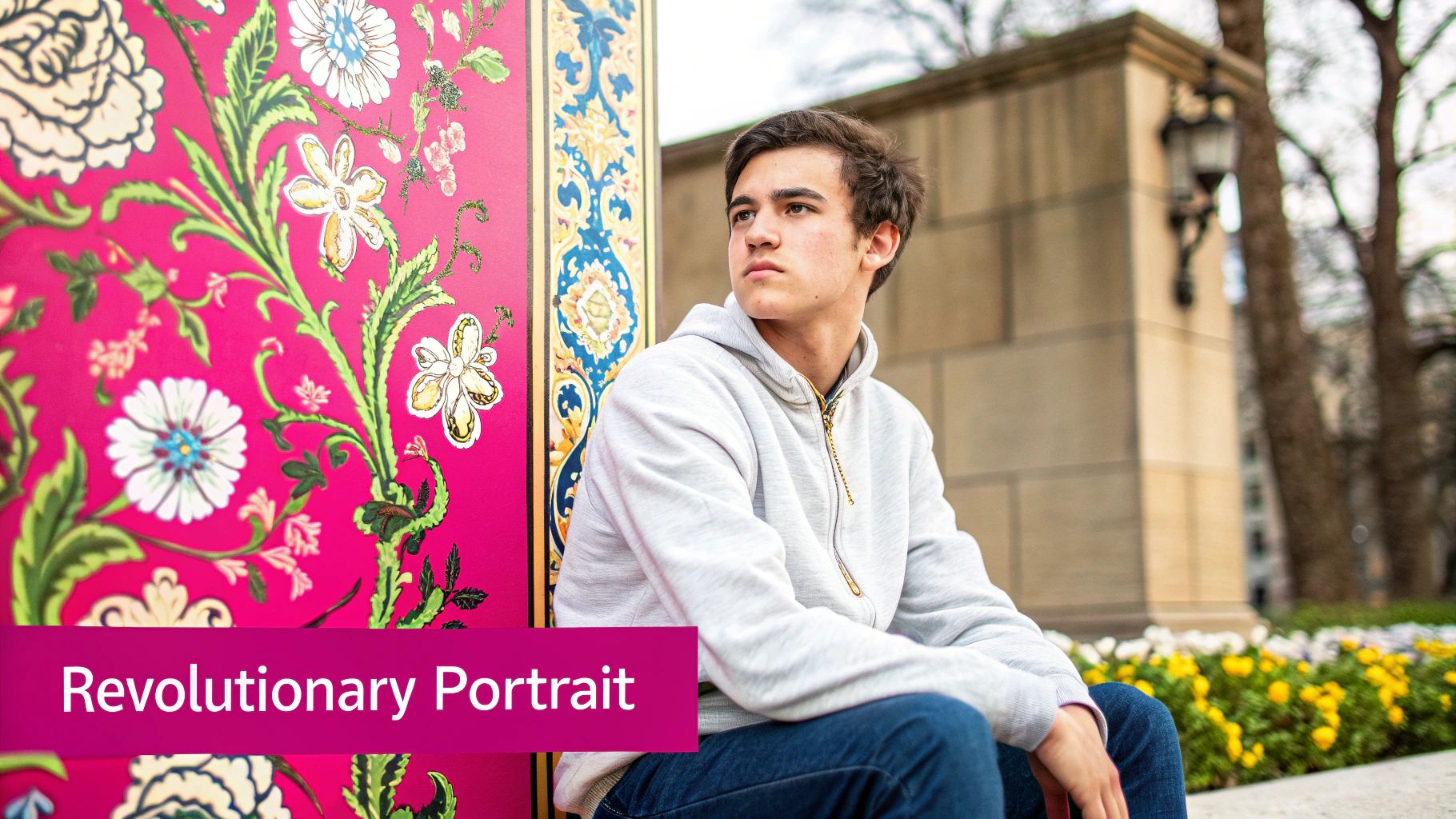
This juxtaposition recontextualizes both the subject and the background. The abstract floral and damask motifs are no longer just ornamentation; they become a critical commentary on the histories of power, race, and representation in Western art. By placing his subjects in these historically loaded settings, Wiley elevates them to the status of heroes, saints, and nobility, directly challenging the exclusionary narratives of art history.
Signature Works and Impact
Wiley’s approach is famously exemplified in works like Napoleon Leading the Army over the Alps (2005), where he replaces the French emperor with a modern Black man in street clothes, set against a luxurious, repeating pattern. His official Portrait of President Barack Obama (2018) brought this style to global prominence, with symbolic flowers like chrysanthemums and jasmine woven into the dense, abstract foliage behind the 44th U.S. President. These works demonstrate how abstraction can be a narrative tool, embedding deep political and cultural meaning within a representational framework.
Actionable Insights for Artists and Collectors
For artists inspired by Wiley's vision, the key is the intentional fusion of disparate visual languages.
- Juxtapose Styles: Experiment with combining highly detailed, realistic subjects with flat, decorative, or purely abstract backgrounds.
- Use Symbolism: Embed meaning into your patterns. Choose motifs that carry historical, cultural, or personal significance to add layers of narrative.
- Play with Scale: Wiley’s portraits are often monumental, giving his subjects an undeniable and commanding presence. Consider how scale can amplify your message.
This technique is most effective when you want to challenge traditional genres and infuse your work with potent social commentary. By merging realism with abstraction, you can create visually stunning pieces that demand deeper engagement from the viewer, moving beyond aesthetics to provoke thought and conversation.
Learn More: Kehinde Wiley Studio
2. Julie Mehretu: Abstraction as Geopolitical Cartography
Julie Mehretu is a leading voice among artists redefining modern abstraction, transforming the canvas into a complex archive of contemporary life. She creates monumental, multi-layered paintings that fuse architectural drawings, maps, weather charts, and explosive gestural marks. Her works are not purely abstract; they are dynamic visual ecosystems that map the intricate networks of globalization, migration, conflict, and social upheaval.
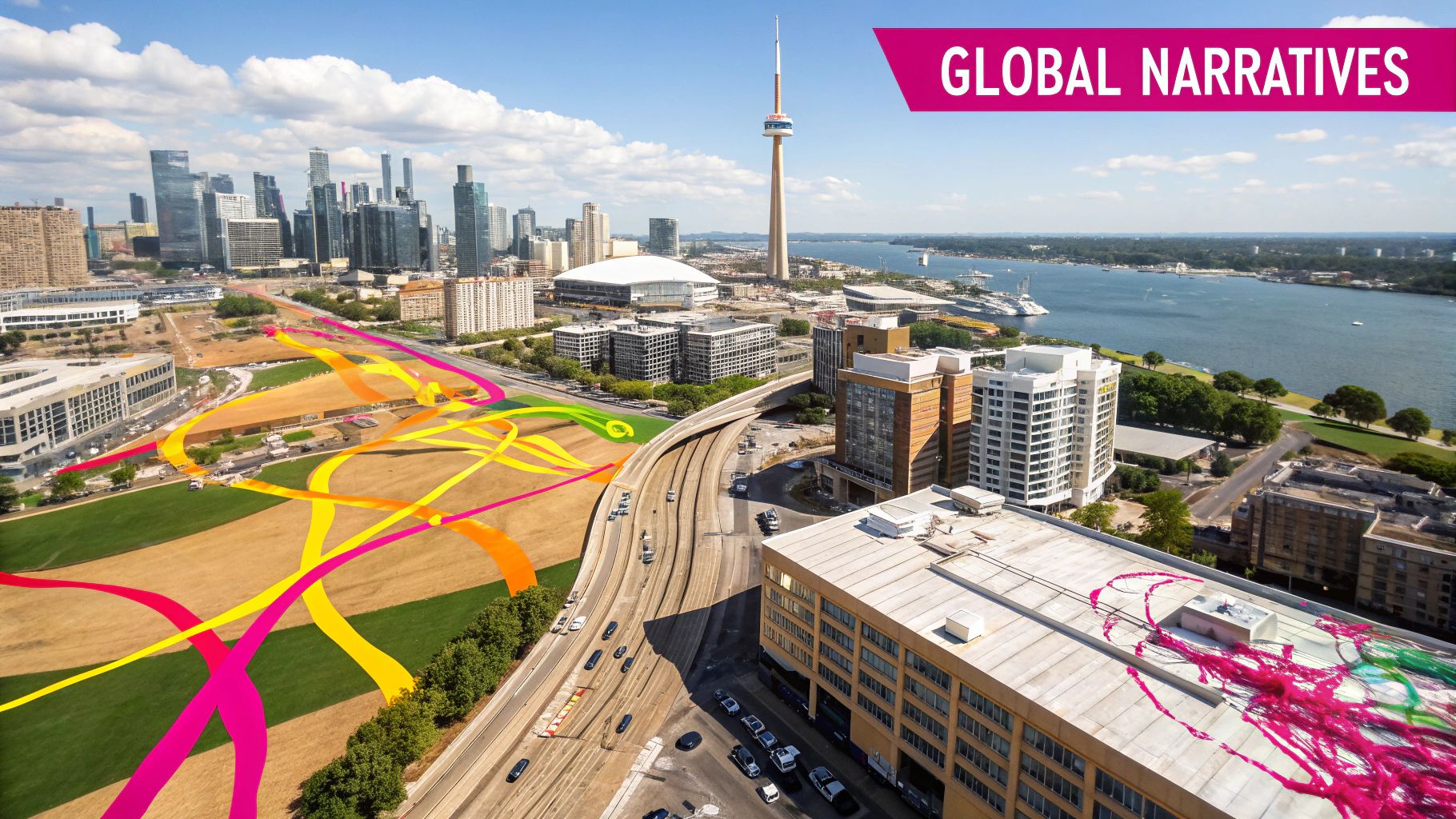
Mehretu’s process involves layering precise, ink-like lines derived from urban plans and architectural schematics with sweeping, calligraphic strokes of paint and ink. This creates a palpable tension between order and chaos, structure and entropy. The abstract forms are thus charged with the energy of cities, revolutions, and historical events, redefining abstraction as a powerful tool for documenting and interpreting our interconnected global reality. To fully appreciate this depth, it helps to understand the foundational principles of abstract art; a deeper dive can help you how to understand abstract art and its narrative potential.
Signature Works and Impact
Mehretu's large-scale commission Mural (2009) at the Goldman Sachs headquarters is a prime example of her method, weaving financial and architectural histories into a vast, energetic composition. Her diptych HOWL, eon (I, II) (2017), exhibited at the Whitney Biennial, layers images from recent American events, such as protests in Ferguson and California wildfires, creating a powerful commentary on contemporary political landscapes. These works show how abstraction can carry profound historical weight, moving beyond aesthetics to become a form of visual journalism.
Actionable Insights for Artists and Collectors
For those inspired by Mehretu’s layered narratives, the key is to build meaning through systematic layering and research.
- Layer Information: Begin by collecting and overlaying different data sources, such as historical maps, architectural plans, or digital schematics, as your foundational layer.
- Contrast Mark-Making: Juxtapose precise, controlled lines with expressive, gestural marks. This contrast can generate visual energy and represent the conflict between systems and human experience.
- Use Transparency: Experiment with transparent and opaque layers to build visual depth. This allows viewers to perceive multiple moments or ideas simultaneously within a single frame.
This approach is highly effective for creating works that explore complex, multi-faceted themes like history, politics, or globalization. By treating the canvas as an evolving map, you can produce intricate abstract pieces that invite sustained investigation and reveal new meanings with every viewing.
Learn More: Julie Mehretu on Artsy
3. Kara Walker: Abstraction Through Provocative Silhouettes
Kara Walker is a formidable force among artists redefining modern abstraction, using the seemingly quaint medium of cut-paper silhouettes to confront brutal histories of racism, violence, and sexuality in America. While her work is figurative, its power lies in abstraction. By reducing complex and violent historical narratives to stark black-and-white forms, she forces the viewer to fill in the grotesque details, abstracting historical trauma into a powerful and unsettling visual language.
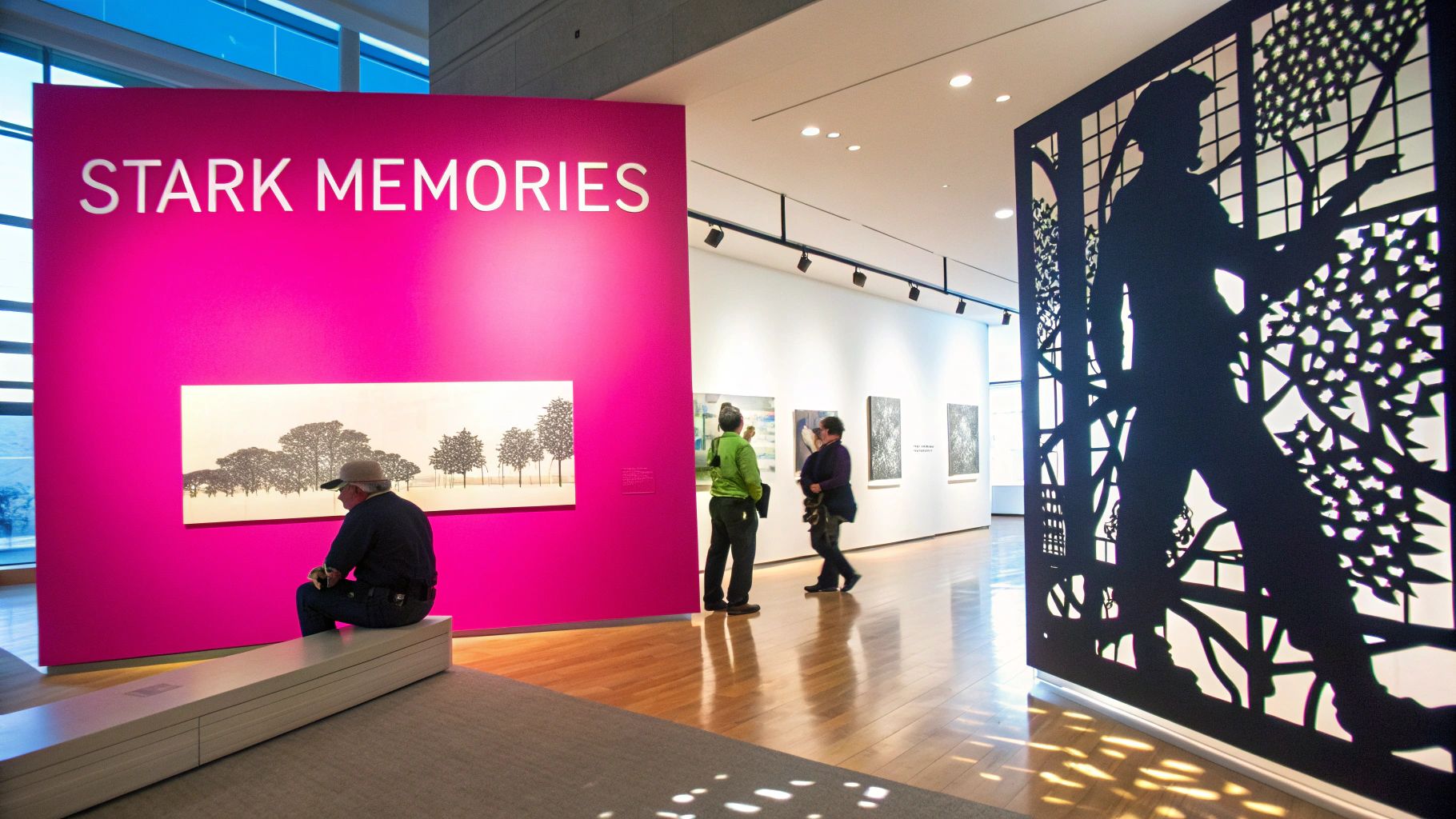
Walker’s large-scale installations turn the gallery wall into a panoramic stage where antebellum stereotypes are exaggerated into nightmarish scenes. This approach subverts the silhouette’s polite, Victorian parlor-art origins, transforming it into a tool for sharp social critique. The elegant forms clash with the horrific content, creating a tension that makes her work deeply challenging and unforgettable. This demonstrates how abstraction can be wielded not just aesthetically but as a potent political weapon.
Signature Works and Impact
Walker first gained widespread acclaim for her 1994 mural, Gone: An Historical Romance of a Civil War as It Occurred b'tween the Dusky Thighs of One Young Negress and Her Heart. This room-sized installation established her signature style of using silhouettes to depict a surreal and disturbing vision of the American South. More recently, her monumental public sculptures like A Subtlety (2014), a massive sugar-coated sphinx-like figure installed in Brooklyn's Domino Sugar Factory, and Fons Americanus (2019) at the Tate Modern, directly confronted the legacies of the sugar and slave trades on an epic scale.
Actionable Insights for Artists and Collectors
For those inspired by Walker’s bold approach, the focus is on simplifying form to amplify meaning.
- Use High Contrast: Experiment with stark contrast and negative space. The simplicity of black against white can create a powerful graphic impact that forces viewers to project their own interpretations onto the work.
- Subvert Traditional Mediums: Take a historic or seemingly outdated art form, like silhouette cutting, and repurpose it to address contemporary social or political issues.
- Command with Scale: Walker often works at an immersive, architectural scale. Consider how making your art overwhelmingly large or surprisingly small can dramatically alter the viewer's physical and emotional response.
This method is most effective when you aim to explore difficult, layered histories or uncomfortable truths. By abstracting complex narratives into simplified, symbolic forms, you can create work that is both visually arresting and intellectually demanding, prompting viewers to engage with subjects they might otherwise ignore.
Learn More: Sikkema Jenkins & Co.
4. Oscar Murillo: Abstraction as Social and Material Experience
Oscar Murillo is a compelling force among artists redefining modern abstraction, distinguished by his method of grounding non-representational art in raw, physical reality. His large-scale paintings, drawings, and installations are characterized by a visceral energy, incorporating industrial materials, studio debris, and aggressive, gestural marks. Murillo’s work transforms abstract expressionism into a direct reflection on labor, migration, and the complex networks of global capitalism.
His process is intensely physical and often collaborative, treating the canvas not as a pristine surface but as a site of production and accumulation. By stitching together dirtied, torn, and worked-over canvases, he imbues his art with a sense of history and lived experience. The resulting compositions are energetic and chaotic, yet they speak profoundly to the social and economic conditions that shape our interconnected world.
Signature Works and Impact
Murillo’s ongoing project, Frequencies (2013-present), exemplifies his socially-engaged approach. He sends canvases to schools across the globe for students to draw and doodle on over a semester. These canvases are then collected and incorporated into vast, layered installations, creating a global archive of youthful expression. His installations, such as Surge (social cataracts) (2019), which contributed to his Turner Prize win, often fill entire rooms with dense, dark paintings, creating an overwhelming, immersive environment that comments on overwhelming global systems.
Actionable Insights for Artists and Collectors
For creators inspired by Murillo, the focus is on embedding process and material with social meaning.
- Embrace Unconventional Materials: Experiment with incorporating dust, dirt, or industrial materials into your work. Let the physical history of your materials become part of the narrative.
- Ground Abstraction in Experience: Consider how your personal history, community, or observations of labor and society can inform your abstract language.
- Utilize Scale and Installation: Move beyond a single canvas. Use the scale of your work and its presentation as an installation to create immersive environments that envelop the viewer.
This approach is highly effective for artists who want their abstract work to engage directly with political and social issues. By rooting abstraction in tangible processes and materials, you can create powerful, resonant pieces that feel both formally innovative and deeply relevant to contemporary life.
Learn More: Oscar Murillo at David Zwirner
5. Amy Sillman: Merging Digital and Painterly Abstraction
Amy Sillman is a vital force among artists redefining modern abstraction, celebrated for her dynamic practice that bridges the gap between traditional painting and contemporary digital media. She creates vibrant, gestural works that often begin as drawings or digital sketches on an iPad before evolving into large-scale oil paintings, animations, and prints. This hybrid approach allows her to explore form, color, and process in a constant state of flux and transformation.
Sillman’s work challenges the notion of a finished piece by revealing its own history of creation, deletion, and revision. The layers, erasures, and awkward yet compelling forms in her paintings mirror the processes available in digital software, yet are rendered with the physical texture and presence of paint. This dialogue between the material and the immaterial breathes new life into abstract expressionism, making it relevant for a digitally native world.
Signature Works and Impact
Sillman's innovative method is powerfully demonstrated in exhibitions like One lump or two (2019) at the Camden Art Centre and in her ALL-OVER series, which combines paintings with digital animations that show their own making and unmaking. In these installations, static canvases are placed in conversation with moving images, creating a loop where the painting process itself becomes the subject. Her influential teaching positions at Bard College and Yale School of Art have further solidified her impact, shaping a new generation of artists.
Actionable Insights for Artists and Collectors
For artists intrigued by Sillman's process-oriented approach, the focus is on embracing translation between different media.
- Translate Across Media: Start a composition on a digital tablet and finish it on canvas, or vice versa. Let the limitations and possibilities of each medium inform the other.
- Show Your Process: Don't be afraid to let your revisions, erasures, and "mistakes" become part of the final work. This adds depth and narrative to abstract forms.
- Create a Dialogue: Exhibit digital and physical works together. An animation can reveal the hidden layers of a painting, enriching the viewer's understanding and connection.
This technique is most effective when you want to explore the nature of creation itself and break down the hierarchy between different artistic tools. By integrating digital and analog methods, you can create a body of work that is not only visually compelling but also intellectually engaging, inviting viewers into your creative journey.
Learn More: See how other artists explore abstraction at wiktoriaflorek.com
6. Tomma Abts: Intimate Abstraction Through Process
Tomma Abts is a crucial voice among artists redefining modern abstraction by focusing on an intensely systematic and intuitive process. She creates complex, geometric compositions on a small, consistent scale, allowing each painting to emerge organically without a predetermined plan. Her work is a testament to how strict formal constraints can paradoxically lead to infinite visual and emotional complexity.
Working exclusively on 48 x 38 cm canvases, Abts builds her paintings through an intensive method of layering, overpainting, and sometimes sanding away sections of acrylic and oil paint. The final image is a culmination of this history, with subtle ridges and textures hinting at the forms that lie beneath. This rigorous, process-driven approach transforms the abstract painting from a mere image into a physical artifact of its own creation.
Signature Works and Impact
Abts's distinct method gained widespread recognition when she won the Turner Prize in 2006 for works including Feie (2005). Her paintings, always titled with German first names sourced from a regional phonebook, defy easy categorization. Works like Zebe (2010), now in the Tate collection, showcase her signature style: intricate shapes that seem to possess an internal logic and an illusion of three-dimensionality, yet remain stubbornly abstract. Her solo exhibitions at major institutions like the Serpentine Gallery have cemented her reputation for creating profound, concentrated works that demand close, contemplative viewing.
Actionable Insights for Artists and Collectors
For artists intrigued by Abts’s methodical rigor, the focus is on embracing process and constraints.
- Establish a System: Work within a consistent format, whether it's size, material, or a set of rules. This allows for deeper exploration of variation within a defined framework.
- Embrace Evolution: Allow your work to develop over extended periods. Be willing to paint over, subtract, and transform the composition until it finds its own resolution.
- Consider Intimate Scale: While large-scale art commands attention, a smaller, consistent format encourages a more personal and focused engagement from the viewer.
This approach is highly effective for artists who want to explore the fundamental nature of painting itself. By prioritizing the journey of creation over a preconceived outcome, you can produce works that are dense with history, texture, and a unique, self-contained logic.
Learn More: David Zwirner Gallery
7. Mark Bradford: Abstraction as Social Archaeology
Mark Bradford is a towering figure among artists redefining modern abstraction, transforming the medium into a form of social archaeology. He creates monumental, multi-layered collage paintings using materials sourced directly from urban environments, such as found posters, billboard papers, and merchant advertisements. This process of excavation and layering turns abstraction into a powerful record of a community’s layered history.
Bradford’s method involves both adding and subtracting materials. He applies layers of paper, paint, and twine to his canvases and then excavates them through sanding, gouging, and scoring. The resulting surfaces are topographies of lived experience, revealing the ghostly remnants of advertisements and announcements that speak to the economic and social pressures of a neighborhood, including gentrification and systemic inequity.
Signature Works and Impact
Bradford’s work gained international acclaim with his exhibition Tomorrow Is Another Day at the 2017 Venice Biennale, where he represented the United States. His sprawling installation Pickett's Charge (2017-2018) at the Hirshhorn Museum is another landmark work, a 400-foot-long cyclorama that reinterprets a 19th-century Civil War painting through his signature abstract language. These pieces demonstrate how abstraction can be deeply rooted in specific historical narratives and social contexts, moving beyond pure aesthetics to engage with urgent political realities.
Actionable Insights for Artists and Collectors
For artists drawn to Bradford's method, the focus is on materiality and context.
- Investigate Local Materials: Source materials from your own environment. Found papers, textiles, or industrial debris can carry potent histories.
- Layer and Excavate: Develop techniques for building up and then stripping away surfaces. This process of revealing and concealing creates visual depth and narrative complexity.
- Connect Abstraction to Social Issues: Consider how your abstract techniques can address specific social, political, or historical content relevant to your community.
This approach is highly effective for creating work that is both formally sophisticated and rich with social commentary. By treating the canvas as an archaeological site, artists can explore the textures of their environment and produce compelling abstract works that tell a story. Discover more about the power of abstraction and its connections to personal and collective histories by exploring the color fields of contemporary abstract painters.
Learn More: Art21 Profile of Mark Bradford
7 Artists Redefining Modern Abstraction: Comparative Analysis
| Artist | Implementation Complexity 🔄 | Resource Requirements ⚡ | Expected Outcomes 📊 | Ideal Use Cases 💡 | Key Advantages ⭐ |
|---|---|---|---|---|---|
| Kehinde Wiley | Moderate to high complexity due to blending classical portraiture with decorative abstraction | High production costs and large-scale canvases | Visually striking social commentary challenging traditional power structures | Political and social portraiture, large impactful artworks | Powerful social narratives; accessible yet sophisticated style |
| Julie Mehretu | High complexity with multi-layered, mixed-media abstract compositions | Requires skilled layering, large canvases, and technical mastery | Complex geopolitical and social narratives rendered in abstract form | Abstract storytelling of global issues, detailed visual analysis | Bridges abstraction with social content; technical innovation |
| Kara Walker | Moderate complexity using silhouette cutting and wall installations | Installation resources, large wall spaces needed | Stark, impactful visual confrontations with historical/social trauma | Exhibitions focused on race, history, and political discourse | Immediate visual impact; innovative traditional craft use |
| Oscar Murillo | High complexity combining mixed media, installations, and found materials | Material-intensive, large scale, and installation needs | Immersive social experience linking abstraction with labor/migration | Socially engaged art addressing globalization and labor | Tactile, material-driven abstraction; accessible social themes |
| Amy Sillman | Moderate complexity integrating traditional painting and digital media | Requires tools for both digital and physical media | Hybrid works bridging digital animation and expressive painting | Modern abstraction across physical and digital platforms | Versatile media integration; relevant to digital age |
| Tomma Abts | High process complexity with intensive layering, sanding, and reworking | Low physical resource need but time-intensive | Intimate, highly systematic abstract paintings with formal rigor | Small-scale, process-oriented abstract painting | Consistent format fostering creativity; formal mastery |
| Mark Bradford | High complexity using collage and layering found urban materials | Material-heavy, large scale, community engagement | Social archaeology through abstraction addressing urban themes | Urban social issues, community-driven large-scale abstraction | Strong social content; innovative material use and technique |
The Ever-Evolving Language of Abstraction
The journey through the work of today's foremost abstract innovators reveals a vital and profoundly relevant artistic landscape. We have seen how artists are dismantling old definitions and rebuilding the genre from the ground up. They are proving that abstraction is not an escape from reality but a powerful, direct engagement with the complexities of our modern world. These creators are not just making art; they are forging new languages to articulate experiences that were previously unspoken.
From the intricate, layered cityscapes of Julie Mehretu to the raw, archaeological explorations of Mark Bradford, the common thread is a relentless push against boundaries. Each artist uses non-representational forms to tackle specific, tangible themes. They demonstrate that abstract art can be deeply political, intensely personal, and culturally resonant all at once. The era of viewing abstraction as purely decorative or emotionally detached is definitively over.
Key Takeaways from Today's Abstract Pioneers
The artists we've explored offer more than just aesthetic innovation; they provide a blueprint for understanding the future of art. Here are the core principles driving their work:
- Abstraction as Social Commentary: Artists like Kehinde Wiley and Kara Walker use abstract patterns and silhouettes not to obscure meaning, but to sharpen their critique of historical narratives, power structures, and racial identity. Their work teaches us that abstract elements can carry immense political weight.
- Materiality as Meaning: The physical substance of the artwork is central to its message. Oscar Murillo’s use of studio debris and Mark Bradford’s layered paper “paintings” transform everyday materials into profound statements on labor, community, and urban decay.
- Process-Driven Discovery: For creators like Amy Sillman and Tomma Abts, the act of creation is a journey of discovery. Their paintings are records of thought, revision, and intuition, reminding us that the final image is just one part of a much deeper conversation between artist and canvas.
Your Next Steps in Exploring Modern Abstraction
Engaging with these concepts will deepen your appreciation and empower you as a collector, critic, or enthusiast. The true value in understanding these artists redefining modern abstraction lies in recognizing that this movement is a living dialogue. To continue your exploration:
- Visit in Person: Seek out exhibitions featuring these artists at galleries and museums. Experiencing the scale, texture, and physical presence of works by artists like Bradford or Mehretu is an entirely different encounter than seeing them on a screen.
- Look Beyond the Canvas: Pay attention to the materials. Ask yourself why an artist chose torn posters over oil paint, or digital processes over traditional brushwork. The medium is integral to the message.
- Discover Emerging Voices: The titans featured here have paved the way for a new generation. Seek out emerging abstract artists in local galleries, art fairs, and online platforms to see how these ideas are evolving in real time.
By actively engaging with these principles, you move from a passive observer to an active participant in the ongoing story of abstract art. You begin to see the world through a new lens, one that values process, material, and hidden meaning. This is the enduring power of abstraction: it doesn't just show us something new; it changes how we see everything else.
If you were inspired by the power of abstraction to convey deep personal and universal themes, explore the work of Wiktoria Florek Mixed Media Abstract Painter. Her art aligns with this new wave, using mixed-media techniques to explore inner transformation and the human condition. Discover how a new generation of talent is continuing this vital conversation at Wiktoria Florek Mixed Media Abstract Painter.